
Why Your Prescription Bottle Has Two Dates
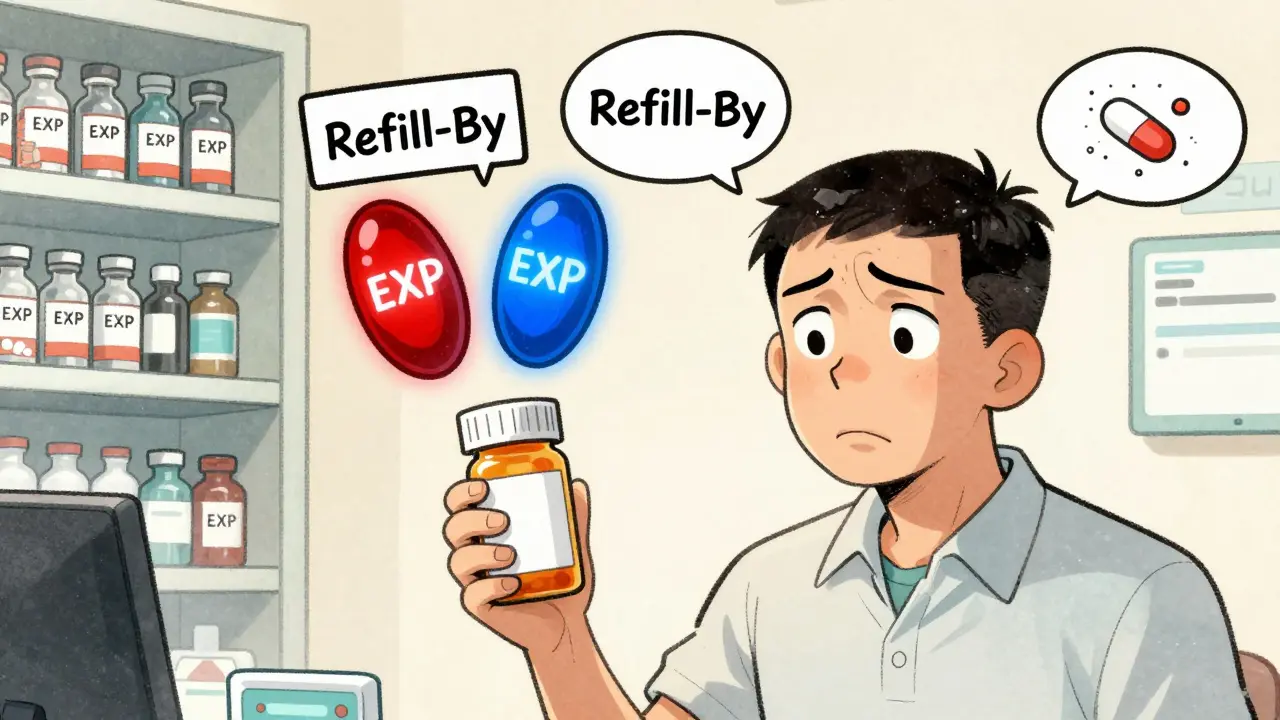
You pick up your prescription, glance at the label, and see two dates: one that says Expiration Date, and another that says Refill-By Date. You might think they mean the same thing - when your medicine stops working. But they don’t. Confusing them can cost you money, disrupt your treatment, or even put your health at risk.
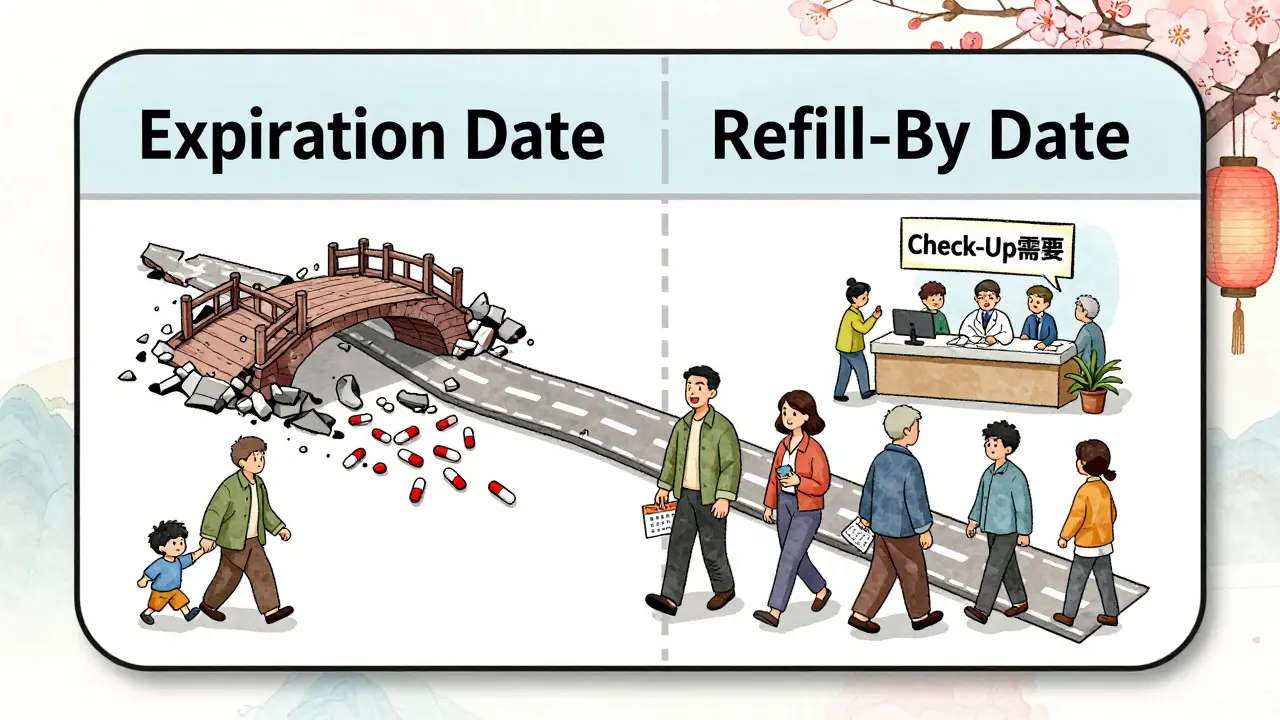
Here’s the simple truth: the Expiration Date is about safety. The Refill-By Date is about rules.
What the Expiration Date Actually Means
The Expiration Date on your prescription bottle isn’t just a suggestion. It’s a legal and scientific boundary. This is the last day the manufacturer guarantees the drug will work as intended and remain safe to use. After that date, the medication could lose strength, change chemically, or become less stable - even if it still looks fine.
Pharmacies don’t just copy the manufacturer’s date. They often set their own expiration date, which is usually one year from when the prescription was filled - unless the drug needs refrigeration, like insulin. In that case, it’s often just 30 days. Why? Because heat, light, and moisture break down medicines faster than we think. The FDA requires drug makers to test stability under real-world conditions, and those results determine the official shelf life.
Here’s something surprising: studies show that most pills and liquids still work fine years after their expiration date if stored properly. But pharmacies can’t legally give you medicine past that date. That’s not because it’s dangerous - it’s because the law requires them to follow the label.
What the Refill-By Date Really Is
The Refill-By Date has nothing to do with whether your medicine still works. It’s an administrative deadline set by your doctor and enforced by your pharmacy and insurance company. This is the last day you can get a refill without your doctor writing a new prescription.
For most non-controlled medications, that’s usually one year from the original fill date. But for drugs like opioids or stimulants (Schedule II or III), federal law limits refills to six months. Some states go further - New York caps refill periods at six months for certain drugs, while California allows up to 12 months.
Why does this exist? It’s a safety net. It ensures your doctor checks in with you before you keep getting the same meds long-term. If you’re on blood pressure pills, your doctor might want to see you every year to check your kidney function or blood sugar. If you’re on pain meds, they need to make sure you’re not developing dependence.
But here’s where people get tripped up: you might have five refills left on your prescription, but if the Refill-By Date has passed, you can’t use any of them. The pharmacy’s system blocks it. No exceptions.
Real-Life Mistakes People Make
People mix these up all the time - and the consequences are real.
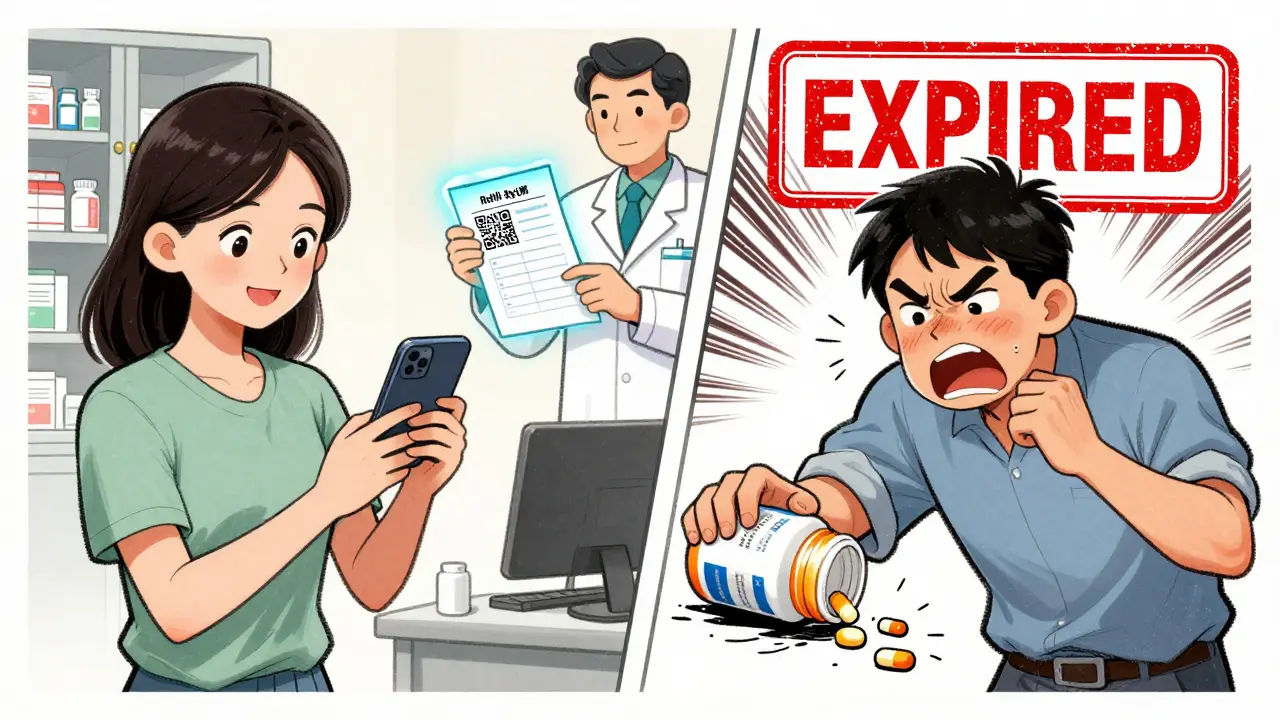
- A woman in Vancouver threw out $300 worth of unopened insulin because she thought the Refill-By Date meant the medicine was expired. It wasn’t. She had to pay out of pocket for a new supply.
- A man with diabetes ran out of metformin because he waited until his last refill was gone before checking the label. The Refill-By Date had passed two weeks earlier. He went without for 10 days.
- Another patient kept taking his antidepressant six months past its Expiration Date because he still had refills left. He started feeling worse - not because the drug stopped working, but because it had degraded. His doctor had no idea he was still taking it.
A Consumer Reports survey found that over half of people couldn’t tell the difference between these two dates on their own bottles. That’s not their fault - the labels aren’t always clear.
How to Read Your Label Like a Pro
Look at your prescription label. You’ll see three key things:
- Expiration Date - Usually labeled as “EXP” or “Use By.” This is the safety cutoff. Never use medicine past this date.
- Refill-By Date - Often says “Refills expire on” or “Last refill date.” This is your administrative deadline. If it’s passed, call your doctor - don’t try to refill at the pharmacy.
- Number of Refills Remaining - This tells you how many times you can still refill before needing a new script. But remember: even if you have refills left, you can’t use them after the Refill-By Date.
Pro tip: Write both dates in your phone calendar. Set a reminder for 7 days before the Refill-By Date. That gives you time to schedule a doctor’s visit if needed.
What Happens When You Ignore These Dates
Ignoring the Expiration Date risks taking ineffective or unsafe medicine. You might think your headache pill still works - but if it’s lost 30% of its potency, you’re not getting the relief you need. In rare cases, degraded antibiotics can lead to treatment failure or antibiotic resistance.
Ignoring the Refill-By Date means you’ll get turned away at the pharmacy. No refills. No exceptions. You’ll need a new prescription - which can take days, especially if your doctor is booked. For chronic conditions like high blood pressure or thyroid disease, even a few days without medication can cause spikes in symptoms or hospital visits.
Medicare Part D data shows that 23.7% of beneficiaries have treatment interruptions because they didn’t refill before the deadline. That’s over 2 million people a year.
What Pharmacies Are Doing to Help
Big pharmacy chains like CVS and Walgreens are finally making changes. They’re using color-coded labels: red for Expiration Dates (safety), blue for Refill-By Dates (administration). Some now include QR codes on labels that, when scanned, play a 30-second video explaining the difference.
CVS reported a 47.8% drop in patient calls about date confusion after rolling out these smart labels in 5,000 stores. That’s huge.
Electronic systems are catching up too. By late 2023, nearly 90% of e-prescribing platforms now separate these dates clearly in digital records. The FDA is pushing for standardized language across all labels - “Use By” and “Refills Expire On” - to remove ambiguity.
What You Can Do Today
You don’t need to be a pharmacist to understand this. Here’s your action plan:
- When you get a new prescription, check both dates immediately.
- Set phone reminders for the Refill-By Date - not the Expiration Date.
- Never take medicine past its Expiration Date, even if you have refills left.
- If your Refill-By Date has passed, call your doctor’s office. Don’t wait until you’re out of pills.
- Keep a simple log: medication name, Expiration Date, Refill-By Date, refills left. Use a notes app or a paper calendar.
People who track both dates report 63% fewer gaps in their treatment, according to the American Pharmacists Association. That’s not magic - it’s just knowing what each date means.
The Bigger Picture
This isn’t just about reading labels. It’s about taking control of your health. Medication errors are one of the leading causes of preventable harm in the U.S. And a lot of them come from simple confusion - like thinking a refill deadline means your medicine is bad.
Doctors, pharmacists, and insurers all play a role. But you’re the one holding the bottle. If you understand the difference between these two dates, you’re already ahead of most people. And that could save you time, money, and maybe even your health.
Can I still use my medicine after the Expiration Date if it looks fine?
No. Even if the pill looks unchanged, the active ingredients may have broken down, making the drug less effective or potentially unsafe. Pharmacies are legally required to not dispense expired medication, and you shouldn’t take it either. The expiration date is based on scientific testing - not guesswork.
Why can’t I refill my prescription after the Refill-By Date even if I still have pills left?
The Refill-By Date is set by your doctor to ensure you’re being monitored regularly. Even if you have pills left, the prescription authorization expires on that date. You need a new prescription to get more - this isn’t about running out of medicine, it’s about your doctor needing to review your condition before authorizing more.
Do all pharmacies follow the same Refill-By Date rules?
Most follow the one-year standard for regular prescriptions, but state laws vary. For controlled substances like opioids or ADHD meds, federal law limits refills to six months. Some states like New York impose stricter limits on certain drugs. Always check your label - if it says “Refills expire in 6 months,” that’s the rule you have to follow.
What should I do if my Refill-By Date is coming up but I’m not ready to see my doctor?
Call your doctor’s office as soon as possible. Many offices offer phone or online renewals for stable, chronic conditions. Don’t wait until you’re out of pills - that’s when you risk a gap in treatment. Some pharmacies can even help you request a renewal electronically.
Is it safe to store medicine past its Expiration Date in the fridge?
Storing medicine in the fridge doesn’t extend its Expiration Date. Some medications, like insulin or certain antibiotics, require refrigeration to stay stable - but they still expire on the date printed on the label. Refrigeration slows degradation, but it doesn’t stop it. Always follow the labeled expiration date.

12 Comments
I used to think the two dates were the same until I ran out of my blood pressure med and got turned away at CVS. My doctor had to write a new script. Took three days. Don't make my mistake.
Dude. The expiration date means it's garbage after that day. Full stop. Stop being cheap and just refill on time. You're risking your life.
This is the kind of info that actually saves lives. I set two phone reminders now - one for refill-by, one for expiration. I used to forget both. Now I’m actually in control of my health for once. Thank you for writing this.
I scan the QR code on my prescriptions now. The 30-second video explains it better than the pharmacist ever did. Seriously, pharmacies are finally getting smarter. Wish they'd done this five years ago.
Wow so the pharmacy system is just lazy and makes us jump through hoops because someone in an office said so? Shocking. Next they'll tell us the sun rises in the east.
The Refill-By Date is a regulatory safeguard not a suggestion. It ensures continuity of care. Ignoring it undermines clinical oversight. Pharmacies are bound by law. Patients are bound by consequence. This is not ambiguity. This is protocol.
The structural dissonance between pharmacological stability and administrative temporality reveals a deeper fracture in healthcare logic. The drug remains chemically viable beyond its labeled expiration, yet the system treats it as inert. Meanwhile, the refill-by date enforces temporal surveillance under the guise of safety. We are managing risk through bureaucracy, not biology. The patient becomes the compliance node.
I once kept my antidepressants past expiration because I didn’t want to bother with a doctor’s visit. Turned out the pills were 20% weaker. I didn’t realize why I felt worse until I got a new bottle. Now I check dates like a hawk. And yes, I still roll my eyes at the refill-by rule. But I get it now.
In India, we don’t have these labels clearly printed. Many people just trust the pharmacy or take what’s left. This post is eye-opening. Maybe we need a global standard. Health shouldn’t depend on where you live or how well you read tiny print.
I keep a little notebook in my wallet with meds, dates, refills. I write it with a Sharpie so it doesn’t fade. It’s saved me twice. No fancy app needed. Just pen and paper and a tiny bit of discipline.
The conflation of temporal regulatory constructs with pharmacological integrity reflects a systemic failure in patient education. The expiration date is a scientifically derived threshold. The refill-by date is a procedural artifact. The patient, caught between these two domains, bears the burden of their misalignment. This is not merely a labeling issue. It is a communication failure of institutional magnitude.
I wish the labels just said 'Do not use after this date' and 'Need new script after this date'. Simple. Clear. No guessing. People aren’t pharmacists. We shouldn’t need a decoder ring to stay alive.
Write a comment