
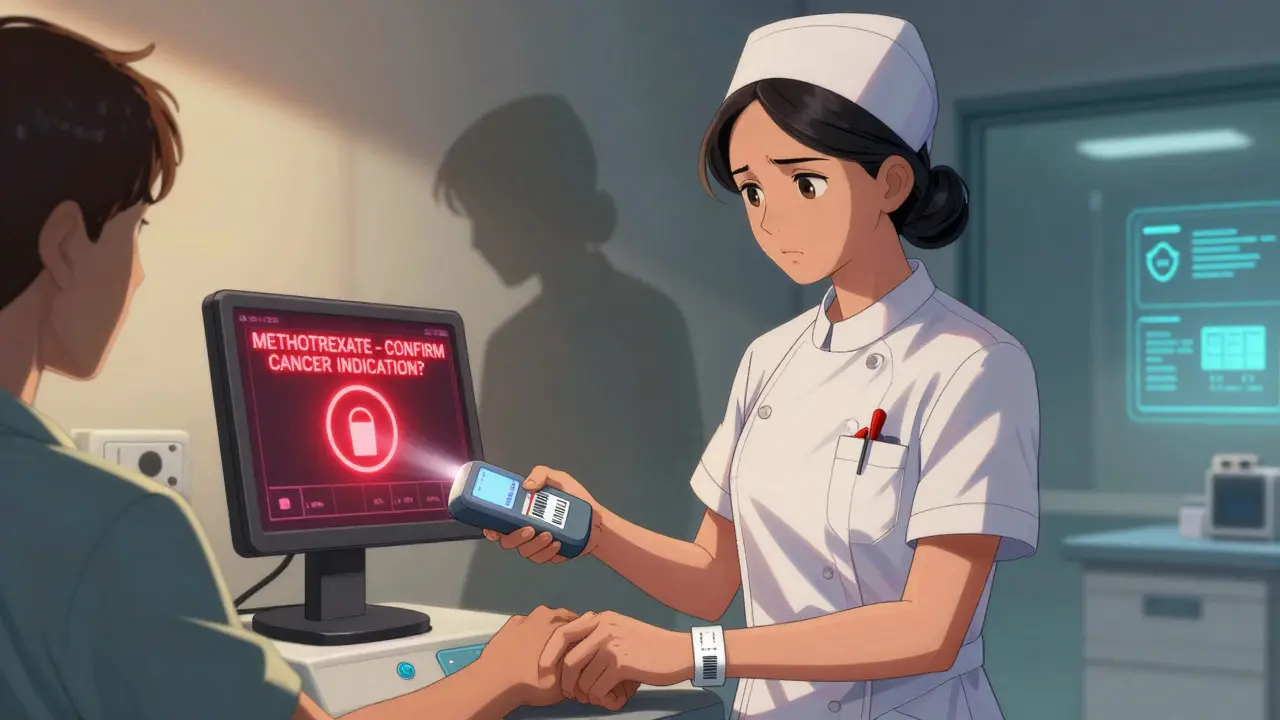
Every year in U.S. hospitals, medication safety failures lead to hundreds of thousands of preventable injuries - and thousands of deaths. It’s not about bad people. It’s about broken systems. A patient walks in for a routine procedure, gets prescribed methotrexate, and accidentally receives it daily instead of weekly. A nurse administers insulin without double-checking the dose. A pharmacist misses a drug interaction because the electronic system didn’t flag it. These aren’t rare mistakes. They’re systemic failures - and they’re fixable.
What Exactly Counts as a Medication Error?
A medication error isn’t just giving the wrong pill. It’s any preventable mistake that happens while a drug is under the control of a healthcare provider, from prescribing to administration. That includes wrong dose, wrong patient, wrong route, wrong timing, or even giving a drug that clashes with another. The American Society of Health-System Pharmacists defines it simply: any event that could cause harm. And the numbers are staggering. Studies show at least one medication error happens per hospital patient every day. In 2025, that still means over 400,000 preventable drug-related injuries in U.S. hospitals annually.
Some errors are silent. A patient leaves the hospital with a new prescription for warfarin, but no one explained how it interacts with their daily vitamin K supplement. Another gets an IV opioid that’s too strong because the pump wasn’t programmed correctly. These aren’t accidents. They’re system gaps - and they’re avoidable.
The Big Players in Medication Safety
Three major frameworks guide how hospitals protect patients: the Institute for Safe Medication Practices (ISMP), the Joint Commission, and the ASHP Guidelines. They don’t all do the same thing.
ISMP’s Targeted Medication Safety Best Practices for Hospitals is the most specific. It doesn’t say "be careful." It says: Don’t allow daily dosing of methotrexate unless you confirm it’s for cancer. It mandates hard stops in electronic systems. It bans glacial acetic acid from hospital floors because someone once confused it with saline and injected it into a spinal canal - killing a patient. These aren’t suggestions. They’re rules built from real error reports.
The Joint Commission’s National Patient Safety Goals are broader. They require hospitals to reconcile medications when patients move between units or get discharged. That means comparing what the patient was taking at home with what’s being prescribed in the hospital. Sounds simple? It’s not. One study found that 70% of patients had at least one discrepancy in their medication list upon admission.
ASHP focuses on high-alert medications - drugs that can cause serious harm if misused. That includes insulin, opioids, anticoagulants, and IV potassium. For these, ASHP says you need three layers: prevent the error, catch it if it happens, and reduce harm if it slips through. That means independent double-checks, standardized concentrations, and automated dose alerts.
How Real Hospitals Are Fixing This
Successful hospitals don’t just buy software. They change culture.
A 350-bed hospital in Ohio installed a hard stop in their electronic system for methotrexate. Before, nurses could order it daily by accident. Now, if someone tries, the system asks: "Is this for cancer?" If not, the order won’t go through. In the first month, they caught three near-misses. One nurse had typed "daily" instead of "weekly" - the system blocked it. No one got hurt.
Another hospital in Minnesota rolled out barcode scanning for every medication. Before, nurses relied on memory and visual checks. Now, they scan the patient’s wristband, the drug’s barcode, and their own badge. If anything doesn’t match, the system alerts them. They cut serious medication errors by 55% in two years.
But it’s not all smooth. Rural hospitals struggle. One nurse manager in Iowa told the American Nurses Association that requiring both written and verbal discharge instructions for methotrexate created delays during staffing shortages. Nurses were spending 20 extra minutes per patient just on paperwork. The system worked - but it wasn’t designed for real-world chaos.

The Tech That’s Making a Difference
Technology isn’t magic - but it’s necessary.
- Barcode Medication Administration (BCMA): Used in 89% of large U.S. hospitals. Scans patient ID and drug label to prevent wrong-patient, wrong-drug errors.
- Electronic Health Records (EHR) with Clinical Decision Support: Flags interactions, allergies, duplicate orders. But 63% of hospitals say their EHR vendor won’t let them build hard stops for high-risk drugs.
- Automated Dispensing Cabinets: Require authentication before pulling controlled substances. Reduces theft and misuse.
- Smart Infusion Pumps: Set dose limits. If a nurse tries to program 100 units of insulin instead of 10, the pump beeps and refuses.
Still, tech alone won’t save lives. A 2022 Reddit post from an ICU nurse described how a neuromuscular blocker was given without proper verification - even though all the systems were in place. The problem? Staff skipped steps because they were rushed. The tools were there. The culture wasn’t.
What About Outpatient Clinics?
Most medication safety efforts focus on hospitals. But the real growth in errors is happening outside.
Between 2018 and 2022, ISMP reported a 47% increase in medication errors in outpatient clinics. Why? Patients get prescriptions from multiple doctors. Pharmacies fill them without knowing what else the patient is taking. No one checks if the patient understands the instructions.
One example: an elderly patient gets a new blood thinner from their cardiologist. Their primary care doctor adds a new antibiotic. The pharmacist doesn’t know about the interaction. The patient starts feeling dizzy. By the time they get to the ER, they’ve had a bleed. This isn’t rare.
ISMP is working on expanding its Best Practices to include ambulatory settings in 2024-2025. Until then, clinics need to do what hospitals do: reconcile meds at every visit, use clear written instructions, and train staff to ask: "Are you sure this is right?"
High-Alert Medications: The Big Three
These drugs are dangerous if used wrong - and they’re used all the time.
- Insulin: A single mistake can cause coma or death. Hospitals now use only standardized concentrations (like 100 units/mL) and require two nurses to verify doses.
- Opioids: The AHRQ aims to cut opioid-related harm by 50% by 2027. That means limiting doses, monitoring breathing, and offering naloxone on hand.
- Anticoagulants (like warfarin, heparin): These thin the blood. Too much = bleeding. Too little = clots. Labs must be checked regularly. Patients must be educated on signs of bleeding.
For all of these, the rule is simple: if it can kill, it needs extra checks. No exceptions.
Why This Matters to Patients
Patients aren’t just passive recipients of care. They’re part of the safety net.
A 2022 survey by the National Council on Aging found that 68% of adults over 65 feel safer when hospitals verify their identity with name, birth date, and wristband before giving any drug. That’s called the "Right Patient Check." It’s basic. It’s free. It’s often skipped.
Patients can help by bringing a list of all their meds - including vitamins and herbs - to every appointment. They can ask: "What is this for?" and "What side effects should I watch for?"
One patient in Oregon told her doctor she’d been taking her blood pressure pill twice a day because the label was blurry. The doctor had prescribed once. She’d been overdosing for six months. A simple question saved her from a stroke.
The Cost of Getting It Wrong
Medication errors cost the U.S. healthcare system $21 billion a year. That’s not just money. It’s lost time, extended hospital stays, and broken trust.
Implementing full safety systems isn’t cheap. A 2020 report estimated $285,000 per hospital for tech upgrades and training. But the cost of doing nothing? One preventable death. One family left behind. One lawsuit that could shut down a clinic.
And it’s getting worse. By 2025, Gartner predicts 75% of U.S. hospitals will use AI to catch errors in real time. That’s promising - but only if staff aren’t overwhelmed by alerts. Too many false alarms lead to "alert fatigue," where people start ignoring them.
What’s Next?
The future of medication safety isn’t just better tech. It’s better teamwork.
Pharmacists are now embedded in ICU teams. Nurses are trained to speak up if something feels off. Patients are being asked to confirm their meds before leaving the hospital. At Mayo Clinic and Johns Hopkins, pilot programs let patients report errors via apps - and they’ve caught 32% more mistakes than staff alone.
Regulators are pushing too. CMS ties hospital payments to safety performance. The FDA now requires clearer labeling on high-concentration electrolytes. And ISMP is updating its Best Practices every year - because mistakes evolve.
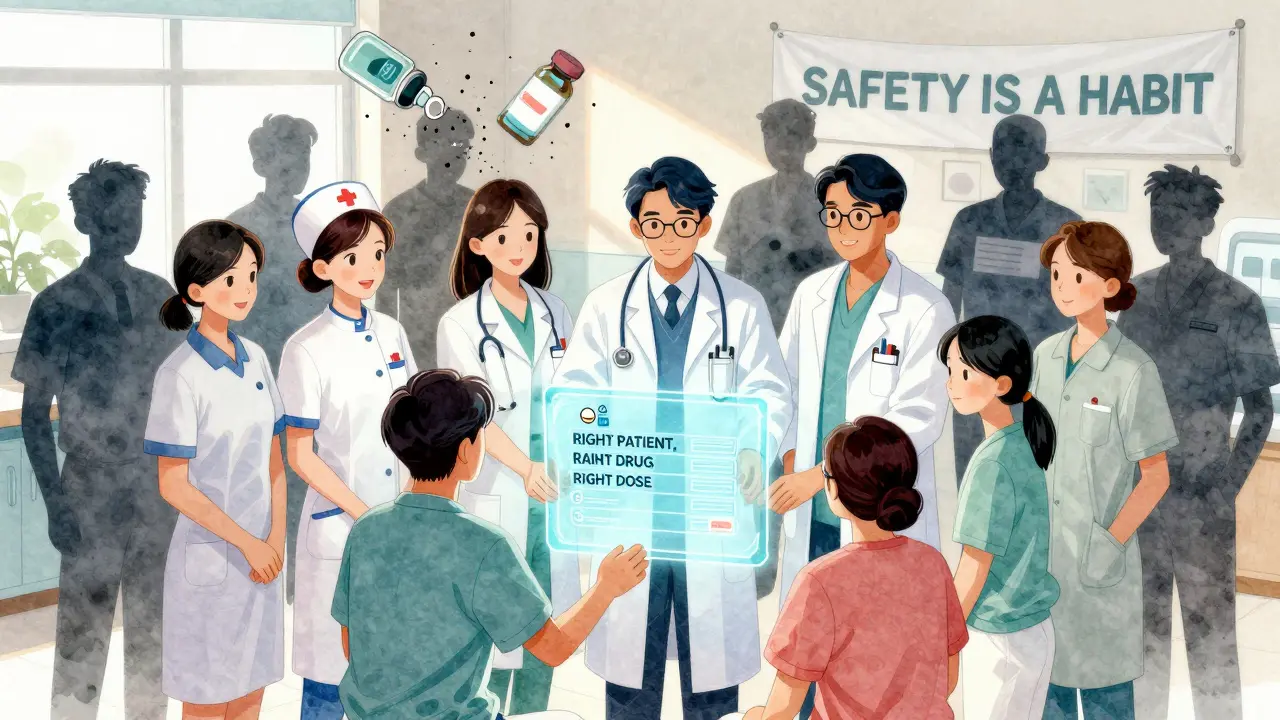
Medication safety isn’t a project with an end date. It’s a daily habit. Every time a nurse pauses before giving a drug. Every time a pharmacist calls a doctor to clarify a dose. Every time a patient asks a question. That’s how you stop errors - not with one big fix, but with thousands of small, careful actions.
What are the most common medication errors in hospitals?
The most common errors include wrong dose (especially with insulin and opioids), wrong patient (due to poor identification), wrong route (like giving a drug meant for the mouth through an IV), and timing mistakes (like giving a weekly drug daily). Drug interactions and unclear handwriting on old paper orders also contribute, though electronic systems have reduced these.
What is a high-alert medication?
A high-alert medication is a drug that carries a higher risk of causing serious harm if used incorrectly. Examples include insulin, opioids, anticoagulants like heparin and warfarin, IV potassium, and neuromuscular blockers. These require extra safety steps like double-checks, standardized concentrations, and automated alerts in electronic systems.
How does barcode scanning improve medication safety?
Barcode scanning links the patient’s wristband, the medication’s barcode, and the nurse’s ID. If any part doesn’t match - wrong drug, wrong patient, wrong dose - the system blocks administration. This cuts wrong-patient and wrong-drug errors by up to 50% in hospitals that use it fully.
Why is methotrexate so dangerous if given daily?
Methotrexate is used weekly for autoimmune diseases like rheumatoid arthritis. But if given daily - which can happen by accident - it becomes a powerful chemotherapy drug. Daily doses can destroy bone marrow, cause severe infections, and lead to death. ISMP’s hard-stop rule in electronic systems requires confirmation that the order is for cancer before allowing daily dosing.
Can patients help prevent medication errors?
Yes. Patients can bring a complete list of all medications (including supplements and over-the-counter drugs) to every visit. They can ask: "What is this for?" and "How should I take it?" They can also confirm their name and birth date before any medication is given. Studies show patients who speak up reduce their risk of errors by nearly 40%.
What should I do if I think a medication error happened?
If you suspect an error - whether it’s a wrong pill, unusual side effect, or confusion about dosage - speak up immediately. Ask the nurse or pharmacist to double-check. If you’re not satisfied, ask to speak with a supervisor or patient advocate. Most hospitals have anonymous reporting systems too. Don’t wait. Early action can prevent serious harm.

11 Comments
I can't even begin to tell you how many times I've seen nurses get stuck in EHR loops just trying to give a simple pill 😭 We need better UX, not more alerts. My cousin almost got double-dosed because the system kept popping up 'confirm dose' but didn't show the actual number. She just clicked 'yes' to make it stop. #TechFail
Let's be real - this is just corporate virtue signaling dressed up as patient safety. You want to fix medication errors? Fire the pharmacists who can't read handwriting and stop paying nurses $28/hour to juggle 8 patients while their EHR crashes. The system is broken because we treat healthcare like a startup with a pivot strategy. Stop buying shiny apps and start valuing human judgment.
i just wanted to say thank you for writing this. my mom had a near miss with warfarin last year because the clinic didn't reconcile her meds. she's fine now but i'll never forget the panic. the barcode thing? it saved her. i wish every clinic had it. also, typo in the third paragraph: 'glacial acetic acid' - that's wild. never heard of that before.
The real issue isn't the tech or the rules - it's the epistemological gap between policy and practice. We design systems assuming rational actors, but healthcare workers operate under cognitive load, time poverty, and institutional neglect. Until we address the phenomenology of burnout, no barcode or AI will matter. Safety is not a feature. It's a culture.
Patients must take responsibility. Bring your meds list. Ask questions. Don't assume someone else is checking. If you don't speak up you're part of the problem. This isn't complicated. Stop waiting for the system to save you. Be your own advocate or die quietly. #NoExcuses
I'm an ICU nurse and this hits home. We use BCMA and smart pumps and still have near misses because someone's tired and clicks past the alert. But here's the thing - last week a new grad stopped a dose because she said 'this feels off' and we checked. No system caught it. That's the real win. Trust your gut. Speak up. Even if you're wrong. Better safe than sorry. 💪❤️
You people are delusional. You think a barcode is going to stop a nurse who's been on a 16-hour shift and hasn't eaten since 5am? This is just performative safety theater. The real solution? Reduce staffing ratios. Pay people enough to care. But no, let's spend $285k on software so executives can pat themselves on the back while nurses cry in the supply closet. Pathetic.
In India, we don’t have barcode scanners or smart pumps - but we have something better: family members who sit by the bed and scream if something looks wrong. One aunt caught a wrong insulin dose because she remembered the pill color from last month. Human memory > algorithmic compliance. Maybe we need more chaos, not more controls.
I've trained nurses in rural clinics across three states. The biggest barrier isn't tech - it's shame. Nurses are terrified to admit they made a mistake, so they hide near-misses. We need psychological safety, not more checklists. If you want to reduce errors, create spaces where people feel safe to say 'I messed up' without getting fired. That’s how learning happens.
This article reads like a pharmaceutical industry white paper. Everyone knows the solutions - hard stops, double checks, standardized concentrations. But the real problem is the commodification of care. When hospitals are run like hedge funds, safety becomes a line item. The only way to fix this is to de-privatize healthcare. Until then, we're just rearranging deck chairs on the Titanic.
I’ve spent the last 14 years working in NHS hospitals, and I can tell you that the U.S. system is a grotesque parody of healthcare - but here’s the thing, the UK isn’t any better. We have the same drugs, the same human errors, the same overworked staff, and the same broken IT systems, except we don’t even have the luxury of EHRs that beep at you. We have sticky notes and handwritten charts and nurses who memorize 40 patient names because the system won’t load. So yes, methotrexate errors happen here too. And no, we don’t have $285k to fix them. We have a 3% pay raise and a prayer. And you know what? We still show up. Every. Single. Day. Because someone has to.
Write a comment