

Imagine taking your medicine every day - but not being able to read the label, tell one pill from another, or hear the pharmacist explain when to take it. For millions of people with low vision or hearing loss, this isn’t a hypothetical scenario. It’s daily life. And the consequences? Mistaken doses, expired pills, dangerous interactions - even hospital stays. This isn’t about convenience. It’s about survival.
Why Medication Safety Is a Crisis, Not a Convenience
Over 7.6 million Americans have significant vision loss. Around 1.8 million people in the UK live with severe sight impairment. And those numbers don’t even include people with hearing loss - another 48 million in the U.S. alone. Many of them take multiple medications daily. Yet, the system wasn’t built for them.
A 2007 survey by the American Foundation for the Blind found that 65% of visually impaired respondents were afraid they couldn’t safely identify their own pills. A decade later, little changed. A 2021 report from RNIB and Action on Hearing Loss confirmed it: packaging, labels, and pharmacy systems still fail people with sensory impairments. The result? People are taking the wrong medicine, missing doses, or taking expired pills - often without telling anyone.
Studies show visually impaired adults are 1.67 times more likely to make a medication error than those with full vision. And here’s the worst part: 68% of those people never told their doctor or pharmacist. Why? Because they’ve been told, again and again, that there’s no solution. So they just cope.
What Makes Medications Hard to Use with Low Vision
It’s not just about blurry text. It’s the whole design.
- Prescription labels are printed in 7- to 10-point font - too small to read even with glasses.
- Pills look nearly identical: small white ovals, similar shapes, no markings. One user on Reddit shared how they almost took their blood pressure pill at night because it looked exactly like their sleep aid.
- Bottle caps are hard to open. Capsules roll off counters. Liquid medicines require measuring cups with tiny markings that vanish under low vision.
- Glare from glossy labels or bright lighting makes reading worse, not better.
The American Foundation for the Blind (AFB) says labels need at least 18-point font, high contrast (black on white), no glare, and plenty of white space. But only 12% of U.S. pharmacies follow these basic guidelines. Most rely on what’s cheap and easy - not what’s safe.
What Makes Medications Hard to Use with Hearing Loss
If you can’t hear, pharmacy counseling becomes useless. Pharmacists explain how to take a new drug - but if you’re in a noisy store, or the pharmacist speaks too fast, or you miss the part about “take with food,” you’re left guessing.
Medication reminder devices often beep or buzz. But if you’re deaf or hard of hearing, those alerts don’t work. A 2022 Guide Dogs UK survey found that 41% of visually impaired users also had hearing loss - and for them, the problem doubles. No one tells them how to use a pill organizer with vibration. No one offers written instructions. No one asks.
Even worse: many people assume hearing loss only affects older adults. But it affects younger people too - from noise exposure, illness, or genetics. And the system doesn’t adapt.

Low-Tech Solutions That Actually Work
You don’t need fancy tech to stay safe. Simple, low-cost changes make a huge difference.
- Color-coding by time of day: Red band for morning pills, blue for night. This works for 78% of users, according to pharmacist surveys. It’s cheap, fast, and easy to teach.
- Rubber bands around bottles: One band = once daily. Two bands = twice daily. It’s not perfect - 65% effectiveness - but it’s better than nothing. One user said it saved them from a dangerous overdose last month.
- Labeling with a permanent marker: Write “AM” or “PM” directly on the bottle. Takes 30 seconds. Works every time.
- Blister packs with large print: If the pharmacy offers them, ask. Each dose is clearly labeled with the day and time. Not perfect for complex regimens, but great for two or three pills a day.
These aren’t “hacks.” They’re essential tools. And yet, only 28% of pharmacies offer them routinely.
High-Tech Tools: Helpful, But Not Everywhere
Technology can help - if it’s designed right.
- Talking Rx devices: These small gadgets record your pill instructions in your own voice. One model plays back 60 seconds of audio when you press a button. In tests, it improved adherence by 92%.
- Smart pill dispensers: Devices like Hero Health or PillDrill beep, flash lights, and send phone alerts. They lock pills until it’s time to take them. But they cost $30 to $200 - out of reach for many on fixed incomes.
- Screen reader-compatible apps: Apps that scan pill labels and speak the name, dose, and instructions. They work best with high-contrast labels. But if the label is printed in tiny font, the app fails.
Here’s the catch: most of these tools require setup, training, and ongoing support. And most pharmacies don’t offer it. So people either pay out of pocket - or go without.
Braille and Large Print: Limited by Access
Braille labels sound ideal - until you realize most people with vision loss didn’t learn braille. Only 15% of adults who lose vision later in life can read it. That’s not because they’re not capable. It’s because braille instruction isn’t offered after vision loss.
Large print labels? They exist - but only on about 8% of medicine packaging. And even then, dosage instructions are often missing. The label might say “Lisinopril,” but not “Take 10 mg once daily.” That’s a dangerous gap.
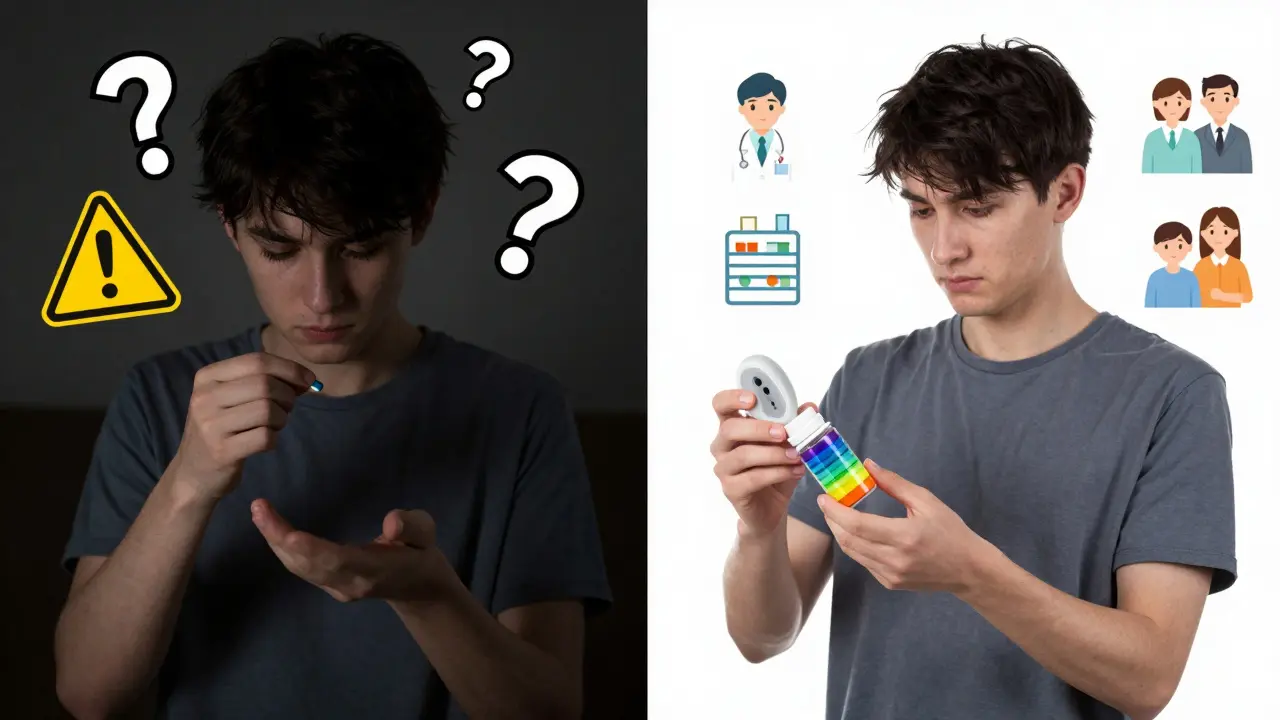
What Pharmacists and Doctors Should Do - But Usually Don’t
Pharmacists have the power to fix this. But they’re not trained to.
The AFB’s 12-point labeling checklist includes:
- 18-point or larger font
- Black text on white background
- No glossy finishes
- Clear indication of drug name, dose, frequency, and expiration
- Offering color-coding or rubber bands
- Providing written instructions
- Asking if the patient needs help
But a 2022 study found only 28% of U.S. pharmacies spend the extra 3-5 minutes needed to do this. Why? Because Medicare pays pharmacies just $14.97 per prescription - and doesn’t reimburse for extra time.
Doctors need to help too. Instead of prescribing five different pills with unclear instructions, they can ask: “Do you need this in large print? Can we simplify your regimen?” Reducing pill burden cuts risk - and saves lives.
What You Can Do Right Now
If you or someone you care for has low vision or hearing loss, here’s what to do today:
- Ask for large print labels. Don’t wait for them to offer it. Demand it.
- Request color-coding. Use red, blue, green, or yellow bands to mark morning, afternoon, evening, and bedtime pills.
- Use a pill organizer. Even a simple weekly tray with labeled sections helps.
- Record instructions. Use your phone to record how to take each pill - name, dose, time, purpose.
- Bring someone to appointments. A friend or family member can take notes, ask questions, and help remember.
- Speak up. Tell your doctor: “I can’t read the label.” Tell your pharmacist: “I need this in a way I can use.”
The System Is Broken - But Change Is Coming
The AFB is launching a pharmacy certification program in 2024. RNIB is rolling out a standardized labeling system in 2025. These are steps forward. But they’re not enough.
Without mandatory rules - like requiring large print and audio instructions on all prescriptions - progress will be slow, patchy, and unfair. Right now, safety depends on luck: which pharmacy you visit, which pharmacist you get, whether you have family to help.
It shouldn’t be that way. Medication safety isn’t optional. It’s a basic right.
Can pharmacies legally refuse to give large print labels?
No. Under the Americans with Disabilities Act (ADA), pharmacies must provide reasonable accommodations - including large print, audio instructions, or tactile labels - when requested. Refusing is a violation of federal law. However, enforcement is weak. Many people don’t know their rights, and pharmacists aren’t always trained to respond. If you’re denied, ask to speak to the manager or file a complaint with the U.S. Department of Justice ADA Information Line.
Are there free or low-cost tools for people with low vision?
Yes. Many nonprofit organizations offer free pill organizers, talking pill dispensers, or label readers. The American Foundation for the Blind, Lighthouse Guild, and local disability centers often have programs. Some pharmacies partner with these groups to provide tools at no cost. Ask your pharmacist if they work with any vision support organizations. Also, check with your state’s Assistive Technology Program - they may loan devices for free.
What should I do if I accidentally take the wrong pill?
Call Poison Control at 1-800-222-1222 immediately. They’re available 24/7 and can guide you on what to do next. Even if you feel fine, some medications cause delayed reactions. Also, contact your doctor or pharmacist. Tell them exactly what you took, when, and why. Keep a list of all your medications - including names, doses, and purposes - in large print or audio format so you can refer to it later.
Can I ask for my prescriptions to be delivered in blister packs?
Yes. Many pharmacies offer pre-sorted blister packs - especially for seniors and people with chronic conditions. Each dose is sealed in a labeled compartment with the day and time. This eliminates confusion and reduces errors. Ask your pharmacist if they offer this service. If they say no, ask if they can order it from their supplier. Some insurance plans cover blister packs for high-risk patients.
Why don’t all pill bottles have braille?
Braille is expensive to print and requires special equipment. More importantly, only about 15% of adults who lose vision later in life can read braille. Manufacturers focus on the most common needs - like large print - because braille adds cost without helping most users. The FDA doesn’t require braille on drug labels. Some countries include braille for drug names, but rarely for dosage or instructions. That’s why color-coding, audio labels, and clear print are more effective for most people.

13 Comments
It’s heartbreaking to think about how many people are silently struggling with this. I have an aunt who’s been blind for over a decade, and she still takes her meds by memory-she doesn’t want to be a burden, so she never asks for help. One time, she took her insulin at the wrong time because the bottle felt like her blood pressure pill. She didn’t tell anyone for weeks. I found out because she passed out at dinner. The system doesn’t just fail people-it makes them feel guilty for needing help. We talk about accessibility like it’s a luxury, but it’s not. It’s survival. And yet, pharmacies act like it’s extra work, not their job. We need mandatory standards. Not suggestions. Not ‘if you have time.’ Mandatory. Every label. Every bottle. Every single time.
And don’t even get me started on how they assume braille is the answer. My aunt never learned it. She’s not lazy. She’s not uneducated. She lost her sight at 58, and no one offered her training. Now she uses color-coded rubber bands and a voice recorder. Simple. Cheap. Effective. But nobody thinks to offer it until you scream.
Stop treating disabled people like problems to be solved. Treat us like people who deserve dignity. And if you’re a pharmacist? You have the power to change this today. Just ask. Just listen. Just do the damn thing.
I’m not mad. I’m just tired.
Oh honey, you mean like how my pharmacy gave me a tiny label that said ‘Lisinopril 10mg’ and then shrugged when I asked for large print? Like they thought I was asking for a custom tattoo? I’m not asking for gold-plated pills-I’m asking for not dying. And the kicker? They told me ‘we don’t do that’ like it was a personal preference. Bro. I have a disability. Not a mood. This isn’t a ‘you do you’ situation. This is a federal law. ADA. Not a suggestion. Not a ‘if you feel like it.’
Also, the fact that we’re still talking about rubber bands like they’re some genius hack? That’s not innovation. That’s failure dressed up as creativity. If your system is so broken that people need to duct tape solutions onto it, maybe stop pretending you’re doing your job.
Also, why do we still have glossy labels? Who thought that was a good idea? Glare + low vision = visual torture. It’s like giving someone a flashlight to read in a dark room and calling it ‘assistance.’
Pharmacists aren’t trained. Medicare doesn’t pay. That’s the whole problem. No one’s to blame. It’s a system failure. Fix the system, not the people.
Also, braille is irrelevant. Most people with late-onset vision loss don’t read it. Focus on large print, audio, and color coding. That’s 90% of the solution.
Stop romanticizing hacks. They’re band-aids on a gunshot wound.
my pharmacist just gave me a pillbox with the days written in sharpie. no big deal. took me 2 mins. no one asked. i just did it. problem solved.
also, color bands. 50 cents at walmart. works like a charm. why are we making this a national crisis? it’s just… basic hygiene. like washing your hands. you don’t need a committee for that.
The deeper issue here isn’t about labels or pill organizers-it’s about how society treats dependency. We are conditioned to see disability as a personal tragedy, not a systemic design flaw. The fact that we praise someone for using a rubber band to differentiate pills reveals how low our expectations are. We don’t demand equity-we celebrate survival. And that’s the real tragedy.
Medication safety isn’t about accessibility. It’s about justice. It’s about whether we believe people with sensory impairments deserve to live without fear, without shame, without having to beg for the basic right to take their own medicine correctly.
Braille isn’t the answer because we’ve stopped offering education after vision loss. Large print isn’t standard because profit > humanity. Audio labels aren’t mandated because we still think disability is a niche market.
Until we treat this like a civil rights issue-not a convenience-we’re just rearranging deck chairs on the Titanic.
India has had tactile pill packaging since 2018. We don’t wait for federal mandates-we innovate. Why does the U.S. still think ‘color coding’ is a breakthrough? We’ve had audio-enabled dispensers in rural clinics for years. You don’t need $200 gadgets. You need willpower.
And yes, braille is outdated. But you know what works? Tactile dots. Raised symbols. Simple. Universal. Cheap. No app. No battery. No Wi-Fi. Just design that respects the user.
Stop acting like this is a Western problem. We solved it. You’re just lazy.
so i just got my meds in a little box with the days printed on it and i was like… wow. it’s like magic.
also my pharmacist gave me a red band for morning pills and i cried. not because it’s fancy. because someone finally asked.
thank u. i’m not usually emotional about pills but… this matters.
❤️
One of the most overlooked solutions is the pharmacist simply asking. Not assuming. Not guessing. Not offering ‘help’ like it’s charity. Just asking: ‘Do you need this in large print? Audio? A pill organizer?’
That single question changes everything. It shifts the dynamic from ‘you’re a burden’ to ‘you’re a person.’
Most pharmacists don’t ask because they’re rushed. But the ones who do? They’re the heroes. And they’re rare.
Train them. Pay them. Reward them. Don’t wait for legislation. Start with a question.
Man, I had a cousin who took her meds wrong for three years because she thought the blue pill was for sleep. She was too proud to say she couldn’t read it. When she finally told her doctor, he just handed her a marker and said ‘write on it.’
That’s it. That’s the whole system. No training. No policy. Just a Sharpie and a prayer.
But hey, at least we have color bands now. Progress? Or just giving up and calling it a fix?
Small wins matter. I got my first large print label last month. Took me 3 calls. 2 complaints. 1 manager who actually listened.
It’s not perfect. But now I know what I’m taking. And that’s everything.
Keep asking. Keep pushing. Someone’s listening.
One day at a time.
people like this are why america is falling apart. you can’t just hand out free solutions to everyone who doesn’t want to try. if you can’t read the label, maybe you shouldn’t be taking pills. maybe you should let someone else do it for you.
and why are we even talking about braille? it’s 2024. get a phone app. or hire someone. stop expecting the government to fix your laziness.
also, why are you even on reddit? you should be in a nursing home.
😭
I’m a social worker. I’ve seen this for 15 years. And I’m telling you-this isn’t about labels. It’s about isolation. People with vision or hearing loss are terrified to ask for help. They think they’ll be judged. Or dismissed. Or worse-told they’re ‘too much.’
So they don’t. They just… survive. And sometimes, they die.
Pharmacists need to be trained to say: ‘I’m here to help you. No shame. No judgment. Just ask.’
And we need to fund this. Not as charity. As healthcare. Because if you can’t take your medicine safely, you’re not getting care. You’re getting a death sentence.
I’ve held people’s hands while they cried because they thought they were the only one. You’re not alone. And you deserve better.
so like… is this really a problem? or are we just making it one? like, i’ve got a grandma who takes 12 pills and she just uses a pill organizer and a flashlight. problem solved.
why are we turning this into a national crisis? it’s just… medicine. you don’t need a TED talk to read a label.
also, braille? on pills? are you serious? who even uses that? it’s like asking for a translator for your coffee cup.
stop overcomplicating things. people are just being dramatic.
Write a comment