
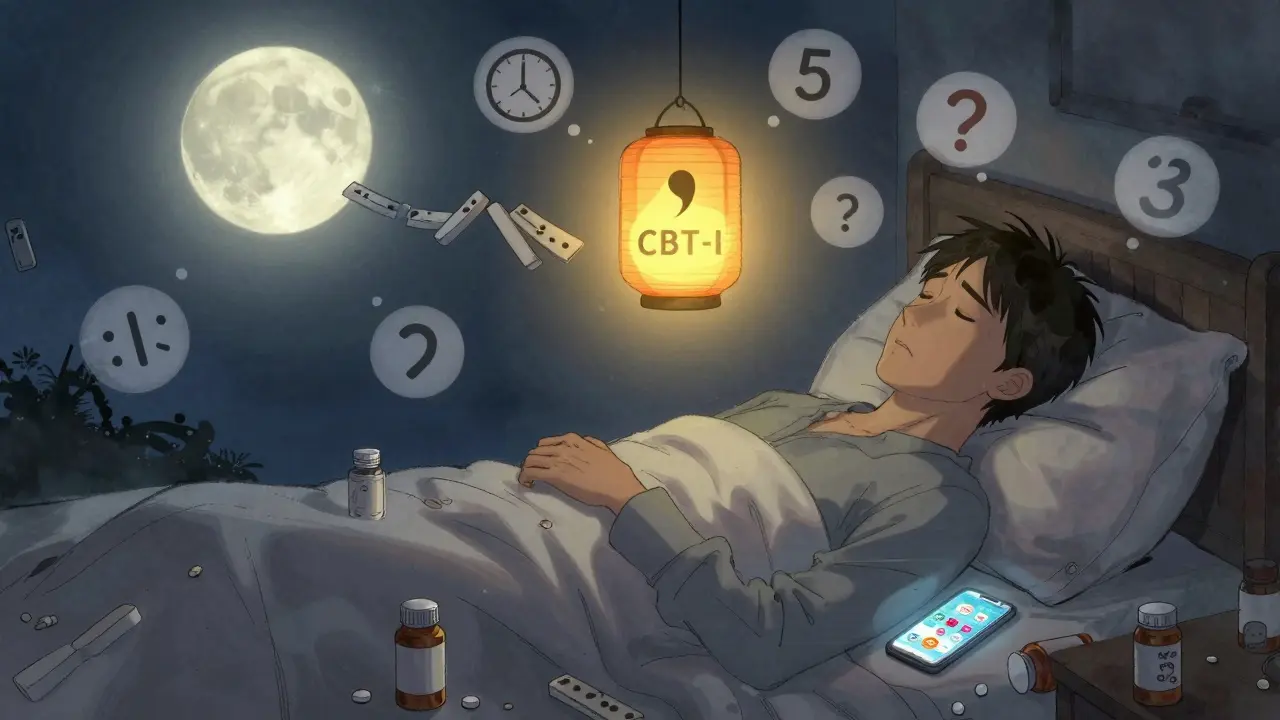
For millions of people, lying awake at night isn’t just annoying-it’s exhausting. You count sheep, try breathing exercises, take a pill, and still stare at the ceiling. The next day, you’re drained, irritable, and dreading another sleepless night. If this sounds familiar, you’re not alone. Chronic insomnia affects about 1 in 3 adults in the U.S., and most reach for sleep meds first. But here’s the truth most doctors don’t tell you: those pills might help you fall asleep tonight, but they won’t fix the real problem. The real fix? Cognitive Behavioral Therapy for Insomnia, or CBT-I.
What CBT-I Actually Does (And Why It Works)
CBT-I isn’t a magic trick. It’s a science-backed, step-by-step program designed to undo the habits and thoughts that keep you awake-even after the original stressor is gone. Think of it like resetting your brain’s sleep software. You’re not just treating symptoms. You’re fixing the broken code.
It’s built on five core techniques, each backed by decades of research. First is sleep restriction. Sounds harsh? It is. But it works. If you’re only sleeping 5 hours a night but spending 8 hours in bed, your brain stops associating the bed with sleep. CBT-I limits your time in bed to match your actual sleep time-no more than 5 hours at first. You set a fixed wake-up time and stick to it, even on weekends. At first, you’ll feel more tired. But within weeks, your sleep efficiency climbs. Studies show this single technique accounts for nearly 40% of CBT-I’s success.
Then there’s stimulus control. Your bed is for sleep and sex-nothing else. No scrolling, no reading, no worrying. If you’re awake for more than 20 minutes, you get up. Go sit in another room until you feel sleepy. This retrains your brain: bed = sleep. No exceptions. People who follow this rule strictly have a 78% higher chance of long-term success, according to a 2022 study in the Journal of Sleep Research.
Cognitive restructuring tackles the scary thoughts that keep you up: “If I don’t sleep 8 hours, I’ll fail at work.” “I’ll have a panic attack tomorrow.” “I’m ruined.” These aren’t just worries-they’re mental traps. CBT-I teaches you to challenge them. You don’t just replace them with positive thoughts. You ask: “What’s the evidence? What’s the worst that could really happen?” A 2024 study in Nature Digital Medicine found patients who completed 80% of these exercises saw a 62% greater drop in insomnia severity than those who skipped them.
Relaxation training-like deep breathing and progressive muscle relaxation-isn’t fluff. It’s physics. Your body is stuck in fight-or-flight mode. CBT-I teaches you to flip the switch. Polysomnography data shows consistent practice reduces physiological hyperarousal markers by 27% in just six weeks.
And finally, sleep hygiene-yes, it’s real, but it’s not enough on its own. Brushing your teeth, avoiding caffeine after noon, dimming lights-these help, but they’re like cleaning the outside of a leaky boat. CBT-I fixes the hole underneath.
Why Sleep Medications Fall Short
Sleep pills like zolpidem (Ambien) are everywhere. In 2022, they made up 47% of all insomnia prescriptions in the U.S. They work fast. You take one, you’re out in 30 minutes. Sounds perfect, right?
Here’s the catch: they don’t fix insomnia. They mask it. And the body adapts. Within 8 weeks, 42% of users develop tolerance. That means you need more to get the same effect. Then comes dependence. Withdrawal can trigger rebound insomnia worse than before. The FDA warned about this in 2021-and it’s still happening.
Long-term data tells the real story. A 2022 meta-analysis in Sleep Medicine Reviews compared CBT-I and sleep meds over 12 months. At the 12-month mark, only 32% of people on medication still had a meaningful improvement. But 68% of those who did CBT-I were still sleeping well. That’s more than double the durability.
And the side effects? Morning grogginess, dizziness, memory issues, even sleepwalking. A 2023 Patient-Reported Outcomes survey found 89% of CBT-I users said they had “no morning grogginess.” That’s not a small win. It’s life-changing.
CBT-I vs. Medications: The Numbers Don’t Lie
Let’s compare what actually works.
| Outcome | CBT-I | Sleep Medications |
|---|---|---|
| Time to see results | 2-4 weeks | 1-2 nights |
| Effect size (d) at 6 months | 1.0-1.5 | 0.3-0.5 |
| Long-term success (12+ months) | 68% | 32% |
| Side effects | None (temporary fatigue) | Grogginess, dizziness, dependence, rebound insomnia |
| Improvement in sleep efficiency | 18.7% increase | Minimal after 4 weeks |
| Reduction in sleep onset latency | 28.4 minutes | Not sustained beyond 4 weeks |
Even when used together-CBT-I plus a short course of meds-the results are strongest. A 2023 JAMA study found 74% of combination therapy patients maintained improvement at 6 months. That’s the sweet spot: meds to get you through the rough patch, CBT-I to keep you sleeping long after the pills are gone.
Who Can Do CBT-I? (Spoiler: Almost Everyone)
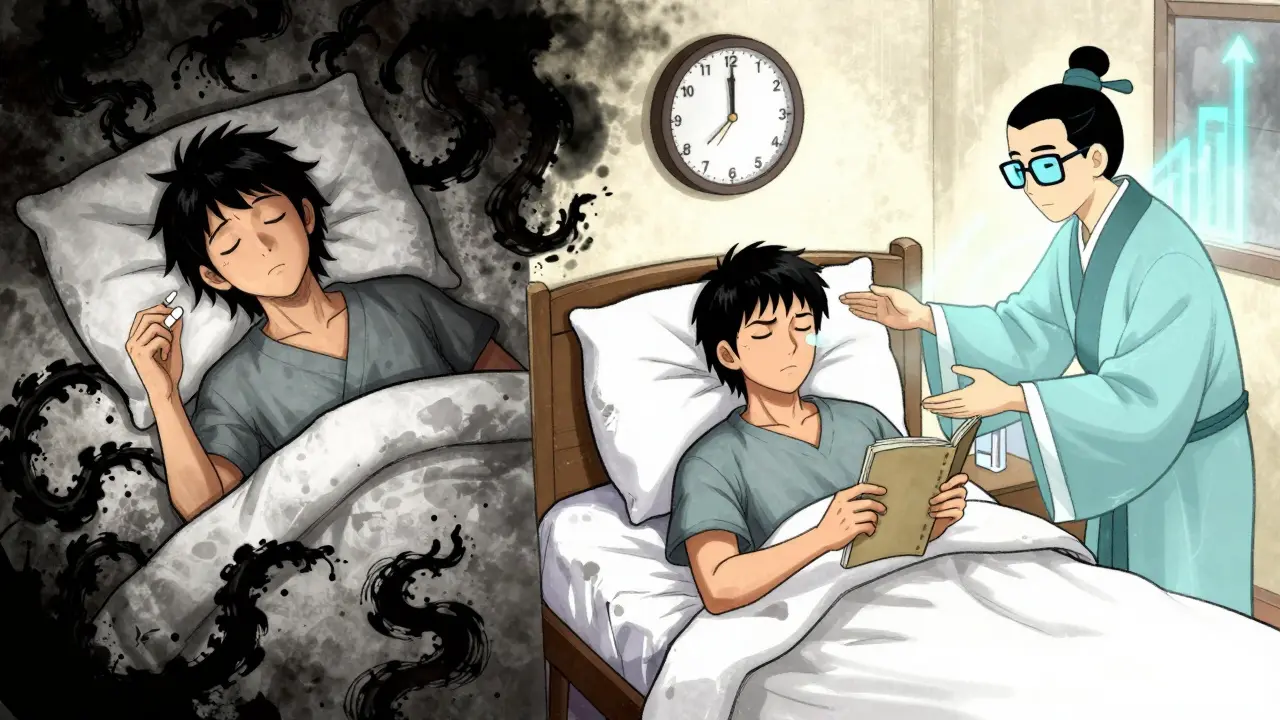
You don’t need to be a yoga master or a meditation guru. You don’t need to quit your job or move to a cabin. CBT-I works for teens, older adults, shift workers, cancer survivors, pregnant women-anyone with chronic insomnia.
Adolescents? A 2024 meta-analysis showed CBT-I improved sleep onset by nearly 30 minutes and added over 45 minutes of total sleep. Medications? No lasting benefit.
Older adults? Yes. A 2024 study found 82% of people aged 65-85 successfully completed digital CBT-I with just 15-20 minutes a day. No tech skills needed. Many used tablets with large buttons and voice guidance.
Even people with anxiety, depression, or chronic pain benefit. CBT-I doesn’t require you to fix everything else first. It fixes sleep-and that alone makes everything else easier.
The Real Barriers (And How to Get Past Them)
If CBT-I is so good, why isn’t everyone doing it?
Two big reasons: access and fear.
Only 15% of U.S. primary care doctors feel trained to deliver it. Most don’t know how to refer patients. And insurance? It’s messy. A typical CBT-I session costs $120. A zolpidem prescription? $15. No wonder people choose the pill.
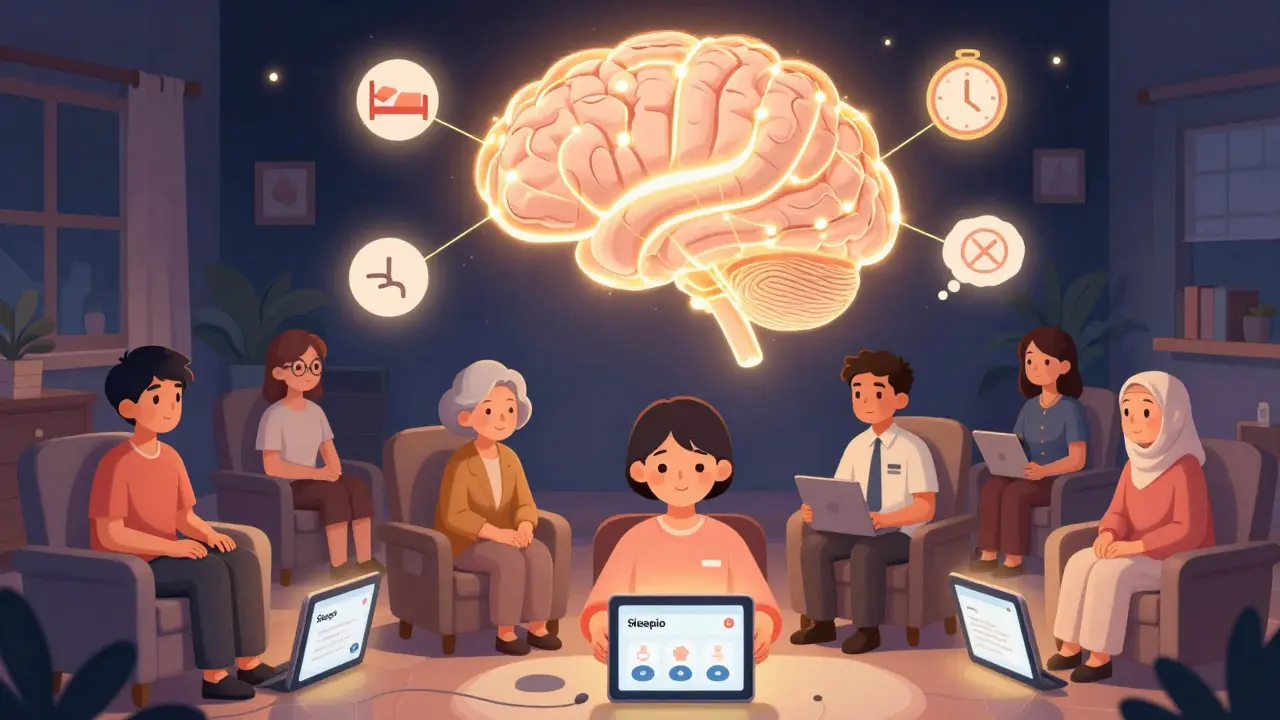
But digital CBT-I is changing that. Platforms like Sleepio and Somryst are FDA-cleared as prescription digital therapeutics. They’re structured, evidence-based, and delivered in 6-8 weeks through an app. Completion rates? 65-70%. Same as in-person therapy.
And Medicare started covering dCBT-I in 2022. UnitedHealthcare now covers it for 28 million members. More insurers are following.
As for fear? The hardest part of CBT-I is sleep restriction. Weeks 2-3 are brutal. You’re tired. You’re tempted to give up. But that’s when the magic starts. A Reddit user, u/SleepWarrior89, said: “After 6 weeks of strict sleep restriction, my sleep efficiency jumped from 68% to 92%. The hardest part? Sticking to the wake time on weekends.”
And here’s the kicker: 72% of people who finish CBT-I say they’d definitely recommend it. Only 28% quit early-and most of them were the ones who didn’t understand why they had to be so strict.
Where to Start
If you’re ready to try CBT-I:
- Find a certified provider. Check the American Board of Sleep Medicine directory.
- Or start with a digital program. Sleepio, Somryst, and CBT-I for Insomnia (by Big Health) are all FDA-cleared and covered by many insurers.
- Get a sleep diary. Track your bedtime, wake time, and how long you were awake. You’ll need it for your therapist or app.
- Commit to the process. Don’t skip sessions. Don’t go to bed early just because you’re tired. Stick to the plan.
- Be patient. The first two weeks are the hardest. The next four? Life-changing.
And if you’re currently on sleep meds? Don’t quit cold turkey. Talk to your doctor. You can taper off while starting CBT-I. Many people do it this way-and end up off pills for good.
The Future of Sleep
CBT-I isn’t just a treatment. It’s becoming the standard. In 2016, the American College of Physicians declared it the first-line treatment for chronic insomnia. In 2022, they reaffirmed it. The American Academy of Sleep Medicine says the same.
And the data keeps getting stronger. A 2023 study tracked patients 10+ years after CBT-I. Their insomnia severity scores were still 56% lower than before treatment. That’s not a temporary fix. That’s a cure.
Medications have their place-for short-term crisis management. But if you’ve had insomnia for more than a few weeks, pills are just delaying the real work. CBT-I is the only treatment that gives you back control. Not just of your sleep. Of your life.
Is CBT-I better than sleeping pills for long-term insomnia?
Yes. While sleeping pills work quickly, their effects fade within weeks, and tolerance or dependence often develops. CBT-I targets the root causes of insomnia-behaviors and thoughts-and provides lasting results. Studies show 68% of people who complete CBT-I still sleep well after 12 months, compared to just 32% on medication.
Can I do CBT-I on my own using an app?
Yes. FDA-cleared digital platforms like Sleepio and Somryst offer structured, evidence-based CBT-I programs you can complete at home. They include sleep tracking, daily exercises, and personalized feedback. Success rates match in-person therapy, and many insurance plans now cover them.
How long does CBT-I take to work?
Most people start seeing improvements in 2-4 weeks. The most intense part-sleep restriction-happens in the first few weeks. By week 6-8, most patients report significantly better sleep. Long-term benefits continue to grow after treatment ends.
Is CBT-I effective for older adults?
Yes. A 2024 study found 82% of adults aged 65-85 successfully completed digital CBT-I with minimal support. Personalized versions improved outcomes by 37% compared to standard programs. Age is not a barrier-CBT-I is designed to adapt to your needs.
Will CBT-I help if I have anxiety or chronic pain?
Absolutely. CBT-I doesn’t require you to fix anxiety or pain first. It improves sleep, which in turn makes managing those conditions easier. Many patients report less pain sensitivity and lower anxiety levels after just a few weeks of improved sleep.
What if I can’t stick to the sleep schedule?
It’s normal to struggle, especially in weeks 2-3. That’s when the body resists change. But consistency is key. Even if you sleep poorly one night, get up at your scheduled time. Don’t nap. Don’t go to bed early. Your brain needs this consistency to relearn sleep. Most people who push through report their best sleep ever by week 6.
Does insurance cover CBT-I?
Yes, increasingly so. Medicare covers digital CBT-I under CPT code 96156. UnitedHealthcare and other major insurers now cover it for millions of members. Check with your provider. Many digital programs also offer sliding-scale fees or payment plans.
Final Thought
You’ve tried the pills. You’ve tried the apps. You’ve tried “just relaxing.” Nothing sticks. That’s because insomnia isn’t a problem of not being able to fall asleep. It’s a problem of your brain forgetting how to sleep. CBT-I doesn’t just help you sleep. It teaches your brain how to sleep again. And once it learns, it never forgets.

15 Comments
So let me get this straight... we're paying $120 for an app to tell me to stop scrolling in bed? 🤡 I've been doing that since 2012. Also, why is the only 'side effect' of CBT-I 'temporary fatigue'? Bro, I'm a single mom who works two jobs. I don't have 6 weeks to be a zombie. 😴💸
The scientific rigor presented in this exposition is commendable. The longitudinal data regarding the durability of Cognitive Behavioral Therapy for Insomnia, as compared to pharmacological interventions, aligns with established clinical paradigms. One must acknowledge the profound implications for public health policy, particularly in nations where access to behavioral healthcare remains constrained. The evidence is unequivocal.
ok but like... i tried sleep restriction and i was so tired i cried into my pillow at 3am and then ate a whole tub of ice cream while watching cat videos. my brain was like 'we are not doing this again' 🥲 but then i did it for real for 6 weeks and now i sleep like a baby who just got a lullaby from a dragon. also no more zombie mode at work. my boss asked if i got a facelift. i said 'no, just less panic about sleep'. ps: the app i used had a little owl that clapped when i hit my wake time. i started talking to it. it's my best friend now. 🦉❤️
This is why America is falling apart. We used to just take a pill and sleep. Now we need to do 8 weeks of brain gymnastics just to get 6 hours? What’s next? Therapy to breathe? This isn’t progress. It’s overengineering. Just let people sleep or die trying.
I appreciate the comprehensive data presented here. However, I am curious about the attrition rates during the critical weeks 2–4 of sleep restriction. Are there any studies correlating patient adherence with socioeconomic status, employment type, or household responsibilities? The clinical success rates may be misleading if the population completing CBT-I is not representative of the broader insomnia cohort.
I used to be the guy who took Ambien like candy. Then I hit 40, woke up at 5am with my heart pounding, convinced I’d forgotten to lock the door - even though I hadn’t left it. CBT-I didn’t just fix my sleep. It fixed my fear. The sleep restriction part? Brutal. But the moment I stopped checking the clock at 2am and just… let myself be tired? That’s when my brain whispered, ‘Oh. Right. We can do this.’ No magic. Just patience. And a lot of staring at the ceiling until my body remembered how to rest.
Let me be clear: this is a corporate-funded narrative. The pharmaceutical industry didn’t spend billions on lobbying to be replaced by a $15/month app. Who profits from CBT-I? Tech startups. Who gets blamed when it fails? The patient. You think this is science? It’s a rebrand. The real solution? A 9-to-5 job that doesn’t exist anymore. But hey, at least your app has a cute owl.
I’m a nurse, and I’ve seen this firsthand. People come in on Ambien, Zopiclone, even melatonin cocktails-exhausted, anxious, terrified of bedtime. We start them on CBT-I. Week one: they’re furious. Week two: they’re exhausted. Week three: they’re skeptical. Week four: they’re quiet. Week five: they cry because they slept 7 hours straight. Week six: they send you a thank-you note with a photo of their dog sleeping next to them. That’s not therapy. That’s resurrection. Don’t give up before week 4. Seriously. I’ve seen miracles.
YOU’RE ALL BEING MANIPULATED. CBT-I IS A SLEEP INDUSTRY SCAM DESIGNED TO MAKE YOU FEEL GUILTY FOR WANTING A PILL. THEY WANT YOU TO THINK YOU’RE BROKEN BECAUSE YOU CAN’T ‘FIX’ YOURSELF WITH A PHONE APP. THE REAL PROBLEM? YOUR JOB. YOUR KIDS. YOUR TRAUMA. NOT YOUR BEDTIME ROUTINE. STOP BLAMING YOURSELF. TAKE THE PILLS. YOU DESERVE TO REST. 🙏🔥
Mate, I did CBT-I after my dad passed. Didn’t sleep for 11 months. Tried everything. Pills made me feel like a zombie. CBT-I? Felt like being slowly unchained from my own mind. Sleep restriction was hell. But I stuck to it. Now I wake up at 6:30am without an alarm. No pills. No apps. Just… peace. 🌅 If you’re reading this and you’re tired? Try it. Not because it’s trendy. Because you deserve to stop fighting your own brain.
I’m 67 and I used the Somryst app on my iPad with voice mode. My grandkids helped me set it up. I thought I’d hate it. But the voice lady was so calm, like my auntie. I did it for 6 weeks. Now I sleep like a log. No more midnight panic. Just… quiet. Thank you for writing this. I’m telling everyone.
CBT-I is just another way to make people feel bad for being weak. Sleep is biological. Not psychological. Stop overthinking. Take the pill. Life is short.
I’ve read every study. I’ve interviewed the researchers. I’ve seen the polysomnography data. And I’m here to tell you: if you’re still on sleeping pills after 3 months, you’re not trying hard enough. This isn’t a suggestion. It’s a moral imperative. Your brain is begging for help. Stop being lazy.
Cbt i is just a distraction from the fact that society is designed to make you sleep less. Corporate america wants you tired so you buy more coffee and don't question the system. The real cure? Quit your job. Move to the woods. Stop using phones. But no one wants to hear that because it's too real
I’m not impressed. This is just another self-help cult dressed up as science. You don’t need a 6-week app to tell you to stop scrolling in bed. You need to stop living like a 14-year-old with anxiety and a smartphone. Wake up. Sleep when tired. That’s it. The rest is marketing.
Write a comment