

If you live with irritable bowel syndrome (IBS), you’ve probably tried every diet under the sun-cutting out gluten, going dairy-free, skipping caffeine-but still wake up with bloating, cramps, or urgent diarrhea. You’re not alone. About 1 in 7 people globally have IBS, and for many, food is the biggest trigger. The good news? There are three science-backed dietary approaches that actually work: the low-FODMAP diet, the low-residue diet, and general elimination diets. But they’re not the same. Choosing the wrong one could make things worse-or waste months of your time.
What the low-FODMAP diet really does
The low-FODMAP diet isn’t just another “avoid bad carbs” trend. It was developed by researchers at Monash University in Australia and is now the most studied and recommended diet for IBS. FODMAP stands for fermentable oligosaccharides, disaccharides, monosaccharides, and polyols. That’s a mouthful, but it just means certain sugars that your gut can’t fully digest. These sugars pull water into your intestines and get fermented by bacteria, causing gas, bloating, and pain.
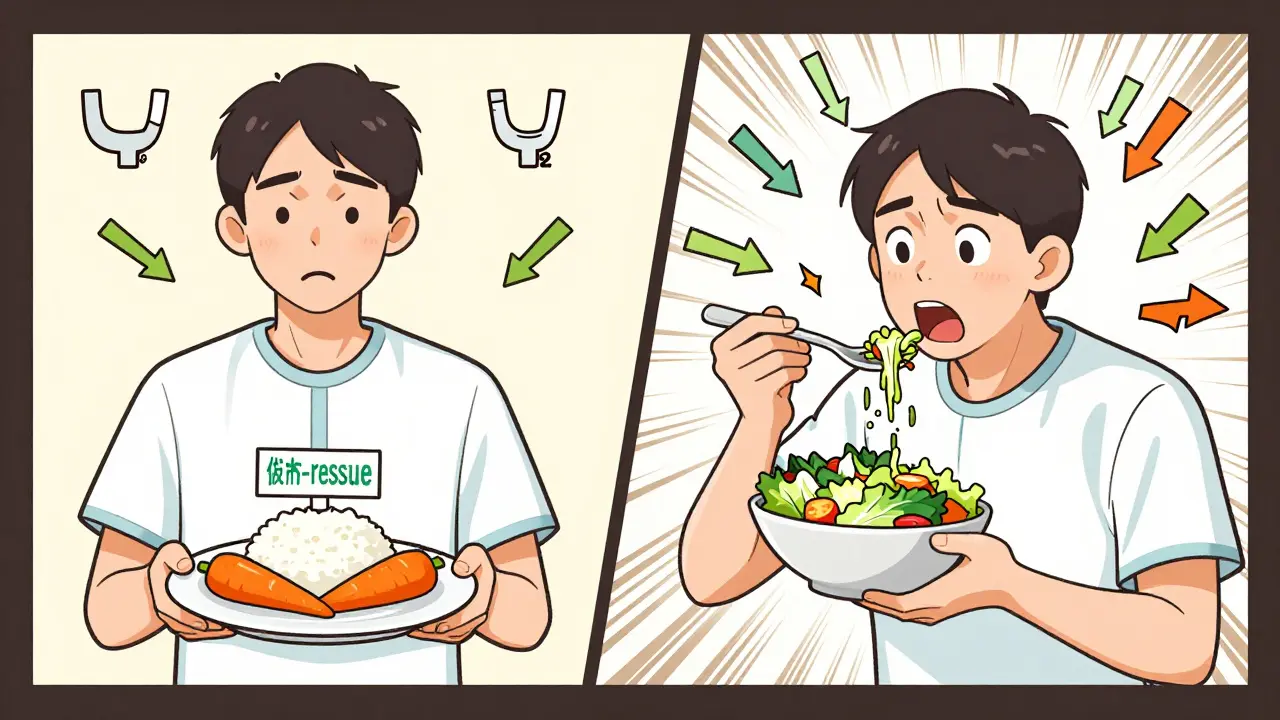
The diet has three phases. Phase 1 is strict: you cut out all high-FODMAP foods for 2 to 6 weeks. That means no onions, garlic, wheat, apples, milk, honey, or artificial sweeteners like sorbitol. You’re not starving-you’re eating chicken, fish, eggs, rice, spinach, carrots, lactose-free yogurt, and small portions of bananas or blueberries. The key? Portion size matters. A whole apple is high-FODMAP, but a quarter of one might be fine. That’s why the Monash FODMAP app (used by over 2 million people) is so helpful. It tells you exactly how much of each food is safe.
Phase 2 is where it gets real. You slowly reintroduce each FODMAP group one at a time. Start with fructans (found in wheat and onions), then galacto-oligosaccharides (in beans and lentils), then lactose, then excess fructose (like in mangoes), and finally polyols (in mushrooms and sugar-free gum). Each challenge uses a specific amount-3 grams of fructans, 5 grams of GOS, 12 grams of lactose-so you know if you’re truly sensitive. Most people find they can tolerate some FODMAPs, just not all. One Reddit user said, “I thought I had to give up everything. Turns out, I only react to onions and mushrooms.”
Phase 3 is personalization. You don’t need to stay on the strict diet forever. Most people end up eating 50-80% of the foods they originally cut out. Studies show 75-80% of IBS patients see major improvement. But if you skip phase 2 and just stay on elimination, you risk missing out on healthy foods and harming your gut bacteria. One study found Bifidobacteria levels dropped 40% after just four weeks on the diet.
Low-residue diet: when less fiber helps
The low-residue diet is older and simpler. It’s not meant for long-term IBS management, but for short-term relief-especially if you have diarrhea-predominant IBS or are preparing for a colonoscopy. It cuts fiber to 10-15 grams per day (compared to the recommended 25-38 grams). That means no raw veggies, no whole grains, no nuts, no seeds, and no skins on fruits. You eat white bread, white rice, eggs, lean meat, cooked carrots, and canned peaches without skin.
It works because fiber adds bulk to stool. Less fiber = fewer bowel movements. For someone with severe IBS-D, this can mean going from 6 bowel movements a day to 1 or 2. But here’s the catch: if you have constipation-predominant IBS, this diet will make things worse. And if you stay on it too long, you risk nutrient deficiencies. Folate drops by 35%, calcium by 25%. It’s not sustainable. In fact, the Cleveland Clinic says 60-70% of IBS patients don’t need this level of restriction at all.
So when is it useful? Only if you’re in a flare-up and need quick relief. A 60-year-old woman in Vancouver told her GI doctor she was having 10 urgent bowel movements a day after eating salads. After three days on low-residue, she was down to two. She went back to her normal diet after the flare passed. That’s the goal: temporary relief, not permanent change.
General elimination diets: the DIY approach
Many people start with a general elimination diet because it’s easy to find online. Cut out dairy, gluten, caffeine, alcohol, spicy foods, and artificial sweeteners for 2-4 weeks. Then add them back one by one. Sounds simple, right? But here’s the problem: it’s not precise.
Unlike the low-FODMAP diet, there’s no standard dose. How much gluten is “too much”? What’s the threshold for lactose? Without testing, you might eliminate gluten thinking it’s the culprit, when really it’s the fructans in your whole grain bread. A University of Virginia study found only 30% of people correctly identified their trigger foods using a DIY elimination diet. That’s why many end up cutting out foods they don’t actually react to-and missing the real ones.
Still, it’s better than nothing. If you can’t afford a dietitian or don’t have access to the Monash app, this is a starting point. Just don’t call it a solution. Use it to gather clues, then move toward a more targeted plan.
Which diet is right for you?
Here’s how to choose:
- If you have diarrhea and bloating → Start with low-FODMAP. It’s the most effective for both.
- If you have only diarrhea and it’s severe → Try low-residue for 5-7 days to get immediate relief, then switch to FODMAP.
- If you have constipation → Avoid low-residue. It’ll make things worse. Focus on soluble fiber and hydration instead.
- If you’re on a budget or can’t find a dietitian → Use a general elimination diet as a first step, but keep a detailed food journal.
Most people don’t need to do all three. The low-FODMAP diet covers the majority of cases. A 2023 meta-analysis of 27 new studies confirmed it reduces overall IBS symptoms more than any other dietary approach. The American College of Gastroenterology gives it a strong recommendation.
What most people get wrong
People think the low-FODMAP diet means “no fruits, no veggies, no whole grains.” That’s not true. You can still eat carrots, zucchini, spinach, oranges, strawberries, and quinoa. The problem? You’re not measuring portions. A tablespoon of garlic is high-FODMAP. A teaspoon might be okay. You need a kitchen scale.
Another mistake: skipping reintroduction. One in three people who try the diet quit after phase 1 because they think they have to stay on it forever. That’s wrong. You’re supposed to challenge foods. Otherwise, you’re not learning anything.
And social life? It’s hard. Eating out during phase 1 feels impossible. But here’s a tip: download the Monash app’s restaurant guide. Many chains now label low-FODMAP options. Carry a small card that says “I’m on a medically supervised elimination diet” to explain why you’re asking for no onions or garlic. Most servers are happy to help.

When not to try it
The low-FODMAP diet isn’t for everyone. If you have an eating disorder, it can worsen food anxiety. The VA Whole Health Library warns it’s contraindicated in 15% of IBS cases. If you’re underweight, pregnant, or have diabetes, talk to a dietitian first. You might need to modify the plan.
Also, don’t assume it’ll work if you’ve tried it before and failed. Maybe you didn’t do it right. Or maybe you’re one of the 25% who don’t respond. That’s okay. There are other options-medications, stress management, gut-directed hypnotherapy. But diet is still the first place to start.
Tools you actually need
- Monash FODMAP app ($9.99/month or $49.99/year): The gold standard. Has a barcode scanner, portion guides, and a food database with 1,200+ items.
- Digital kitchen scale: Accurate to 1 gram. You can’t eyeball FODMAPs.
- Food and symptom journal: Track what you eat, when you eat it, and how you feel 2-24 hours later.
- Low-FODMAP recipe book: Try “The Complete Low-FODMAP Diet” by Sue Shepherd or “IBS Free” by Kate Scarlata.
Don’t waste money on “low-FODMAP” snacks from the grocery store. Many are labeled without certification. Look for the Monash certification logo. There are over 1,200 certified products now.
What’s next?
Research is moving fast. Monash is testing AI meal planners in their app. The NIH is running a trial to find blood biomarkers that predict who will respond to FODMAP diets. In five years, we might have personalized gut microbiome tests to guide your diet.
But right now, the best tool is still the three-phase low-FODMAP diet. It’s not easy. It takes time. But for most people with IBS, it’s the most effective path to reclaiming your life-without lifelong restrictions.
Can I do the low-FODMAP diet without a dietitian?
Yes, but it’s harder. Studies show people who work with a dietitian have 85% compliance after three weeks. Without help, it drops to 45%. If you go solo, use the Monash app, stick to the official phase structure, and track symptoms carefully. Don’t skip reintroduction-that’s where you learn what you can tolerate.
Is the low-FODMAP diet a permanent change?
No. It’s designed to be temporary. The goal is to identify your triggers, then reintroduce as many foods as you can handle. Most people end up eating 50-80% of the foods they cut out. Only 10-15% need to stay on the strict version long-term.
Does the low-FODMAP diet help with constipation?
It helps less than it does for diarrhea. Studies show only 40-50% of constipation-predominant IBS patients improve. That’s because FODMAPs mainly affect gas and bloating, not slow motility. For constipation, focus on soluble fiber (like oats, psyllium), hydration, and movement. A low-residue diet would make it worse.
Can I eat out on a low-FODMAP diet?
Yes, but it takes planning. Use the Monash app’s restaurant guide. Ask for grilled meats or fish with steamed vegetables. Avoid sauces, garlic, onions, and breaded items. Many restaurants now offer low-FODMAP options-especially chains like Subway (no onions, garlic, or honey mustard) or Chipotle (black beans, rice, chicken, lettuce, salsa). Carry a small card explaining your dietary needs.
What if the low-FODMAP diet doesn’t work?
You’re not alone. About 25% of people don’t respond. That doesn’t mean it’s hopeless. Talk to your doctor about other options: gut-directed hypnotherapy, peppermint oil capsules, low-dose antidepressants, or stress management. Sometimes IBS is linked to anxiety or past trauma-not just food. Diet is powerful, but not the only tool.
13 Comments
The low-FODMAP diet is one of those rare interventions where science actually meets real life. Phase 2 reintroduction is where most people fail-not because it’s hard, but because they don’t track properly. A food journal isn’t optional. It’s the difference between guessing and knowing. I’ve seen people eliminate 20 foods and still feel awful because they didn’t test lactose properly. Portion size matters more than you think. A teaspoon of garlic powder can trigger symptoms. A whole clove? Maybe not. Monash app is non-negotiable. No shortcuts.
This is the most practical guide I’ve read on IBS diets. So many people think it’s about restriction, but it’s really about discovery. The fact that 75-80% improve with proper reintroduction gives me hope. I used to avoid restaurants entirely. Now I just ask for no garlic, use the app, and eat grilled chicken with steamed zucchini. Life doesn’t have to stop. You just have to be smart about it.
Isn’t it ironic? We’re told to eat ‘clean’ and ‘whole’ foods, but for IBS, ‘clean’ is the enemy. The body isn’t a machine-it’s a fragile ecosystem. The low-FODMAP diet doesn’t punish you. It listens. It asks: what is your gut screaming at? And then it gives you the tools to answer. We’ve been taught to fear carbs. But the real villain isn’t wheat-it’s the fear of not knowing. Knowledge is the real FODMAP.
Just want to add: if you’re doing this solo, don’t skip the food journal. Write down everything-even if it seems trivial. I thought my morning coffee was fine until I noticed a pattern: 20 minutes after, bloating. Turns out, it wasn’t the caffeine. It was the lactose in the splash of milk I didn’t even think about. The app helped me realize that. Also, carry a small scale. You’ll thank yourself later.
This article is dangerously misleading. The low-FODMAP diet is not science. It’s a fad dressed in lab coats. People have lived for centuries without Monash apps and kitchen scales. The real issue is gut dysbiosis from processed foods, not FODMAPs. You’re training people to be afraid of natural foods. This is nutritionism at its worst. Eat real food. Stop overcomplicating.
Let’s be real: the low-FODMAP diet is a 3-phase psychological experiment disguised as nutrition. You cut everything. You panic. You cry. You reintroduce onions and feel like a traitor to your gut. Then you realize you’re fine with 1/4 of a banana. Congratulations-you’ve been gaslit by a food pyramid. The real solution? Stop eating. Or just accept that your gut is broken and live with it. Or better yet-blame your childhood trauma. That’s what the experts really want you to do.
While the low-FODMAP diet is evidence-based, the implementation challenges are frequently underestimated. Compliance drops precipitously without structured professional support. The average individual lacks the nutritional literacy to accurately execute Phase 2 challenges. Furthermore, the reliance on commercial applications introduces potential bias. Certified products are not universally accessible, and cost barriers may exacerbate health inequities. A systemic solution requires policy-level intervention-not just individual behavioral modification.
Why are we letting Western science dictate how we eat? In India, we’ve had gut remedies for millennia-turmeric, asafoetida, ginger tea. Now you want me to stop eating garlic and onions? That’s our holy trinity. This diet is colonial nutrition. You think your Monash app is better than grandma’s kitchen? I’ve eaten spicy food all my life. My gut is stronger than your lab. Stop pathologizing culture.
Thank you for this. I’ve been on this journey for 2 years. Phase 1 was brutal. Phase 2? Life-changing. I can now eat a slice of sourdough (yes, it’s low-FODMAP if fermented long enough) and a handful of blueberries without panic. I used to cry in grocery stores. Now I smile. The app, the scale, the journal-it all works. You’re not broken. You’re just misunderstood. 💪
I tried it. Didn’t work. Next.
The structured reintroduction phase is the most underappreciated aspect of this approach. Too many individuals abandon the process prematurely due to perceived social inconvenience or lack of immediate results. The long-term benefit lies not in restriction, but in the restoration of dietary autonomy. This is not a diet-it is a diagnostic protocol. Professional guidance remains optimal, yet informed self-management is demonstrably feasible with rigorous adherence to protocol.
bro i tried the low fodmap thing and it was a nightmare. i ate nothing but chicken and rice for 6 weeks. then i tried garlic and my stomach exploded. turns out i’m fine with garlic now? idk. i think the whole thing is bs. why do we need an app to tell us what to eat? just eat less junk. also i think gluten is the real problem. i stopped bread and felt better. maybe it’s not the fructans. maybe it’s just capitalism selling us apps.
As someone who grew up in a culture where fermented foods and spice blends were medicine, I see the irony in this. The Monash app is brilliant, but it’s also a product of a system that pathologizes traditional diets. I reintroduced asafoetida after phase 2-no symptoms. My grandmother’s hing saved me more than any lab test. Maybe the answer isn’t just about what we remove-but what we remember.
Write a comment