
Every year in the U.S., over 1.3 million people end up in the emergency room because of bad reactions to their medications. That’s not just a statistic-it’s your neighbor, your parent, maybe even you. Many of these reactions happen because people are taking too many pills, or their lifestyle is working against their meds. The good news? You don’t have to just accept it. Simple, everyday changes can cut your medication risks in half-and sometimes even let you take fewer pills.
Let’s be real: most of us don’t think about how what we eat, how we sleep, or whether we move our bodies affects our prescriptions. But here’s the truth: your lifestyle isn’t just background noise. It’s part of the treatment plan. A 2023 study in JAMA Internal Medicine that looked at 3.4 million people showed that people who made just a few key changes reduced their need for meds by 25% to 50% for conditions like high blood pressure, diabetes, and high cholesterol. That’s not a miracle. That’s science.
Move More-Even a Little
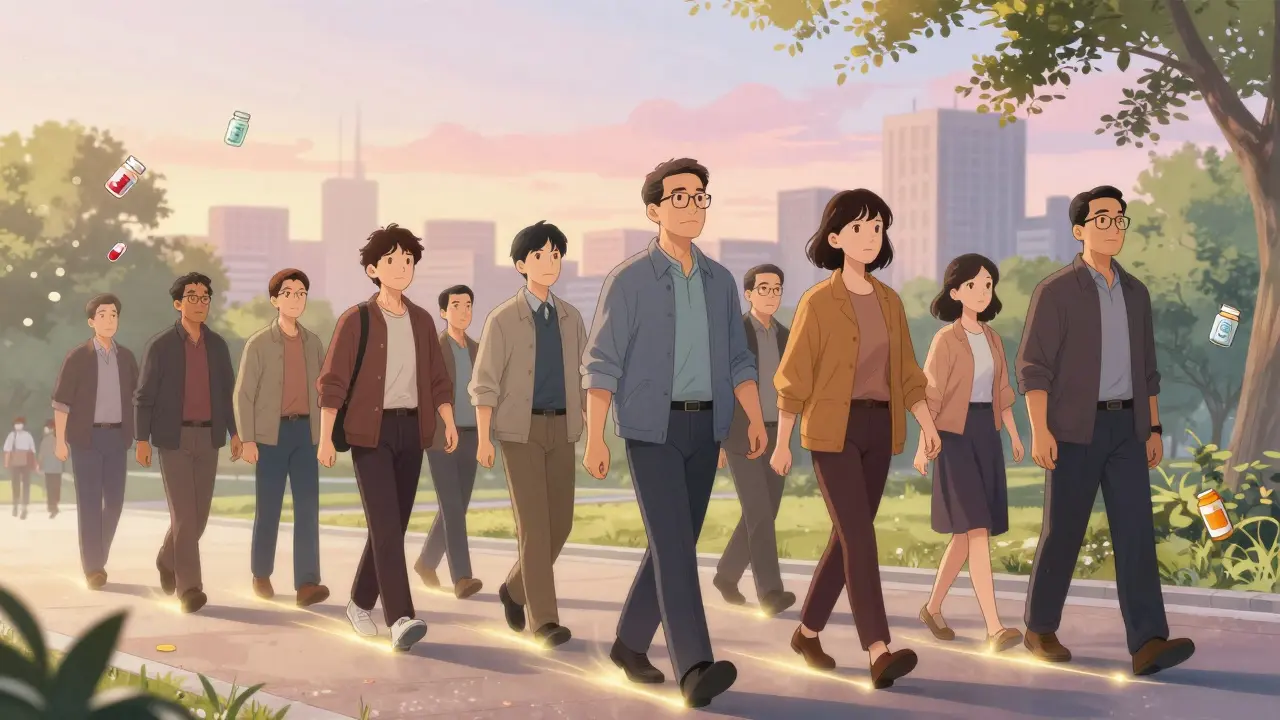
You don’t need to run marathons. You don’t need a gym membership. You just need to move. Brisk walking for 30 minutes, three times a week, can do more for your blood pressure than you think. When you walk, your heart gets stronger. It doesn’t have to work as hard to pump blood. That means your blood pressure drops. In fact, research from the New England Journal of Medicine found that walking regularly can lower blood pressure by about 11/5 mm Hg-just as much as one common blood pressure pill.
And it’s not just blood pressure. People with Type 2 diabetes who walked daily and lost just 5-7% of their body weight cut their need for insulin or other meds by up to 60%. That’s not a guess. That’s from real data presented at the UC Davis Wellness Academy in 2024. The goal? 150 minutes of moderate activity a week. That’s 30 minutes, five days a week. If that feels too much, start with 10 minutes a day. Build up. Your body doesn’t care if you’re perfect. It just cares if you show up.
Eat Smarter-Not Strictly
Forget fad diets. You don’t need to cut out carbs forever or eat only kale. What matters is what you cut in. For high blood pressure, reducing sodium is huge. Most people eat over 3,500 mg a day. The recommended limit? 1,500 mg. That’s not impossible. Skip the processed snacks. Don’t add salt at the table. Read labels. One person on Reddit shared they dropped their blood pressure from 150/95 to 125/80 in six months just by cutting salt and walking. Their doctor took them off one pill.
For diabetes, focus on whole foods: vegetables, beans, whole grains, lean proteins. A 2024 presentation by pharmacist Heather Martin showed that eating this way can control blood sugar as well as medication-for some people. And for cholesterol? Swap out butter for olive oil, chips for nuts, soda for water. The DASH diet (Dietary Approaches to Stop Hypertension) isn’t a trend. It’s a proven system backed by decades of research.
But here’s the catch: some healthy foods can interfere with meds. Grapefruit? It messes with 85% of statins. Spinach and kale? High in vitamin K, which can make blood thinners like warfarin less effective. Dairy? It can block absorption of some antibiotics. That’s why talking to your pharmacist matters. Not your doctor-your pharmacist. They know what’s in your pills and what’s in your fridge.
Sleep Like Your Life Depends On It
You’ve heard it before: get 7 to 9 hours. But here’s why it’s not just advice-it’s medicine. People who sleep less than 6 hours a night are far more likely to develop high blood pressure, Type 2 diabetes, and obesity. And if you already have one of those conditions? Poor sleep makes your meds work worse. Your body needs rest to repair itself. Without it, your insulin resistance goes up. Your stress hormones stay high. Your inflammation spikes.
Try this: go to bed and wake up at the same time every day-even on weekends. No screens an hour before bed. Keep your room cool and dark. If you’re tossing and turning, don’t lie there stressing. Get up, read something boring, and come back when you’re sleepy. It sounds simple, but consistency matters more than duration. One study found that people who improved their sleep habits cut their blood pressure meds by 20% within three months.

Quit the Bad Habits-One at a Time
Smoking? It wrecks your blood vessels. Alcohol? More than two drinks a day for men, or one for women, raises blood pressure and can interact with meds. Stress? It spikes cortisol, which raises blood sugar and blood pressure. You don’t have to quit everything at once. Pick one. Maybe it’s cutting back on late-night wine. Or swapping cigarettes for a walk. Or trying 10 minutes of breathing exercises before bed.
Yoga, meditation, even just sitting quietly for 10 minutes a day lowers stress hormones. A 2023 study from Michigan State University found that people who managed stress along with their meds had 30% fewer heart-related hospital visits. That’s not magic. That’s biology.
Why This Works: The Root Cause Fix
Medications treat symptoms. Lifestyle changes fix the root. High blood pressure? Often caused by too much salt, too little movement, and too much stress. Type 2 diabetes? Usually from too many processed carbs and not enough activity. When you fix those, your body doesn’t need as much help from pills.
And here’s the big win: taking five or more medications (called polypharmacy) triples your risk of dangerous side effects, falls, and hospital stays, according to the Journal of the American Geriatrics Society. Reducing meds isn’t about being “natural.” It’s about being safer. Fewer pills means fewer interactions, fewer side effects, fewer trips to the ER.
What to Do Next: A Realistic Plan
Don’t try to change everything tomorrow. Pick one area. Here’s a simple starter plan:
- Start walking: 10 minutes a day, 3 days this week. Add 5 minutes every week.
- Reduce sodium: Swap one processed food for a whole food. Try swapping canned soup for homemade broth.
- Track sleep: Set a bedtime alarm. No phone in bed.
- Talk to your pharmacist: Ask, “Are there any foods I should avoid with my meds?”
- Check in with your doctor: Don’t stop or change meds on your own. But do ask: “Could lifestyle changes help me reduce my meds?”
These changes take time. You won’t see results in a week. It takes 3 to 6 months for your body to respond. But if you stick with it, you might not just avoid side effects-you might feel better than you have in years.
What’s Holding People Back?
It’s not laziness. It’s not lack of willpower. It’s system failure. Most doctors don’t have time to talk about diet or sleep. Insurance doesn’t always cover nutrition coaching. Social pressure makes it hard to say no to pizza or wine. And let’s be honest-when you’re tired, stressed, or overwhelmed, eating a salad feels impossible.
That’s why support matters. Join a walking group. Use a free app to track meals and sleep. Ask a friend to do it with you. The American Heart Association found that 68% of people who made lifestyle changes alongside their meds said their quality of life improved. But 32% struggled-mostly because they did it alone.
You don’t have to be perfect. You just have to be consistent. One good choice today is better than a perfect plan that never starts.
It’s Not Either/Or-It’s Both
Some people think, “If I eat right and exercise, I won’t need meds anymore.” That’s not the goal. The goal is to make your meds work better and safer. Dr. Rob Shmerling from Harvard Health says it clearly: “Medications should be in addition to lifestyle changes, not instead of them.”
Think of it like this: if you have a leaky roof, you don’t just mop the floor. You fix the roof. Medications mop the floor. Lifestyle changes fix the roof.
And the data backs it up. A 2023 study led by Dr. Xuan-Mai Nguyen showed that people with Type 2 diabetes who took GLP-1 meds and followed six healthy habits had far lower heart disease risk than those who just took the drug. The combination was powerful. Not because one replaced the other. But because they worked together.
Looking Ahead
More than 12,000 doctors in the U.S. are now certified in lifestyle medicine. Medicare Advantage plans are starting to cover nutrition counseling and exercise programs. The FDA is asking drug makers to prove their meds work better with lifestyle changes. This isn’t a trend. It’s the future of care.
By 2030, experts predict 60% of chronic disease management will include structured lifestyle plans. You don’t have to wait for the system to catch up. You can start today-with one walk, one less salt shaker, one earlier bedtime.
Your meds are there to help. But they’re not the whole story. You are. And what you do every day matters more than you think.
10 Comments
OMG I literally cried reading this
I was on 5 meds for high blood pressure and diabetes and I started walking 10 mins a day and swapped my morning bagel for eggs
6 months later my doc took me off TWO pills
I still can't believe it
My sister thought I was doing some weird keto thing but nope just walking and not eating processed crap
Now I take my walk every morning before work and it's my favorite part of the day
I used to hate exercise but now I listen to podcasts and it feels like therapy
Also I stopped putting salt on everything
Who knew the answer was just moving and eating real food
Stop overcomplicating it
This is all true but nobody cares
People will keep eating chips and soda and taking pills
It's easier
And doctors don't care enough to push this
So yeah nice article
Doesn't change anything
I love how this breaks it down without being preachy
I started with just one change-cutting out soda
My fasting blood sugar dropped 20 points in three weeks
Then I added more veggies and started walking after dinner
My pharmacist noticed and asked if I'd been changing anything
I told her and she said my lab numbers looked like someone who'd been on meds for years but was suddenly doing better
It's not magic
It's just consistency
And honestly? I feel lighter. Not just physically
I think the mental shift matters as much as the physical one
It is a well established fact that the pharmaceutical industry has systematically suppressed lifestyle intervention data for profit
The FDA and AMA are complicit
Studies showing diet and exercise can replace medication are buried
This article is merely a surface level distraction
Real change requires systemic overhaul not individual compliance
Furthermore the DASH diet is a marketing construct designed to sell produce
True health comes from ancestral eating patterns
Which are not represented here
And let us not forget the role of glyphosate in insulin resistance
But of course this article ignores environmental toxins
So it is incomplete and misleading
Okay so let me get this straight
You're telling me that if I just walk and eat kale I can avoid Big Pharma?
Like what
Are we in a cult now
GLP-1s are the future
They're not just drugs they're biotech miracles
And yes I use the word miracle because I'm not afraid of truth
Also grapefruit is a biohacking tool if you know how to use it
My endocrinologist said I'm a data point
Because I take my meds AND do intermittent fasting AND walk AND meditate
My biomarkers are so clean they're almost artificial
But I still need my Ozempic
Because science > vibes
And if you think lifestyle alone works you're just not taking your meds right
You people are delusional
Medication is not a crutch
It's a lifeline
And you think walking is going to fix your insulin resistance after 20 years of eating like a garbage disposal
It's not about willpower
It's about biology
And biology doesn't care if you drank water instead of soda
It cares if your pancreas is dead
And if you're telling people they can just 'walk it off' you're not helping
You're endangering them
Also your pharmacist is not a doctor
Stop trusting randoms with white coats
Real medicine is in the lab not in your yoga studio
Yeah I tried walking
Got bored
Then ate a bag of chips
Went back to bed
Still on my meds
Not judging anyone
Just saying
This feels like guilt porn
Like if I don't do all this I'm failing
But I'm tired
And my job sucks
And I have two kids
So I'll keep taking my pills
And that's okay
As a nurse in India I see this daily
Patients come with diabetes and hypertension
They are given medications
But they continue to eat fried food and sit all day
They are not lazy
They are not ignorant
They are trapped
By cost
By lack of safe spaces to walk
By cultural norms that equate food with love
And yes
Medication is necessary
But we must also build systems that make healthy choices accessible
Not just ask individuals to be perfect
I almost didn't read this
Because I thought it was another 'just drink more water' post
But then I saw the part about talking to your pharmacist
And I cried
Because my grandma died from a drug interaction
She was on warfarin
And she ate spinach every day
And no one ever told her
Not her doctor
Not her pharmacist
Just assumed she knew
So I started asking questions
Now I bring my meds list to every appointment
And I ask the pharmacist
And I tell my family
Because nobody else will
And if this saves one person
Then it matters
Just started this
10 min walk today
no salt on eggs
bed at 11
no phone
feels weird
but also kinda good
like my body is saying thanks
weird right
lol
still on meds tho
but maybe next year i can ask about cutting one
🤞
Write a comment