Imagine popping your daily blood pressure pill, only to find out weeks later that the bottle contained a different strength than labeled. It sounds like a scene from a medical thriller, but for patients relying on generic drugs, which are medications equivalent to brand-name drugs in dosage, safety, strength, route of administration, quality, performance characteristics, and intended use, this is a real risk. In 2024 alone, the U.S. Food and Drug Administration (FDA) documented 347 drug recalls. While most don’t end in tragedy, they send shockwaves through pharmacies and hospitals, leaving patients wondering if their medicine is safe.
The system isn't broken, but it is complex. Most people assume the government forces companies to pull bad drugs off shelves. The reality? About 98% of these actions are voluntary moves by manufacturers. So, what actually triggers a company to admit defeat and issue a recall? Is it a whistleblower, a failed test, or a patient complaint? Understanding these triggers helps you navigate safety alerts with confidence rather than fear.
How the FDA Classifies Recall Severity
Not all recalls are created equal. When you see a news headline about a "drug recall," it’s crucial to understand the severity level. The FDA categorizes every recall into one of three classes based on the potential harm to the consumer. This classification dictates how urgently you need to act.
| Class Level | Risk Description | Typical Triggers | Action Required |
|---|---|---|---|
| Class I | Reasonable probability of serious adverse health consequences or death. | Sterility lapses, wrong active ingredient, severe mislabeling (e.g., potassium chloride overdose risk). | Immediate cessation; contact provider ASAP. |
| Class II | Temporary or medically reversible adverse health consequences. | Minor CGMP violations, slight potency deviations, packaging defects. | Consult pharmacist; switch lots if possible. |
| Class III | Unlikely to cause adverse health consequences. | Labeling typos, minor container flaws, regulatory technicalities. | Usually no action needed; monitor for updates. |
In 2024, 87% of all recalls fell into Class I or Class II categories. This means the vast majority involve significant health risks that warrant attention. For instance, a Class I recall might involve a sterile injection that wasn't properly sterilized, introducing bacteria directly into the bloodstream. A Class II recall could be a tablet where the active ingredient is slightly under-dosed, potentially reducing efficacy but not causing immediate harm. Knowing the difference stops panic and promotes smart action.
The Top Triggers: Why Drugs Get Pulled
So, what goes wrong inside the factory? According to MedShadow's analysis of FDA data from 2012 to 2023, the causes are specific and measurable. They aren't random accidents; they are usually failures in strict manufacturing protocols known as Current Good Manufacturing Practices (cGMP).
- Sterility Lapses (37%): This is the biggest trigger. If a facility fails to maintain sterile conditions, microbes can contaminate injectable drugs. The FDA requires air quality testing with particle counters measuring contaminants at 0.5-micron levels. Miss that threshold, and the batch is toxic.
- Particulate Matter Contamination (12%): Tiny specks of dust, glass, or rubber from manufacturing equipment ending up in pills or liquids. While often harmless in small amounts, large particles can block veins or cause inflammation.
- Labeling Errors (9%): Human error strikes here. Imagine a vial labeled as 10 mEq of potassium chloride when it actually contains 20 mEq. A nurse administering the dose sees the label, not the contents. This mismatch led to the major ICU Medical recall in July 2024.
- API Potency Issues (7%): The Active Pharmaceutical Ingredient (API) is too strong or too weak. This happens when mixing ratios are off or raw materials degrade before being processed.
These triggers highlight a critical point: generic drug safety relies heavily on precise industrial control. When a single sensor fails or a worker skips a step, thousands of doses can be compromised. That’s why the FDA monitors these metrics so closely.
The Foreign Facility Gap: Where Oversight Fails
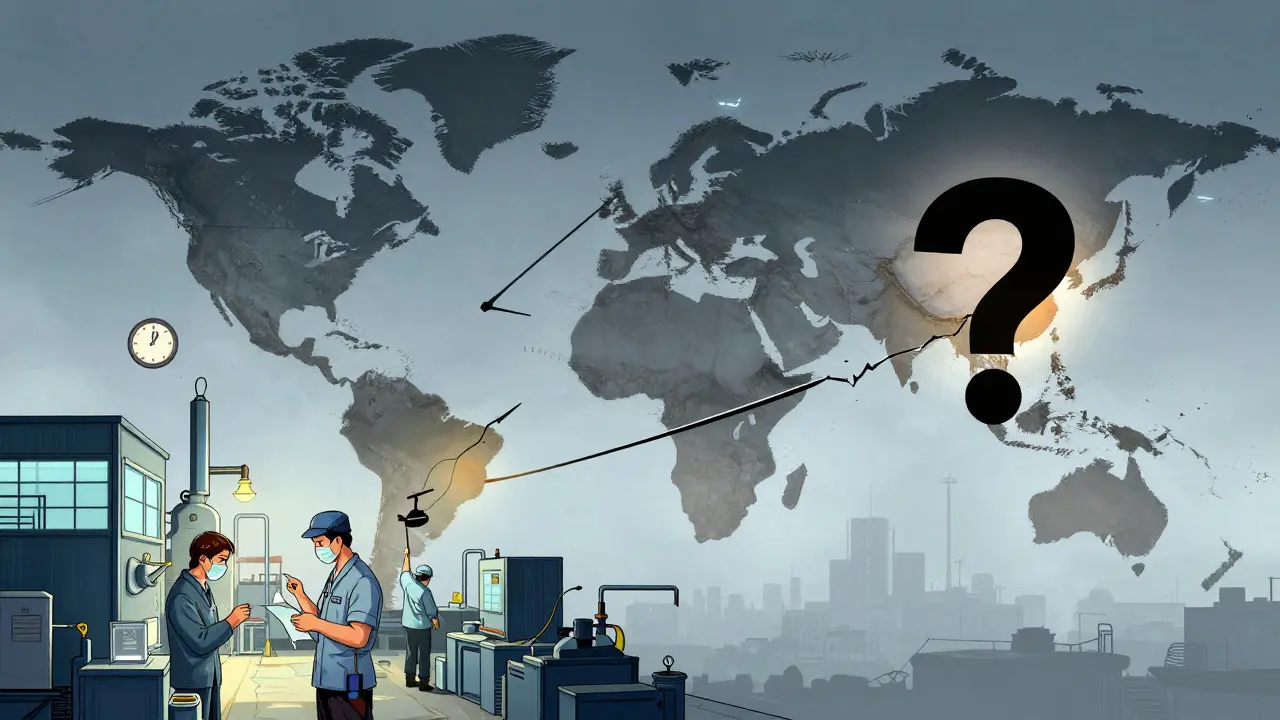
Here is where the story gets complicated. The U.S. doesn't make most of its generic drugs anymore. Approximately 80% of the active pharmaceutical ingredients (APIs) used in American medicines come from facilities in India and China. This globalization creates a blind spot in our safety net.
Data reveals a stark disparity in inspection frequency. Domestic U.S. facilities are inspected by the FDA every 1.8 years on average. In contrast, foreign facilities face an inspection cycle of once every 4.6 years. This gap was exposed dramatically during the Glenmark Pharmaceuticals scandal in April 2025. Journalists discovered repeated cGMP violations at Glenmark’s Indian plants-violations the FDA had missed because they hadn't inspected the site in over four years.
Dr. Peter Lurie, former FDA associate commissioner, testified before the Senate Health Committee in March 2025 that this limited capacity creates a "dangerous blind spot." The result? Foreign manufacturers account for a disproportionate share of recalls. In 2024, Indian manufacturers were responsible for 34% of all generic drug recalls, despite producing only 20% of U.S. generics. The delay between a quality failure occurring overseas and the FDA discovering it can take months, leaving patients vulnerable.
Voluntary vs. Mandatory: How the System Works
A common misconception is that the FDA orders recalls. In reality, the U.S. system is primarily voluntary. Manufacturers initiate 98% of recalls. The FDA requests them, recommends them, and threatens enforcement, but the legal power to force a recall is limited compared to other jurisdictions.
This contrasts sharply with the European Union, where regulatory agencies have stronger mandatory powers. A 2024 study published in the *Journal of Pharmaceutical Policy and Practice* found that the U.S. system averages 42 days between detecting a quality issue and notifying the public. The EU system averages just 18 days. Why the delay? Because U.S. manufacturers must first investigate, confirm the defect, and voluntarily agree to pull the product. While this collaboration model preserves industry relationships, it introduces a lag time that can endanger patients with acute conditions.
However, the FDA isn't powerless. If a manufacturer refuses to act, the agency can seize products, obtain injunctions, or pursue criminal charges. These tools are rarely used because most companies prefer to protect their reputation by acting quickly. Still, the reliance on self-reporting remains a structural weakness.
What Patients Should Do When an Alert Hits
If you receive a notice about a recalled medication, your reaction matters. A May 2025 survey by AARP found that 78% of adults would stop taking a recalled drug immediately. While caution is good, stopping essential medications without consulting a doctor can be dangerous. For example, abruptly quitting blood pressure meds can cause a spike in readings.
Here is a practical checklist for handling a recall:
- Check the Lot Number: Recalls almost always affect specific batches, not the entire drug supply. Look at your prescription bottle. Does the lot number match the one listed in the alert?
- Contact Your Pharmacist: Don’t guess. Pharmacists have direct lines to manufacturers and access to updated databases. They can tell you if your specific bottle is affected.
- Don’t Panic-Stop: Unless the recall is Class I and involves an immediate life-threatening risk (like a contaminated injection), keep taking your meds until you speak to a professional.
- Report Side Effects: If you suspect a problem, report it to the FDA’s MedWatch program. In 2024, over 142,000 reports were filed. Your data helps trigger future investigations.
Hospitals also play a key role. According to ASHP guidance, effective recall management requires hospital pharmacists to update "do not purchase" lists within procurement systems immediately. If you’re inpatient, trust that your care team has received the alert. If you’re outpatient, you may need to advocate for yourself by checking the FDA’s Enforcement Reports database, which is searchable and free.
The Future of Drug Safety: Tech and Transparency
The landscape is changing. The Glenmark incident and others have pushed Congress and the FDA to act. In May 2025, the Pharmaceutical Supply Chain Security Act was introduced, requiring real-time quality data sharing from foreign manufacturers. Imagine a world where sensors in an Indian factory automatically flag a sterility breach to the FDA in Boston within seconds. That’s the goal.
Technology is already helping. Blockchain implementations in pharmaceutical supply chains grew from 3% in 2023 to 18% in 2025. This tech allows for immutable tracking of every pill from raw material to pharmacy shelf. Additionally, the FDA is investing $47 million in AI-powered predictive analytics to identify potential quality issues before they trigger recalls. Early models suggest this could reduce recall identification time from days to hours.
Yet, challenges remain. The Government Accountability Office warned in May 2025 that without a $780 million annual increase in funding for foreign inspections, the U.S. supply chain will stay vulnerable. As the generic market consolidates-with the top 10 manufacturers now controlling 65% of the U.S. market-the stakes are higher than ever. One major player failing could disrupt millions of prescriptions.
For now, the best defense is awareness. Generic drugs save billions annually and provide essential care to millions. They are safe, but they are not infallible. By understanding what triggers a recall-from sterility lapses to labeling errors-you empower yourself to stay safe in a complex global system.
Are generic drugs less safe than brand-name drugs?
No. Generic drugs must meet the same rigorous FDA standards for safety, efficacy, and quality as brand-name drugs. However, because there are more generic manufacturers and many operate overseas, the volume of recalls can appear higher. The safety profile is equivalent, but the supply chain complexity introduces different risk factors.
How do I know if my medication is recalled?
You can check the FDA’s online Enforcement Reports database, which lists all current recalls. Your pharmacist should also notify you if a specific lot of your medication is affected. Signing up for alerts from your pharmacy or local health department can also help you stay informed.
What is the difference between a Class I and Class II recall?
A Class I recall indicates a reasonable probability of serious health consequences or death, such as a contaminated injection. A Class II recall involves temporary or medically reversible adverse health effects, like a slight deviation in drug potency. Class I requires immediate action, while Class II may only require switching to a new batch.
Why are foreign factories inspected less frequently?
The FDA faces budget and resource constraints. With hundreds of foreign facilities producing APIs for the U.S. market, the agency cannot inspect all of them annually. Currently, foreign facilities are inspected every 4.6 years on average, compared to every 1.8 years for domestic ones. New legislation aims to close this gap.
Should I stop taking my medication if it’s recalled?
Not necessarily. First, check the lot number on your bottle to see if it matches the recalled batch. Then, consult your pharmacist or doctor. Stopping essential medications abruptly can be harmful. Only discontinue use if advised by a healthcare professional or if the recall poses an immediate, life-threatening risk.