

When your liver is damaged by cirrhosis, the blood flow through it gets blocked. That forces blood to find new paths - often through fragile, swollen veins in your esophagus or stomach. These are called varices. And when they burst? It’s not just a bleed. It’s a medical emergency. About 1 in 5 people who suffer a variceal bleed die within six weeks. But here’s the good news: we know how to stop it. And we know how to prevent it from happening again. The keys? Endoscopic band ligation, beta-blockers, and a clear plan - not just one, but all three working together.
What Happens When Varices Bleed?
Portal hypertension isn’t a disease itself. It’s the result of liver scarring. As cirrhosis worsens, the liver stiffens. Blood can’t flow through easily. Pressure builds. Veins that normally carry blood away from the gut swell under the strain. The bigger they get, the thinner their walls become. Eventually, they rupture. Bleeding can be sudden, massive, and silent until you’re vomiting blood or passing black, tarry stools. Some people just feel dizzy, weak, or pass out. The clock starts ticking the moment bleeding begins. Every minute matters.
Endoscopic Band Ligation: The Gold Standard
When someone shows up in the ER with active bleeding from varices, the first thing gastroenterologists do is get them to the endoscopy suite - fast. The guidelines say it must happen within 12 hours. Delay beyond that increases the chance of death. The tool? Endoscopic band ligation, or EBL. It’s simple in concept: a tiny rubber band is placed around the base of the bleeding vein. Cut off the blood supply. The vein shrinks, dies, and scars over. No more leak.
Modern banding devices can place up to eight bands in one go. The newer multi-band systems, like the Boston Scientific Six-Shot, cut procedure time by over a third compared to older single-band tools. Success rates? Between 90% and 95% for stopping bleeding the first time. That’s why it replaced sclerotherapy (injection of chemicals) as the top choice back in 2005. Sclerotherapy caused more scarring, strictures, and complications.
But it’s not perfect. If the bleeding is too heavy, the view gets blurry. The endoscopist can’t see the varices clearly. In those cases, banding fails in about 10-15% of patients. Multiple sessions are needed - usually three to four, spaced one or two weeks apart - to completely remove all the dangerous veins. Each session costs between $1,200 and $1,800 in the U.S. But compared to the cost of repeated hospitalizations or a TIPS procedure? It’s a bargain.
Beta-Blockers: The Silent Shield
Band ligation stops the bleeding. But it doesn’t fix the root problem: high pressure in the portal vein. That’s where beta-blockers come in. These aren’t heart meds you take for chest pain. They’re the only drugs proven to lower portal pressure - and prevent rebleeding.
The two main ones? Propranolol and carvedilol. Both are non-selective. That means they block more than just heart receptors - they also calm down the blood vessels in your gut. Less flow. Less pressure. That’s the goal.
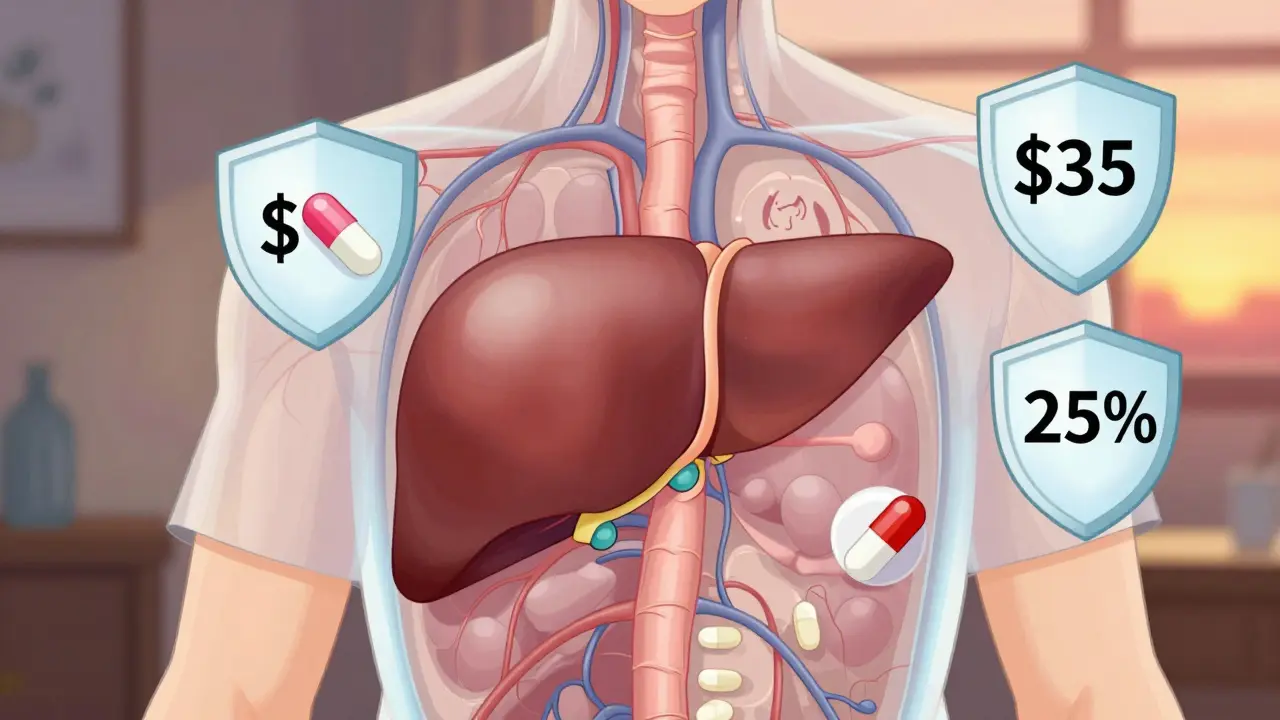
Propranolol usually starts at 20mg twice a day. You slowly increase until your heart rate drops by 25% or you hit the max dose of 160mg/day. Carvedilol, a newer option, starts at 6.25mg once daily and can go up to 12.5mg/day. Why does carvedilol matter? Because it doesn’t just block beta-receptors. It also relaxes blood vessels. Studies show it lowers portal pressure by 22%, compared to 15% with propranolol. In a 2021 trial, carvedilol beat propranolol head-to-head. But here’s the catch: carvedilol costs $25 to $40 a month. Propranolol? $4 to $10. Generic wins on price.
Both cut the risk of rebleeding by half. But they’re not for everyone. If you have asthma, a slow heart rate, or heart failure, you can’t take them. About 1 in 3 people can’t tolerate the side effects - fatigue, dizziness, low blood pressure. One Reddit user wrote: "Propranolol made me so tired I couldn’t get out of bed." Another switched to carvedilol but complained about the $35 copay.
Here’s the critical point: beta-blockers alone won’t stop an active bleed. That’s why guidelines say they should never be used alone in an emergency. They’re for prevention - before the first bleed (primary) and after (secondary). Banding does the heavy lifting during the crisis. Beta-blockers keep it from happening again.
What About Other Treatments?
Not every varix is the same. Esophageal varices respond well to banding. Gastric varices? Not so much. For those, a procedure called BRTO - balloon-occluded retrograde transvenous obliteration - works better. A 2023 analysis of over 7,000 patients showed 30-day mortality was 6.2% with banding alone, but dropped to 2.8% when BRTO was added.
Then there’s TIPS - transjugular intrahepatic portosystemic shunt. This is a metal tube placed inside the liver to create a shortcut for blood. It drops portal pressure dramatically. For high-risk patients - those with Child-Pugh B or C cirrhosis - TIPS boosts one-year survival from 61% to 86%. But it comes with a trade-off: up to 30% of patients develop hepatic encephalopathy. That’s brain fog, confusion, even coma. It’s not a first-line fix. It’s for the ones who keep rebleeding despite banding and beta-blockers.
And what about drugs like terlipressin or octreotide? They’re used in the ER to buy time - to slow bleeding while you prep for banding. Terlipressin cuts death risk by 34%. Octreotide works just as well in real-world settings. Now, there’s a new long-acting octreotide (Sandostatin LAR) that only needs a monthly shot. That could help patients stick with treatment. Right now, only 62% of people take their daily octreotide as prescribed.
The Real Challenge: Getting Care on Time
Even with perfect guidelines, the system often fails. Only 68% of U.S. hospitals get patients to endoscopy within 12 hours. Why? Delays in transferring from ER to GI, staffing shortages, equipment issues. And even if you get banding? Only 55% of patients ever reach the full, effective dose of beta-blockers. Too many are started too low. Too many are scared of side effects and quit.
Centers that do over 50 banding procedures a year have 15% fewer rebleeds. Experience matters. That’s why academic hospitals - with 98% adoption of full protocols - do better than small community hospitals. The American Liver Foundation’s nurse navigator program helps 12,000 patients a year just to coordinate care. That’s not luxury. It’s necessity.

What’s Next?
Research is moving fast. The 2024 Baveno VIII meeting will decide if carvedilol alone can replace banding for primary prevention in high-risk patients. Early data says maybe. A 2023 NEJM study found carvedilol was non-inferior to banding - meaning it worked just as well to prevent the first bleed.
Another promising idea? AI. Researchers are training algorithms to predict who’s about to bleed - based on imaging, lab values, and even voice patterns. The PORTAS trial is testing a new way to place TIPS without needing a full interventional radiology team. If it works, TIPS could become available in 75% of U.S. hospitals by 2027 - up from 45% today.
But the biggest hurdle isn’t technology. It’s access. Uninsured patients die from variceal bleeding at 35% higher rates than insured ones. That’s not a medical problem. It’s a system problem.
Bottom Line
Variceal bleeding is deadly - but not inevitable. If you have cirrhosis, you need three things: a plan, a team, and a timeline. Banding stops the bleeding now. Beta-blockers keep it from happening again. And if those aren’t enough, TIPS or BRTO can step in. The goal isn’t just survival. It’s living without fear of the next bleed. That’s possible. But only if you get the right care - and get it fast.
Can beta-blockers stop an active variceal bleed?
No. Beta-blockers lower portal pressure over time to prevent bleeding, but they cannot stop active bleeding on their own. In an emergency, endoscopic band ligation is required to achieve hemostasis. Pharmacological agents like octreotide or terlipressin are used as temporary measures to reduce bleeding while preparing for endoscopy, but they are not substitutes for banding in acute cases.
How many banding sessions are needed to eliminate varices?
Most patients need three to four banding sessions, spaced one to two weeks apart, to fully eradicate varices. Each session targets remaining or new varices that weren’t treated before. Complete eradication reduces the risk of rebleeding by over 80%. After that, maintenance endoscopy every 6 to 12 months is recommended to check for recurrence.
Why is carvedilol becoming preferred over propranolol?
Carvedilol lowers portal pressure more effectively than propranolol - by about 22% versus 15% - because it has both beta-blocking and vasodilating properties. Studies show it reduces rebleeding risk just as well, and may be more effective for primary prevention. However, it’s more expensive and not suitable for everyone. Propranolol remains a good option for patients who need an affordable, well-studied treatment.
Can variceal bleeding be prevented entirely?
In high-risk patients with large varices, primary prevention with beta-blockers or endoscopic banding can reduce the chance of first bleeding by 50% or more. For patients with small varices, beta-blockers alone are usually enough. But prevention isn’t 100% - even with perfect treatment, about 65% of patients still experience at least one rebleeding episode within a year. That’s why ongoing monitoring and a multidisciplinary care team are essential.
Is TIPS a good option for everyone with variceal bleeding?
No. TIPS is reserved for patients who continue to rebleed despite banding and beta-blockers - especially those with Child-Pugh B or C cirrhosis. It’s highly effective at reducing portal pressure and improving survival, but it carries a 30% risk of hepatic encephalopathy. It also requires specialized expertise. Only 45% of U.S. hospitals can perform TIPS within 24 hours. For most, banding and medication remain the first-line approach.
15 Comments
Band ligation works but only if you get to a real hospital fast. Too many rural ERs just pump you full of octreotide and call it a day. Then you get transferred three days later when you're already in shock. System is broken.
I think about how our bodies betray us. The liver, this silent worker, turns into a prison. The veins swell like veins in a dying tree. It's not just medicine. It's a quiet tragedy unfolding in slow motion.
People don't realize how much of this is about access. Carvedilol works better but if you're on Medicaid in Texas you're stuck with propranolol because the pharmacy won't cover the difference. This isn't science. It's economics dressed up as treatment.
So let me get this straight... you're telling me we have a $1200 procedure that works 95% of the time... but we're still pushing beta-blockers because 'they're cheaper'? And we call this medicine? This is a pyramid scheme disguised as healthcare. The real winners? Pharma and hospital administrators. Everyone else? Just collateral damage.
It is imperative to note, with the utmost scientific rigor, that the assertion regarding the efficacy of endoscopic band ligation is predicated upon a cohort of patients who possess adequate vascular access, timely diagnostic imaging, and non-comorbid conditions. In real-world settings, particularly among the uninsured, the reported 95% success rate is statistically inflated and methodologically unsound.
In Nigeria, we don't even have enough endoscopes. We use ultrasound and clinical signs to guess if varices are present. Banding? Only in Abuja or Lagos. Most patients die before they even get to a hospital. The real solution isn't better drugs-it's more machines, more training, more nurses. We need global investment, not just better guidelines.
I’ve watched my dad go through this. Banding felt like a miracle. But the real hero? The nurse who stayed after shift to explain why he couldn’t skip his propranolol. That’s the care that saves lives-not the tech.
The integration of multidisciplinary care is essential. While technological advancements such as TIPS and BRTO are commendable, their utility is diminished without consistent patient education, culturally competent counseling, and long-term follow-up structures. Sustainable outcomes require human connection as much as medical intervention.
This whole thing is a scam. Cirrhosis? It’s caused by drinking. So why are we spending millions on banding and beta-blockers? Just tell people to stop drinking. No one’s forcing them. If you make bad choices, you don’t get a free pass to the ER. This isn’t healthcare. It’s enabling.
I’m so glad this got written. I work in a clinic and see patients who don’t even know they have cirrhosis until they’re vomiting blood. We need screening. We need to talk to people before it’s too late. Prevention isn’t glamorous, but it’s the only thing that actually works.
banding is overrated. just give them the drugs and let nature take its course. why spend 1k+ on a procedure when you can just chill with a beer? 😌
So... we have a $1,800 procedure that works 95% of the time. And we still need three sessions. And beta-blockers. And then TIPS if that fails. And AI to predict it. And nurse navigators. And a whole team. And still 35% of uninsured die. So... what’s the point?
The fact that 55% of patients don't reach the full beta-blocker dose says everything. We're not failing because we don't know how to treat this. We're failing because we don't care enough to help people stick with it. It's not a medical problem. It's a compassion problem.
carvedilol? more like carve out your wallet. propranolol works fine. if you cant afford it, maybe you shouldnt have gotten cirrhosis. also tips gives you brain fog? sounds like a feature not a bug.
I’m so proud of how far we’ve come. From dying in the ER to having a real plan-banding, meds, follow-up. It’s not perfect, but it’s progress. To anyone reading this: if you have cirrhosis, don’t give up. There’s a team out there who can help you live. You’re not alone. 🙌
Write a comment