
Have you ever stared at a blood test result that said "normal" but still felt completely drained? You are not alone. For millions of people, the gap between lab numbers and how they actually feel is a source of deep frustration. The key to bridging this gap lies in understanding two specific hormones: TSH (Thyroid-Stimulating Hormone) and T4 (Thyroxine). These tests are the gold standard for diagnosing thyroid issues, but interpreting them requires more than just looking at whether a number falls inside a reference range. It involves understanding how your brain talks to your thyroid, why ranges vary by age and pregnancy status, and how doctors calculate the precise dose of medication you need.
The Communication Loop: How TSH and T4 Work Together
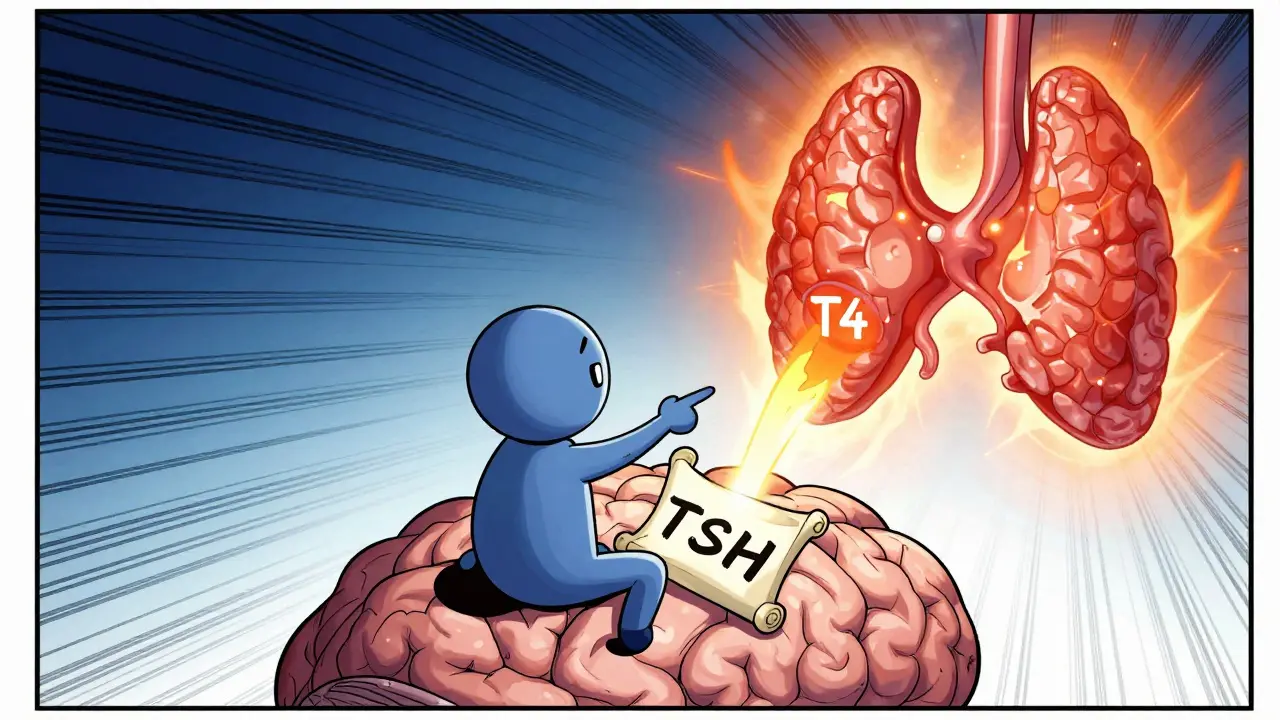
To understand these tests, you first have to visualize the conversation happening in your body. Your pituitary gland, located at the base of your brain, acts like a thermostat. It monitors the level of thyroid hormone in your blood. If it senses too little hormone, it releases TSH (Thyroid-Stimulating Hormone) to tell your thyroid gland to work harder. If there is plenty of hormone circulating, the pituitary stops sending signals.
This is why TSH is often called the most sensitive indicator of thyroid health. A high TSH usually means your thyroid is struggling to keep up (hypothyroidism), while a low TSH suggests it is overactive (hyperthyroidism). However, TSH is just the messenger. The actual worker is T4 (Thyroxine), the primary hormone produced by the thyroid gland. When we talk about T4 testing, we are specifically looking at Free T4-the portion of the hormone that is unbound and available to enter your cells and do its job. Total T4 includes hormone bound to proteins, which doesn't reflect what your tissues are actually using.
The American Thyroid Association established a two-step protocol in 1995 that remains the global standard today: check TSH first. If it is abnormal, follow up with Free T4. This approach catches 98% of primary thyroid dysfunction cases. Relying on T4 alone misses nearly a quarter of potential issues because TSH changes before T4 levels drop out of range.
Decoding Your Lab Results: What Is Normal?
One of the biggest sources of confusion is the concept of "normal." Laboratories provide reference ranges, but these are statistical averages based on large populations, not necessarily optimal ranges for every individual. Here is what you need to know about the numbers.
| Test Type | Normal Range | Key Context |
|---|---|---|
| TSH | 0.5 - 5.0 mIU/L | Varies significantly by age and pregnancy status. |
| Free T4 (FT4) | 0.7 - 1.9 ng/dL | Preferred over Total T4 in 89% of clinical settings. |
| Total T4 | 5.0 - 12.0 μg/dL | Affected by binding proteins; less reliable during pregnancy. |
For most adults, a TSH between 0.5 and 5.0 mIU/L is considered normal. However, endocrinologists like Dr. Rebecca Smith-Bindman from UCSF argue that population-based ranges can overdiagnose hypothyroidism in older adults. In fact, guidelines suggest higher upper limits for seniors: 0.5-5.5 mIU/L for ages 70-79, and 0.5-6.5 mIU/L for those 80 and older. Pushing an elderly patient’s TSH down to the lower end of the adult range can sometimes cause heart strain or bone density loss.
Pregnancy changes everything. During the first trimester, your body needs more thyroid hormone to support fetal brain development. Consequently, TSH levels should be lower, ideally between 0.1 and 2.5 mIU/L. As pregnancy progresses, the target range shifts slightly upward. Ignoring these trimester-specific targets can impact both maternal health and neurodevelopmental outcomes for the baby.

Diagnosing Thyroid Disorders: Beyond the Numbers
Doctors use the combination of TSH and Free T4 to pinpoint exactly what is going wrong. The pattern of results tells a specific story:
- Overt Hypothyroidism: High TSH (>4.5 mIU/L) combined with Low Free T4 (<0.8 ng/dL). This indicates the thyroid gland itself has failed to produce enough hormone.
- Subclinical Hypothyroidism: Elevated TSH (4.5-10 mIU/L) with Normal Free T4. The thyroid is struggling, but still managing to maintain output. Treatment decisions here depend on symptoms, age, and cholesterol levels.
- Hyperthyroidism: Suppressed TSH (<0.1 mIU/L) with High Free T4 (>1.8 ng/dL). The thyroid is producing excess hormone, often due to Graves' disease or toxic nodules.
- Central Hypothyroidism: Low TSH (<0.5 mIU/L) with Low Free T4 (<0.8 ng/dL). This is rare (affecting 1 in 20,000-30,000 people) and points to a problem with the pituitary gland rather than the thyroid itself.
It is crucial to note that TSH testing alone misses 5-7% of thyroid disorders, particularly in hospitalized patients. Non-thyroidal illness, known as euthyroid sick syndrome, can temporarily alter TSH and T4 levels without indicating a true thyroid disease. In critical care settings, doctors rely heavily on Free T4 measurements regardless of TSH results to avoid misdiagnosis.
Levothyroxine Dosing: Finding the Sweet Spot
If you are diagnosed with hypothyroidism, the standard treatment is Levothyroxine (synthetic T4 hormone replacement). Getting the dose right is not a one-time event; it is a process of fine-tuning. The goal is to restore your TSH to a target range that alleviates symptoms without causing side effects.
For healthy adults under 60 with primary hypothyroidism, the starting dose is typically calculated at 1.6 mcg per kilogram of body weight per day. If you weigh 70 kg (about 154 lbs), your initial prescription might be around 112 mcg daily. Doctors often round this to the nearest available tablet size, such as 100 mcg or 125 mcg.
However, dosing is not one-size-fits-all. Elderly patients or those with heart conditions start much lower, often at 1.0 mcg/kg/day or even less, to prevent cardiac stress. Infants, conversely, require much higher doses relative to their weight-between 10 and 15 mcg/kg/day-to support rapid brain development.
Once you start medication, patience is key. It takes about six weeks for your body to reach a new steady state of hormone levels. Therefore, doctors monitor TSH every 6 weeks until stable, then annually. The target TSH for most treated patients is between 0.5 and 2.5 mIU/L. Staying within this narrower band is associated with better symptom relief and quality of life compared to simply staying within the broad "normal" lab range.

Common Pitfalls and Patient Experiences
Despite clear guidelines, many patients face diagnostic delays. A 2023 survey of 12,500 patients on ThyroidChange.org revealed that 68% experienced delays because their TSH was technically "normal" despite severe symptoms. In many of these cases, a subsequent Free T4 test showed low levels, confirming hypothyroidism that TSH alone had missed.
Another major issue is laboratory variability. Different manufacturers use different assays. For instance, Roche’s Elecsys FT4 assay may show values 12% higher than Siemens’ Advia Centaur system. If you switch labs, your "normal" number might look different, leading to unnecessary dose adjustments. Always try to get your tests done at the same laboratory whenever possible.
Timing also matters immensely. Levothyroxine absorption is easily disrupted by food, coffee, calcium, and iron supplements. Taking your pill with breakfast can reduce absorption by up to 40%. The best practice is to take it on an empty stomach, at least 30-60 minutes before eating, or at bedtime four hours after your last meal.
The Future of Thyroid Testing
Technology is improving the precision of these tests. In 2024, the FDA approved a harmonized TSH reference material (NIST SRM 2921) that reduces inter-laboratory variation from 15% down to just 5%. This means your results will be more consistent regardless of where you live.
Researchers are also exploring the role of Free T3 (triiodothyronine) testing. While current guidelines focus on TSH and T4, some patients continue to feel unwell despite normal TSH/T4 levels. Emerging evidence suggests that in 15-20% of these cases, checking Free T3 provides additional insights. Additionally, AI-assisted interpretation tools are being piloted to analyze TSH, FT4, age, BMI, and symptoms together, potentially reducing misdiagnosis rates by 22%.
Why is my TSH normal but I still feel tired?
A normal TSH does not always rule out thyroid issues, especially if your Free T4 is low-normal or if you have central hypothyroidism. Other factors like sleep apnea, anemia, vitamin D deficiency, or stress can mimic thyroid fatigue. If symptoms persist, ask your doctor to check Free T4, iron levels, and vitamin B12.
How long does it take for levothyroxine to work?
It typically takes 4 to 6 weeks for levothyroxine to fully stabilize in your system and for TSH levels to reflect the new dose. You may notice slight improvements in energy within the first few weeks, but full symptom resolution can take several months of dose adjustments.
Should I take my thyroid medication with food?
No. Levothyroxine should be taken on an empty stomach for optimal absorption. Wait at least 30 to 60 minutes before eating breakfast, drinking coffee, or taking other supplements like calcium or iron, which can block absorption.
Is subclinical hypothyroidism serious?
Subclinical hypothyroidism (high TSH, normal T4) varies in severity. Mild elevations (TSH < 10 mIU/L) may not require immediate medication if you have no symptoms. However, it increases the risk of high cholesterol and heart disease over time, so regular monitoring is essential.
Do thyroid reference ranges change with age?
Yes. As we age, our TSH levels naturally rise slightly. For adults over 80, a TSH up to 6.5 mIU/L may be considered acceptable. Treating elderly patients to younger adult ranges can lead to overtreatment and side effects like heart palpitations or bone loss.

12 Comments
man this is exactly why i feel like my doctor doesnt care about me he just looks at the tsh and says were good but i am still so tired all the time
it makes sense now that the pituitary is like a thermostat trying to push the thyroid harder when it isnt working right
i wish more people knew about free t4 because total t4 can be totally misleading if you have binding protein issues
thanks for breaking this down simply
useless article
western medicine is always overcomplicating simple things with these hormone charts
in india we dont need such detailed tests for basic health
just eat clean and stop whining about fatigue
Your assertion that western medicine is overcomplicating things is factually incorrect and demonstrates a profound lack of understanding regarding endocrinology. The differentiation between Total T4 and Free T4 is not a matter of opinion but of clinical necessity, particularly in cases where binding proteins are altered by pregnancy or liver disease. To dismiss established diagnostic protocols as 'whining' is not only rude but dangerous advice for anyone suffering from genuine hypothyroidism. Please do not offer medical opinions based on anecdotal cultural preferences rather than peer-reviewed science.
you are too sensitive
science is whatever they say it is today
tomorrow they will change the ranges again
people just want pills instead of fixing their lifestyle
The epistemological crisis within modern endocrinology is palpable; one must ask whether the 'normal' range is a biological truth or merely a statistical construct imposed upon a heterogeneous population. It is pretentious to assume that a single reference interval applies to all human beings without considering the nuanced interplay of individual physiology. We are trapped in a paradigm where numbers dictate reality, yet the subjective experience of the patient remains largely ignored by the hegemony of clinical guidelines. This is not just medicine; it is a philosophical failure to recognize the uniqueness of the self.
it is interesting how the body tries to balance itself out before things get really bad
i think many people ignore the early signs because they blame stress or aging
but reading about the trimester specific targets made me realize how much our bodies change during pregnancy
it is good to know that lower tsh is actually normal then
we should listen to our bodies more
nothing here is new
i have been taking levothyroxine for ten years and my doctor never explained any of this
i just take the pill and hope for the best
why did i read this whole thing for nothing
I find it incredibly frustrating that doctors continue to use outdated ranges that clearly do not reflect optimal health for most patients. It is a moral failing of the medical community to tell women they are fine when they are miserable. I have seen friends struggle for years because their TSH was 4.8 which is technically normal but feels terrible. We need to demand better standards and hold physicians accountable for ignoring symptoms. It is not enough to just survive; we deserve to thrive.
oh my god yes!! :O
i felt so alone thinking i was crazy because my labs said normal
this explains everything
please share this everywhere
u guys are missing the point its not just about the numbers its about the conversion to t3 which this article barely mentions
so many people have normal tsh and ft4 but low ft3 and no one talks about it
typical shallow analysis
i bet the author hasnt even dealt with hashimotos personally
Absolutely brilliant breakdown of the feedback loop! 🌟 It’s fascinating how the pituitary acts as that master thermostat, isn’t it? I’ve always found the concept of Free T4 versus Total T4 to be a bit of a mind-bender, but explaining it as the 'available' hormone vs the 'bound' hormone makes perfect sense. It’s like having money in your bank account versus money locked in a savings bond-you can’t spend what you can’t access! Thanks for shedding light on this crucial distinction. It really helps demystify those confusing lab reports.
hey there thanks for sharing this info
i always get confused with the different types of t4 tests
good to know that free t4 is usually what matters most
hope this helps others understand their results better too
Write a comment