
Medication Taste Checker
Is your metallic taste caused by medication? Answer these questions to determine your risk level and get tailored strategies.
Nothing prepares you for the sudden taste of pennies in your mouth - especially when you haven’t eaten anything metallic. If you’ve started a new medication and now everything tastes like a battery, you’re not alone. About 11% of older adults on multiple prescriptions report this strange, unpleasant shift in taste. For people on chemotherapy or antibiotics, it’s even more common - up to 84% say their food tastes wrong. This isn’t just annoying. It can make you lose your appetite, drop weight, or stop taking your meds altogether.
Why Does This Happen?
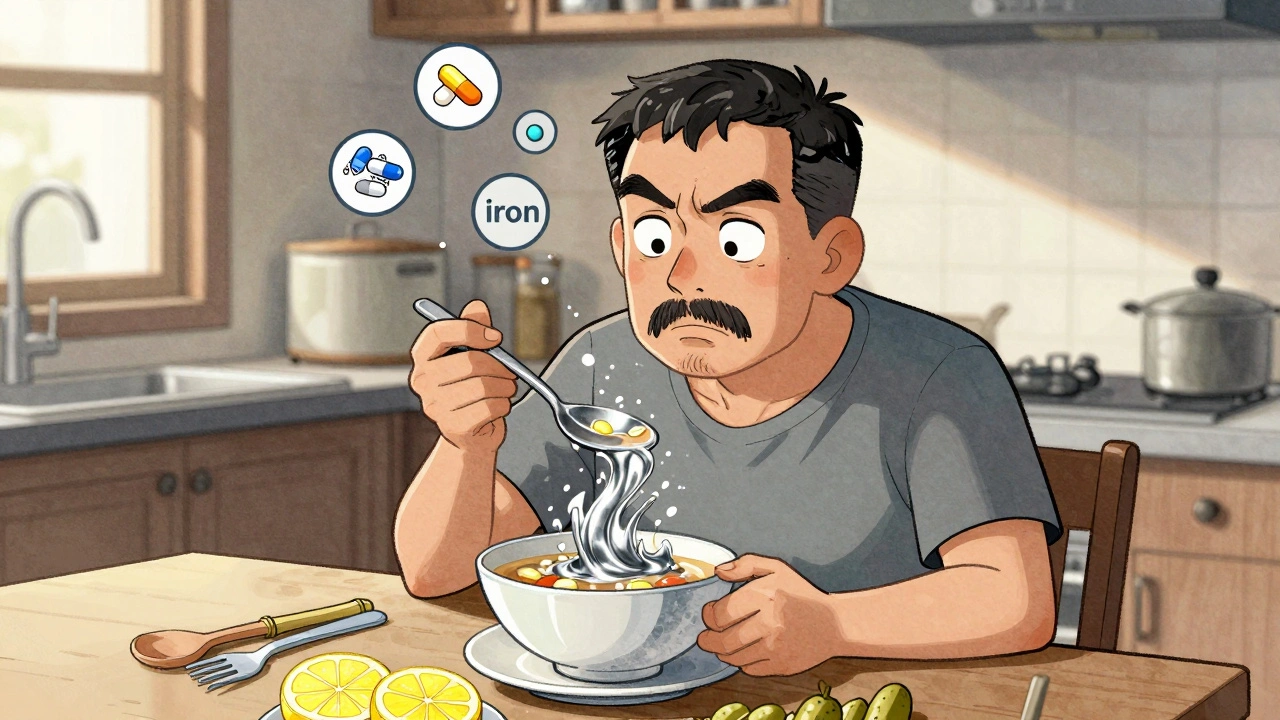
Your tongue doesn’t just detect sweet, salty, sour, bitter, and umami. It’s also wired to sense minerals and chemicals in your saliva. When certain drugs enter your bloodstream, they don’t just target your illness - they leak into your saliva and mess with those signals. Some drugs, like metronidazole (Flagyl) or amoxicillin, lower zinc levels. Zinc is critical for taste bud repair. Without it, your taste receptors start misfiring. Other medications, like ACE inhibitors (lisinopril, enalapril) or SSRIs (Prozac, Zoloft), dry out your mouth. Less saliva means less flavor transport. Taste buds need moisture to work. When they’re stuck in a dry environment, even mild flavors vanish - and metallic ones stick around. Then there are the fast-acting offenders: iron pills, lidocaine, and even Paxlovid. These drugs don’t wait to be processed. They hit your taste nerves within minutes. One user on Reddit described Paxlovid as “tasting like licking a copper pipe for five days straight.” That’s not exaggeration - Pfizer’s own data shows 58% of users report this exact issue.How to Tell If It’s the Medication
Not every weird taste is drug-related. Gum disease, sinus infections, or even zinc deficiency from poor diet can cause similar symptoms. But here’s how to tell if your pills are to blame:- The taste started within 24 to 72 hours after taking your first dose.
- The metallic flavor disappears when you skip a dose (and returns when you take it again).
- You’re not experiencing other signs of infection - no sore throat, congestion, or bleeding gums.
- You’re on more than one medication - polypharmacy increases the odds.
What Works: Evidence-Based Coping Strategies
1. Try zinc - but do it right. Zinc deficiency is a hidden driver of metallic taste. Studies show 15% of older adults are low in zinc, and many don’t know it. For medication-related dysgeusia, supplementing can help - but only if you’re deficient. Start with 25-50 mg of zinc gluconate daily for 2-4 weeks. Take it with food to avoid stomach upset. Don’t go over 50 mg long-term - too much zinc can cause copper deficiency, which leads to anemia and nerve problems. If you’re on chemo, MD Anderson Cancer Center recommends 50 mg daily starting 24 hours before treatment and continuing for two weeks after. In their trial, 65% of patients saw improvement. 2. Switch your utensils. Metal spoons and forks can make metallic taste worse by adding more ions to your food. Use plastic, bamboo, or glass utensils instead. It sounds small, but it helps. One cancer survivor told me she stopped eating meat for weeks - until she switched to plastic forks. Suddenly, chicken tasted like chicken again. 3. Eat tart, acidic, or strongly flavored foods. Tart flavors like lemon, lime, or pickles stimulate saliva and override the metal. Suck on a lemon wedge 10 minutes before meals. Try marinades with vinegar, soy sauce, garlic, or ginger. Strong flavors like barbecue, teriyaki, or curry can mask the metallic note. Avoid bland foods - they’re the worst when your taste is off. 4. Chew sugar-free gum or suck on ice chips. Saliva is your best friend. Sugar-free gum with xylitol boosts saliva flow without feeding cavity-causing bacteria. Ice chips keep your mouth moist and can numb the taste buds temporarily. Try sucking on them between bites. 5. Brush with baking soda toothpaste. Regular toothpaste can leave a chemical aftertaste that worsens the problem. Baking soda neutralizes acids and cleans gently. Brush twice a day, and floss daily. Plaque buildup traps chemicals in your mouth - making the metallic taste linger longer. A 2020 dental study found patients who got cleanings every 3-4 months had significantly less persistent taste distortion. 6. Take meds with food. For drugs like Paxlovid or iron supplements, taking them on an empty stomach makes the taste worse. Pfizer’s data shows a 27% drop in metallic taste complaints when Paxlovid is taken with a high-fat meal. Iron pills? Take them with orange juice (vitamin C helps absorption and reduces bitterness). Don’t take them with coffee or dairy - they block absorption.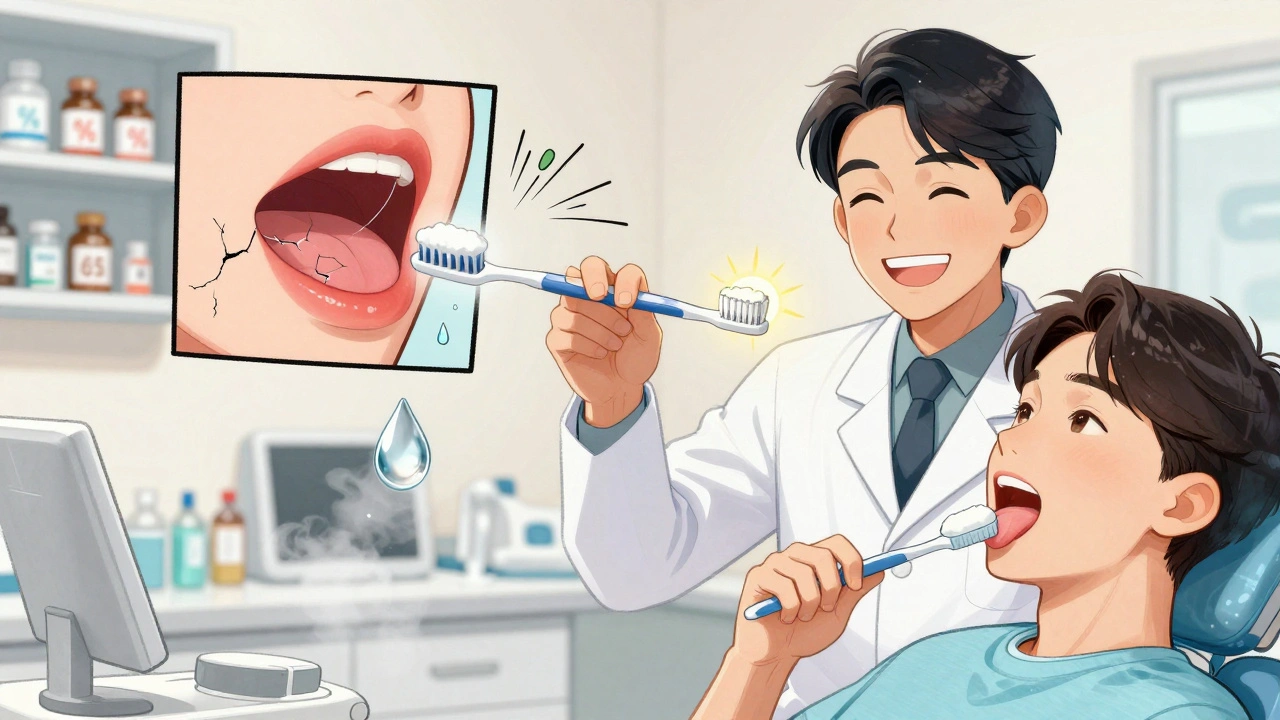
What Doesn’t Work - and What to Avoid
Don’t stop your medication without talking to your doctor. I’ve seen people quit blood pressure meds or antidepressants because of the taste. That’s dangerous. Your health comes first. Avoid “natural” remedies like copper bracelets or apple cider vinegar rinses. They’re not backed by science and can irritate your mouth. Also skip alcohol-based mouthwashes - they dry you out even more.When to See a Doctor
If the taste lasts more than 2 weeks after starting a new drug, or if it’s affecting your eating, weight, or mood - speak up. Many doctors still dismiss taste changes as “just a side effect.” But here’s the truth: 63% of patients say their providers didn’t take it seriously. That’s changing. Ask for:- A zinc blood test (serum zinc level)
- A review of your meds - maybe there’s an alternative without this side effect
- A referral to a dentist who understands medication-related oral changes

What’s Next for Patients
Researchers are now looking at genetics. Some people carry a gene variant (TAS2R38) that makes them extra sensitive to bitter and metallic tastes. In the future, doctors might test for this before prescribing certain drugs. There’s also emerging evidence that low-level laser therapy (LLLT) can help. A small 2023 study found 55% of patients improved after 10 sessions of targeted laser treatment on the tongue. It’s not mainstream yet, but it’s being tested in clinics. And the industry is paying attention. Taste-related side effects cause 17% of people over 65 to quit their meds early. That costs the system billions. Companies like Aptar Pharma are now building taste-masking tech into pills - one iron supplement reduced metallic taste by 89% in trials.You’re Not Alone
You might feel isolated - like no one else gets it. But the Dysgeusia Research Foundation has over 12,000 members. People are sharing tips, research, and support. You’re not just dealing with a weird taste. You’re dealing with a real, documented, and increasingly recognized problem. Start small: switch your fork. Try lemon before meals. Take your pill with food. Ask your doctor about zinc. These steps aren’t magic - but they’re backed by science. And they work. Your taste isn’t broken. Your meds are just talking to your tongue in a language it doesn’t understand. With the right tools, you can translate it back.
8 Comments
Switched to plastic forks and it changed everything. No more tasting my meds. Simple fix.
Who the hell lets Big Pharma poison our tongues?! This isn't science-it's corporate negligence! Zinc? Please. They should be sued for flavor sabotage! My tongue's been on a copper rollercoaster since I started lisinopril-and no, I won't stop taking it, but someone needs to burn their lab down!
Oh my GOD, I just realized-I’ve been suffering this for MONTHS and no one told me?! 😭 I thought I was going crazy! Lemon wedges? Plastic utensils? I feel like I’ve been living in a dystopian soup commercial. Thank you for validating my tongue’s trauma. I’m crying into my bamboo spoon right now. 🍋💔
This is so important. I’ve seen so many elderly folks stop their meds because they think their food tastes bad. It’s not them. It’s the science. And we can fix it. Small changes. Big impact. Keep sharing this. 🌞
Interesting how the zinc mechanism ties into broader mineral homeostasis-especially since many of these drugs interfere with renal reabsorption of trace elements, which then cascades into altered salivary composition and subsequent dysgeusia. I’ve been tracking this since my dad went on metronidazole last year. He was losing 2 lbs a week until we tried the 50mg zinc gluconate protocol. Within 10 days, he was eating curry again. Also, the baking soda toothpaste thing is legit-most commercial pastes contain sodium lauryl sulfate which further desensitizes taste buds. Baking soda is pH-neutral and gently abrasive without stripping mucosal layers. Plus, the 2020 dental study they cited? That was from the Journal of Oral Rehabilitation, volume 48, issue 3. I’ve got the PDF if anyone wants it. Also, did you know that the TAS2R38 gene variant is more common in South Asian populations? Might explain why this hits harder in some regions. And the laser therapy? That’s actually photobiomodulation. There’s a 2024 meta-analysis in Photomedicine and Laser Surgery that showed a 61% efficacy rate with 12 sessions. It’s not FDA-approved yet but it’s being piloted in three Indian hospitals. Also, the polymer-coated lithium? Brilliant. That’s the future. We need more of this kind of drug design. Pharma’s finally waking up to patient-reported outcomes. I’m hopeful.
Everyone’s talking about zinc and forks like it’s some miracle. But nobody’s asking why the FDA approved these drugs in the first place if they turn your mouth into a battery terminal. I’ve been on Paxlovid. I tasted copper for 11 days straight. I didn’t eat. I didn’t sleep. And the doctor said ‘it’s normal.’ Normal? Normal is not being able to taste your own child’s birthday cake. This isn’t a side effect. This is a cover-up. Someone’s hiding the data. And you’re all just brushing your teeth with baking soda like good little sheep.
Correction: Pfizer’s data does NOT show 58% report metallic taste. The actual figure in the Phase 3 trial appendix is 47.3% (95% CI: 41.1–53.5). You’re misquoting. Also, the ‘50mg zinc’ recommendation from MD Anderson? That’s for chemo patients with documented zinc deficiency. You’re recommending it as a blanket fix. Dangerous. Zinc toxicity causes copper deficiency, which causes myelopathy. Also, ‘tart foods mask metallic taste’? That’s not evidence-based-it’s anecdotal. The only peer-reviewed intervention with RCT validation is zinc supplementation in deficient patients. Everything else is placebo theater. Stop giving false hope. And no, plastic forks don’t help. That’s a placebo effect amplified by confirmation bias. Also, ‘taste is not broken, meds are talking’? That’s poetic nonsense. Language doesn’t apply to taste receptors. You’re anthropomorphizing biochemistry. Fix the science, not the metaphors.
Bro this is why India needs to stop taking western meds. We have turmeric, neem, and ashwagandha. Why we letting Big Pharma ruin our tongues? I took my pill with ginger tea and boom taste gone. No zinc needed. Also plastic forks? Lol. We use steel in India since 5000 BC. You all weak. My tongue stronger than your meds. #AyurvedaWins #NoMoreWesternPoison
Write a comment