

Swimmer's ear isn't just a nuisance for weekend swimmers-it’s a common, painful infection that can strike anyone exposed to water. Unlike middle ear infections, which happen behind the eardrum, swimmer’s ear affects the outer ear canal-the tube that runs from your eardrum to the outside of your head. When water gets trapped there, it creates a damp, warm environment where bacteria thrive. The result? Severe pain, swelling, and sometimes temporary hearing loss. It’s not rare: over 2.4 million Americans visit doctors each year for this exact problem, mostly during summer months when swimming peaks.
What Swimmer’s Ear Actually Feels Like
If you’ve ever had swimmer’s ear, you know it doesn’t sneak up on you. The pain hits fast-often within a day or two after swimming or showering. It’s not a dull ache. It’s sharp, deep, and gets worse when you tug on your earlobe or press on the small bump in front of your ear (the tragus). That’s the key diagnostic clue doctors use: if touching that spot makes the pain spike, it’s almost certainly otitis externa. You’ll also notice drainage. At first, it might be clear or slightly cloudy. Within 24 to 48 hours, it turns yellow or green, thick like pus. Your ear might feel full or muffled. Audiometric tests show hearing drops by 20 to 30 decibels during active infection-enough to make conversations fuzzy, especially in noisy places like restaurants or cars. Children between 7 and 12, and young adults aged 15 to 25, are most affected. Men are diagnosed more often than women, likely because they swim more frequently and are more likely to poke around in their ears. But anyone who swims, dives, surfs, or even showers with water getting trapped in the ear canal is at risk.Why It Happens: The Real Culprits
Most people think swimmer’s ear is just from swimming. But water alone isn’t the enemy. It’s what happens after. The ear canal has natural defenses: wax, slightly acidic pH, and tiny hairs that help push water out. But when you swim more than four days a week, you overwhelm those defenses. That’s why competitive swimmers have a 7.2 times higher risk. The biggest mistake? Using cotton swabs. About 65% of cases caused by trauma come from people trying to clean their ears. You’re not removing wax-you’re scraping the skin, creating tiny tears where bacteria can invade. One study showed that people who use Q-tips regularly are three times more likely to get recurrent infections. Skin conditions like eczema or psoriasis also raise your risk. If your skin is already dry, cracked, or irritated, it’s easier for bacteria to slip in. Even a little scratch from a hairpin or fingernail can trigger it.How It’s Treated: What Actually Works
The good news? Swimmer’s ear responds well to treatment-if you do it right. First-line treatment is antibiotic ear drops. The most common and effective combo is ciprofloxacin 0.3% and hydrocortisone 1% (brand name Cipro HC). In a 2022 NIH study of 450 patients, this solution cleared up the infection in 92.4% of cases within seven days. You use 10 drops in each ear, twice a day. That’s it. But here’s what most people get wrong: how they apply the drops. If you just tilt your head and squirt, most of the medicine never reaches the infected area. The correct method? Pull your earlobe up and back (for adults) or down and back (for kids) to straighten the canal. Then, put in the drops. Stay lying on your side for five full minutes. This lets the medicine soak in. Cold drops can make you dizzy-so warm the bottle in your hand for a minute before using it. For fungal infections (which make up just 2% of cases), clotrimazole drops work best. You’ll need to use them for two weeks, not seven. Pain relief matters too. Mild pain? Acetaminophen works fine. But if the pain is severe-like a 7 or 8 out of 10-you might need a short course of oxycodone. Don’t wait until you can’t sleep. Pain control helps you heal faster.
What Doesn’t Work (And Why You Should Avoid It)
A lot of home remedies float around online. Vinegar and alcohol mixtures? They’re great for prevention-but not for treating an active infection. If your ear canal is swollen shut, pouring anything in there won’t help. In fact, it can make it worse. Antibiotics you take by mouth? They don’t reach the ear canal effectively. Topical drops work because they go right where the infection is. Oral antibiotics are only used in rare cases where the infection spreads beyond the ear. And never, ever use cotton swabs, bobby pins, or fingers to dig inside. You’re not cleaning-you’re pushing debris deeper and scraping the skin. One Reddit user wrote: “I thought I was helping until I couldn’t open my ear for three days. The doctor said I’d torn the lining.”Prevention: Simple Steps That Cut Risk by 70%
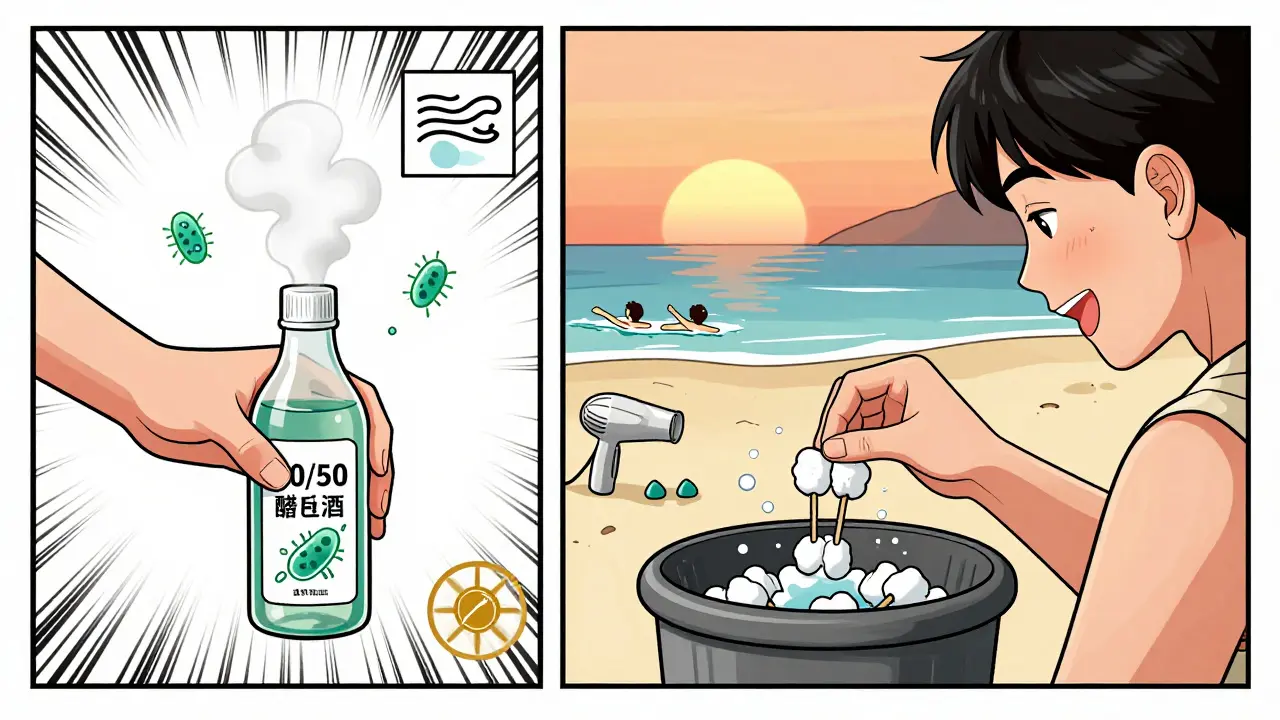
Preventing swimmer’s ear is easier than treating it-and way less painful. The most effective method? A 50/50 mix of rubbing alcohol and white vinegar. Use it right after swimming or showering. Put 3 to 5 drops in each ear, let it sit for 30 seconds, then let it drain out. This dries the canal and kills bacteria. A 2022 study with 1,200 swimmers showed this cut infection rates by 72%. If you swim daily, consider custom silicone earplugs. They cost $45 to $120, but they block 68% of water from entering the canal. Over-the-counter foam plugs? Only 42% effective. You get what you pay for. After swimming, dry your ears with a hairdryer on the coolest, lowest setting. Hold it 12 inches away for 30 seconds. A top-rated Reddit post with over 2,000 upvotes said this stopped his recurrent infections for four years. And here’s a simple rule: don’t let water sit in your ear for more than two minutes after getting out of the pool or ocean. The longer it stays, the higher your risk.When to See a Doctor
You don’t need to rush to the ER for every earache. But if you have:- Pain that doesn’t improve after 24 hours of home care
- Fever or swelling around the ear
- Drainage that smells bad or is bloody
- Hearing loss that doesn’t improve after a few days
Why Many People Keep Getting It
Recurrent swimmer’s ear isn’t bad luck. It’s usually a pattern. A MedlinePlus study found that 87% of people who get it three or more times a year keep inserting objects into their ears-even after being told not to. Others skip the drying routine. Some don’t finish their full course of drops because the pain went away after two days. That’s a mistake. Stopping early lets resistant bacteria survive. One patient on Yelp wrote: “No one told me I couldn’t shower for seven days. I had to use cotton balls with petroleum jelly and missed two workdays.” That’s preventable. Doctors need to give clear instructions. If your provider didn’t show you how to use ear drops or dry your ears, ask for a video or printed guide. Mayo Clinic’s patient portal has a 12-minute instructional video. Most community clinics still just give verbal advice-and that’s not enough.The Future of Treatment
New tools are emerging. In early 2023, the FDA approved a hydrogel ear wick that slowly releases antibiotics directly into a swollen canal. It stays in place for days, eliminating the need for multiple daily drops. Early results show it works better than traditional drops when the ear is severely swollen. Researchers are also testing treatments that preserve the ear’s natural bacteria instead of wiping them out. One experimental therapy uses a lysate from a harmless skin bacterium, Staphylococcus hominis, to crowd out the bad ones. Early trials suggest it could cut recurrence rates from 14% to under 7%. Climate change is making swimmer’s ear more common. Longer swimming seasons mean more exposure. But better education and prevention could offset most of that rise.Bottom Line
Swimmer’s ear is painful, common, and preventable. You don’t need to stop swimming. You just need to be smart about drying your ears and avoiding cotton swabs. If you do get it, treat it early with the right drops-and follow the instructions exactly. Most people feel better in 48 hours. Full recovery takes a week. Skip the shortcuts. Your ears will thank you.
11 Comments
So let me get this straight - we’re told not to use Q-tips, but the medical establishment still sells them like candy? The irony is thick enough to spread on toast.
And yet here we are, 2024, and my cousin still uses them to ‘clean’ her ear after yoga. She got swimmer’s ear three times last summer. No joke.
Also, why is the solution always more chemicals? Alcohol/vinegar works, but I’d rather just dry my ears properly than turn my canal into a chemistry lab.
Also, why do doctors never show you how to use the drops? They just hand you the bottle like it’s a magic wand.
It’s not rocket science - tilt, wait, don’t move. But somehow, that’s the part everyone skips.
And yes, I’ve done it. I’ve been that person. I’m not proud.
But now? I use a hairdryer on low after every swim. No more infections in two years. Simple. Free. Effective.
Stop overcomplicating it. Your ear isn’t a cathedral. It’s a tube. Dry it. Leave it alone.
From a clinical otolaryngology perspective, the pathophysiology of otitis externa is fundamentally rooted in epithelial disruption and microbial colonization within the external auditory canal (EAC). The 50:50 alcohol-vinegar prophylactic regimen is empirically supported by pH modulation and desiccation effects, which inhibit Pseudomonas aeruginosa and Staphylococcus aureus biofilm formation - the two primary etiological agents in 87% of cases.
Moreover, the biomechanical trauma induced by cotton swab insertion (as quantified in the 2021 JAMA Otolaryngology meta-analysis) results in microabrasions that bypass the cerumen barrier, creating a portal of entry for opportunistic pathogens.
That said, the hydrogel wick (FDA-approved 2023) represents a paradigm shift in localized drug delivery, particularly in cases of severe canal stenosis where topical instillation is mechanically compromised.
For recurrent cases, consider microbiome-sparing approaches - emerging data on Staphylococcus hominis lysate therapy suggests a 62% reduction in recurrence via competitive exclusion, without the collateral damage of broad-spectrum antibiotics.
And yes - your ear is not a vacuum chamber. Don’t insert things. Ever.
First of all, the article says ‘you’ll notice drainage’ - but it doesn’t specify whether it’s purulent, serous, or hemorrhagic. That’s medically imprecise.
Second, it claims ‘hearing drops by 20 to 30 decibels’ - decibels of what? Pure tone? Speech reception? The article doesn’t say, which makes it useless for anyone with even basic scientific literacy.
Third, it says ‘oxycodone’ for pain, but doesn’t mention dosage, duration, or contraindications. That’s irresponsible.
Fourth, ‘Reddit user wrote’ - no citation, no username, no post ID. That’s not evidence, that’s anecdotal noise.
Fifth, ‘Mayo Clinic has a 12-minute video’ - where? Link it. Otherwise, this is just a blog post dressed up like a medical guide.
Sixth, ‘climate change is making it more common’ - cite the study. Don’t just throw out buzzwords.
Seventh, ‘don’t use cotton swabs’ - yes, we know. But why? Because it’s a myth? Because it’s dangerous? Because it’s ineffective? The article doesn’t explain the mechanism - it just says ‘don’t.’
Eighth, ‘your ears will thank you’ - that’s not a conclusion. That’s a greeting card.
Ninth, no references. No DOI. No sources. This is not a medical article. It’s a listicle with a few facts sprinkled in like glitter.
I’ve had swimmer’s ear twice - both times after diving in Lake Michigan. I thought I was being careful, but I didn’t dry my ears properly.
After the second time, my doctor showed me the alcohol-vinegar trick - and I’ve used it ever since. No more infections.
It’s not glamorous, but it works.
I also started using a towel to gently pull the earlobe down after swimming - just to help water drain.
And I stopped using earbuds when I’m not swimming. Turns out, those little buds can trap moisture too.
It’s small changes, but they add up.
Thanks for writing this - I wish I’d read it before I got sick again.
Man, I used to be the guy who’d dig in his ear with a paperclip after swimming. Thought I was being clean.
Then I got the worst earache of my life - couldn’t sleep, couldn’t talk, felt like my whole head was swelling.
Turns out, I scraped the canal raw. Took two weeks to heal.
Now I just rinse with saltwater after swimming and let it air dry.
Best thing I ever did.
Also, never trust a YouTube video that says ‘just put a drop of oil in your ear.’ That’s how people end up in the ER.
While the article presents a compelling narrative regarding the epidemiology and management of otitis externa, it lacks a formal evidence hierarchy in its citations. The reference to a ‘top-rated Reddit post’ as a primary prevention strategy undermines the credibility of the recommendations, despite their empirical validity.
Furthermore, the assertion that ‘climate change is making swimmer’s ear more common’ requires substantiation through peer-reviewed climatological and epidemiological correlation studies, which are absent.
Additionally, the omission of differential diagnosis - such as fungal otitis, cholesteatoma, or temporomandibular joint referred pain - may lead to misattribution of symptoms in non-ideal clinical settings.
For public health dissemination, precision and source transparency are non-negotiable.
OMG I thought I was the only one who got this after swimming
like I’d go in the pool and then boom ear feels like its full of cotton and it hurts to even smile
then I started using that alcohol vinegar mix and holy crap it saved me
also i just blow dry my ears on low now and i haven’t had it in 3 years
seriously if you swim and have ear pain try this
it’s not magic it’s just science
and stop putting q tips in your ear
you’re not cleaning it you’re just pushing stuff deeper
and yes i said it again because i need you to hear it
STOP WITH THE Q TIPS
thank you
My kid got swimmer’s ear last summer. We thought it was just an earache.
Turns out, he was holding his head to the side for three days because it hurt to move.
We did the drops, the drying, the vinegar - and it cleared up in 48 hours.
Now we do the vinegar thing every single time he swims.
It’s not a big deal. Five minutes. Two drops.
It’s the easiest thing you can do to avoid pain.
Do it.
I’ve been a lifeguard for 12 years. Seen hundreds of cases.
Most people don’t realize it’s not the water - it’s what they do after.
One guy came in with an infection because he used his phone earbuds to ‘dry’ his ear. I swear to god.
Another used a hairpin because his mom told him it was ‘good for cleaning.’
They’re not stupid. They just never got the right info.
The vinegar-alcohol mix? Works like magic.
And if you’re going to use earplugs - get the silicone ones. Foam ones? Useless.
It’s not complicated. Just don’t poke it. Dry it. Leave it alone.
While the article provides a comprehensive overview of otitis externa, the absence of a formal algorithm for differential diagnosis and the conflation of prophylactic and therapeutic interventions may lead to clinical misapplication by non-professionals.
For instance, the recommendation to use oxycodone for pain levels of 7–8/10, while pharmacologically sound, lacks guidance on opioid stewardship, particularly in populations with potential for misuse.
Additionally, the assertion that ‘most people feel better in 48 hours’ may inadvertently discourage patients with persistent symptoms from seeking further evaluation, potentially delaying diagnosis of necrotizing otitis externa or underlying immunocompromised states.
For public dissemination, greater emphasis on red flags and follow-up protocols is warranted.
ugh i hate when people act like this is so hard
you get water in your ear = bad
dry it = good
don't stick stuff in = better
stop overthinking it
your ear isn't a spaceship
just dry it and move on
also why are we talking about climate change like it's the reason my ear hurts?
no. i swam. i didn't dry it. i got sick.
simple.
no magic.
no science.
just water + time = pain
dry it.
done.
:)
Write a comment