
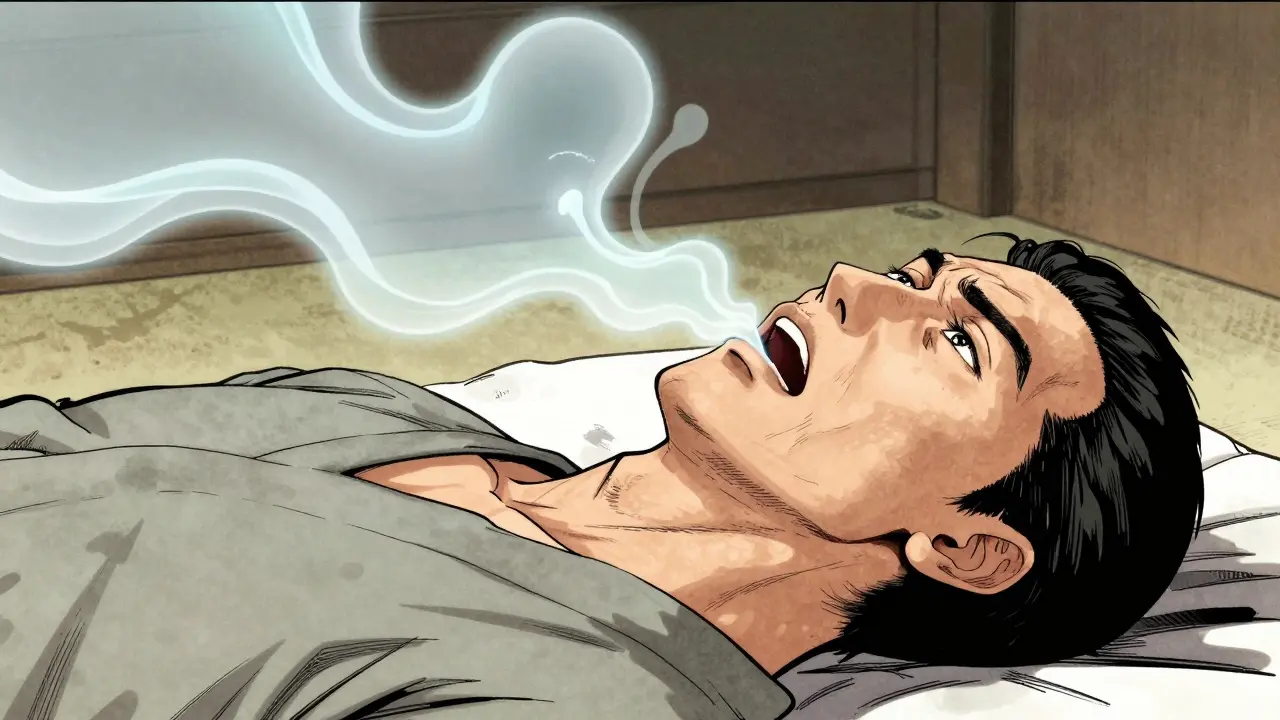
If you’ve ever woken up gasping for air, or your partner says you snore like a chainsaw, your sleep position might be the culprit-not just bad habits or weight. For many people with obstructive sleep apnea (OSA), the difference between a restful night and a fragmented one comes down to whether they sleep on their back or their side. This isn’t just about comfort. It’s about physics, anatomy, and how gravity works against your airway when you lie flat on your back.
Why Sleeping on Your Back Makes Apnea Worse
When you sleep on your back (supine position), gravity pulls your tongue, soft palate, and throat muscles backward. This isn’t a slight shift-it’s a significant narrowing. Studies show the upper airway space can shrink by 30-40% compared to side sleeping. That’s enough to turn a mild obstruction into a complete blockage. For someone with OSA, this means breathing interruptions can jump from 5 per hour to 30 or more. Oxygen levels drop. Heart rate spikes. You don’t remember waking up, but your body does. And that’s why your daytime fatigue doesn’t go away, no matter how long you think you slept.Doctors call this positional obstructive sleep apnea (POSA). It’s diagnosed when your apnea-hypopnea index (AHI)-the number of breathing pauses per hour-is at least double when you’re on your back versus on your side. About half to two-thirds of people with OSA have this pattern. That’s not a coincidence. It’s a clear signal that changing your sleep position could dramatically improve your symptoms.
Why Side Sleeping Helps
Sleeping on your side keeps your airway open. Without gravity pulling your tongue and throat tissues backward, the passage stays wider. Snoring drops. Breathing becomes smoother. Oxygen stays steady. In fact, research from the Sleep Foundation shows side sleeping can reduce apnea events enough to move someone from severe to mild-or even normal-levels. It’s not a cure, but for many, it’s the most effective first step.Side sleeping also helps with heart strain. The supine position increases pressure on the heart and lungs, which can worsen conditions like heart failure. For people with OSA, that extra strain during sleep adds up over time. Switching to side sleeping doesn’t just improve sleep-it may lower long-term cardiovascular risk.
Positional Therapy: What It Is and How It Works
Positional therapy isn’t a new idea. It’s been used for decades. But today, it’s more precise, more comfortable, and more effective than ever. The goal? Train your body to avoid sleeping on your back. There are two main approaches: simple, low-tech methods and advanced, tech-driven devices.One of the oldest tricks is the tennis ball technique. Sew a tennis ball into the back of your pajama top. If you roll onto your back, it hurts-enough to make you shift. It’s cheap, easy, and surprisingly effective for some. But it’s not perfect. About 45% of people who try it quit within three months because it disrupts sleep. You wake up sore. You toss and turn. The discomfort becomes its own problem.
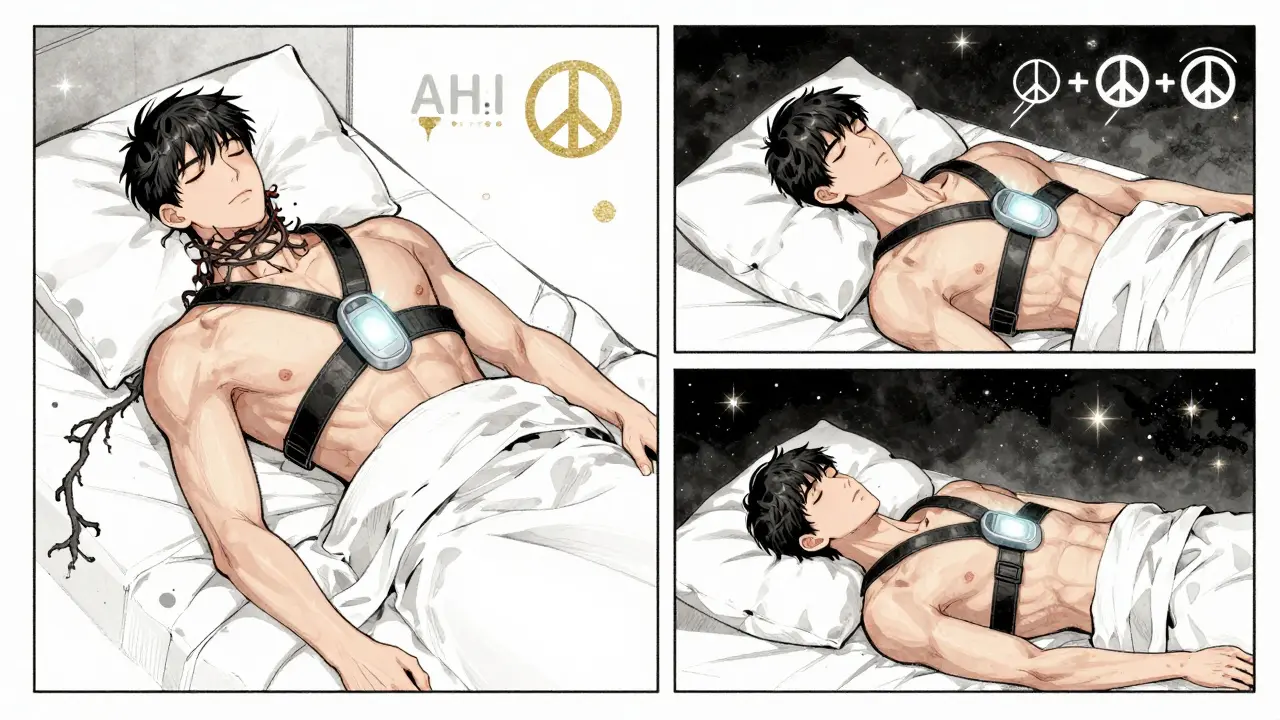
More advanced tools like the Sleep Position Trainer (SPT) use gentle vibration instead of pain. Worn like a chest strap, it detects when you roll onto your back and gives a soft pulse to nudge you back to your side. You don’t fully wake up. You just adjust. A 2015 study in the Journal of Clinical Sleep Medicine found that 68% of SPT users achieved treatment success (AHI under 5), compared to just 42.9% using the tennis ball method. Better yet, users reported higher satisfaction and better quality of life scores.
Other devices like Smart Nora and NightBalance work similarly. They’re not meant to replace CPAP, but they’re designed for people who struggle with it. And that’s the key.

Positional Therapy vs. CPAP: The Real Trade-Off
CPAP is still the gold standard. It works. It reduces AHI more than any other treatment. But here’s the catch: only about half of people stick with it long-term. Why? The mask is uncomfortable. The air pressure feels unnatural. It’s noisy. You can’t travel with it easily.Positional therapy doesn’t solve every case. But for those with clear positional OSA, it’s often more sustainable. Studies show adherence rates for positional therapy are 35-40% higher than for CPAP. That’s huge. Because if you don’t use it consistently, it doesn’t matter how good it is on paper.
Experts agree: if your apnea is worse when you’re on your back, positional therapy should be the first option. The American Academy of Sleep Medicine recommends it for mild to moderate cases where supine AHI is at least twice the side AHI. It’s not a second choice-it’s the right first choice for the right person.
Who Should Try It-and Who Shouldn’t
Not everyone with sleep apnea will benefit. If your AHI is high no matter what position you’re in, positional therapy won’t help. That’s why a proper sleep study is critical. It’s not enough to say, “I snore when I’m on my back.” You need data. The study must break down your AHI by position. Otherwise, you might miss the real problem.Also, if you have central sleep apnea (CSA)-where your brain doesn’t send the right signals to breathe-positioning helps less. Side sleeping might reduce snoring, but it won’t fix the neurological disconnect. That needs different treatment.
And if you’re severely overweight, positional therapy alone won’t cut it. Weight loss is still the most powerful long-term solution. But even then, combining side sleeping with weight loss can speed up results.
Getting Started: What to Try First
If you suspect your sleep position is making your apnea worse, start simple:- Try sleeping with a body pillow or a wedge pillow to keep you on your side.
- Use the tennis ball trick for a week. See if you notice less snoring or fewer awakenings.
- Track your symptoms with a sleep app or journal. Note how you feel in the morning.
If you’re still struggling, talk to your sleep specialist. Ask for a positional analysis during your next sleep study. If you qualify, consider a wearable SPT. They cost between $300-$500, but many insurance plans cover them if you have a diagnosis of positional OSA.
And don’t forget: elevate your head slightly. Even a 30-degree angle can help keep your airway open. Combine side sleeping with a slight incline, and you’re stacking the odds in your favor.
The Bigger Picture
Sleep apnea isn’t just about snoring. It’s about oxygen, heart health, brain function, and long-term survival. Positional therapy doesn’t fix everything, but for millions of people, it’s the missing piece. It’s non-invasive, low-risk, and doesn’t require daily maintenance like a mask or machine. It’s about working with your body, not against it.And here’s the truth: if you’ve tried CPAP and quit, you’re not alone. But you’re also not out of options. Positional therapy might be the bridge you need-until you’re ready for more, or until it’s enough on its own.
14 Comments
I tried the tennis ball trick for two weeks and it was a disaster. I woke up with a bruise on my back and still rolled onto my back like a damn log. Then I got the Sleep Position Trainer and it’s been life-changing. No more gasping. No more 3 a.m. panic attacks. I actually feel human now.
OMG YES!! 😭 I had no idea my constant exhaustion was from sleeping on my back!! I started using a body pillow last month and my husband says I haven’t snored once since!! I’m crying happy tears!! 🥹💤✨
so you’re telling me gravity is the enemy of my sleep? like… wow. i guess i should’ve paid attention in high school physics instead of texting my ex. still cheaper than cpap tho. #gravitywins
The data presented here is compelling. AHI reduction through positional change is statistically significant in multiple peer-reviewed studies. I would recommend that individuals with suspected positional OSA undergo a split-night polysomnography to confirm lateral dominance before investing in devices.
People spend thousands on gadgets when all they need is to stop being lazy. Sleep on your side. Done. No tech. No excuses. Your body isn’t broken. You just refuse to change.
In India we’ve been sleeping on sides for centuries - no machines, no balls, just a pillow between the legs. Our grandparents didn’t need fancy gadgets. Maybe the West overcomplicates everything. Simple = better.
I JUST FOUND OUT I HAVE POSITIONAL OSA AND I’M SO RELIEVED!!! I thought I was just a bad sleeper!! I’ve been exhausted for YEARS!! I bought a wedge pillow and slept on my side last night and I didn’t wake up once!! I’m literally dancing around my room!! 🕺💃
This is the kind of info that changes lives. No meds. No masks. Just a smarter way to lie down. I used to hate bedtime. Now? I look forward to it. Side sleeping + slight incline = my new holy trinity. If you’re reading this and you’re tired - try this. It’s free. It’s easy. It works.
I’ve been using the SPT for 8 months now. It’s not perfect - sometimes it buzzes when I’m already on my side - but the improvement in my sleep quality is undeniable. I went from 22 AHI to 3.5. I’m not saying it’s magic, but it’s science. And science works.
It is of considerable interest to note that the biomechanical principles underlying positional sleep apnea have been well documented since the 1980s. The resurgence of interest in non-device-based interventions reflects a broader paradigm shift in sleep medicine toward patient-centered, low-intervention modalities.
I’m not gonna lie. I read half of this. Then I got distracted. But I did see the part about tennis balls. I tried it. Didn’t work. I’m getting a CPAP. Done.
CPAP is for people who can’t be bothered to turn over. I sleep on my side. I don’t snore. I don’t have a mask. I don’t need your gadgets. You’re all overthinking this.
I used to think I was just tired because I worked too hard. Turns out, I was suffocating in my sleep. The tennis ball trick didn’t work. The SPT did. I’m sleeping 8 hours now. I’m not crying. I’m not celebrating. I’m just… rested.
I went from ‘I’m gonna die before 40’ to ‘I might actually live to see my dog retire.’ Side sleeping + wedge pillow = my new love story. My mattress doesn’t even miss me anymore. I’m a changed man. No, really. I even started doing laundry. 🤯
Write a comment