
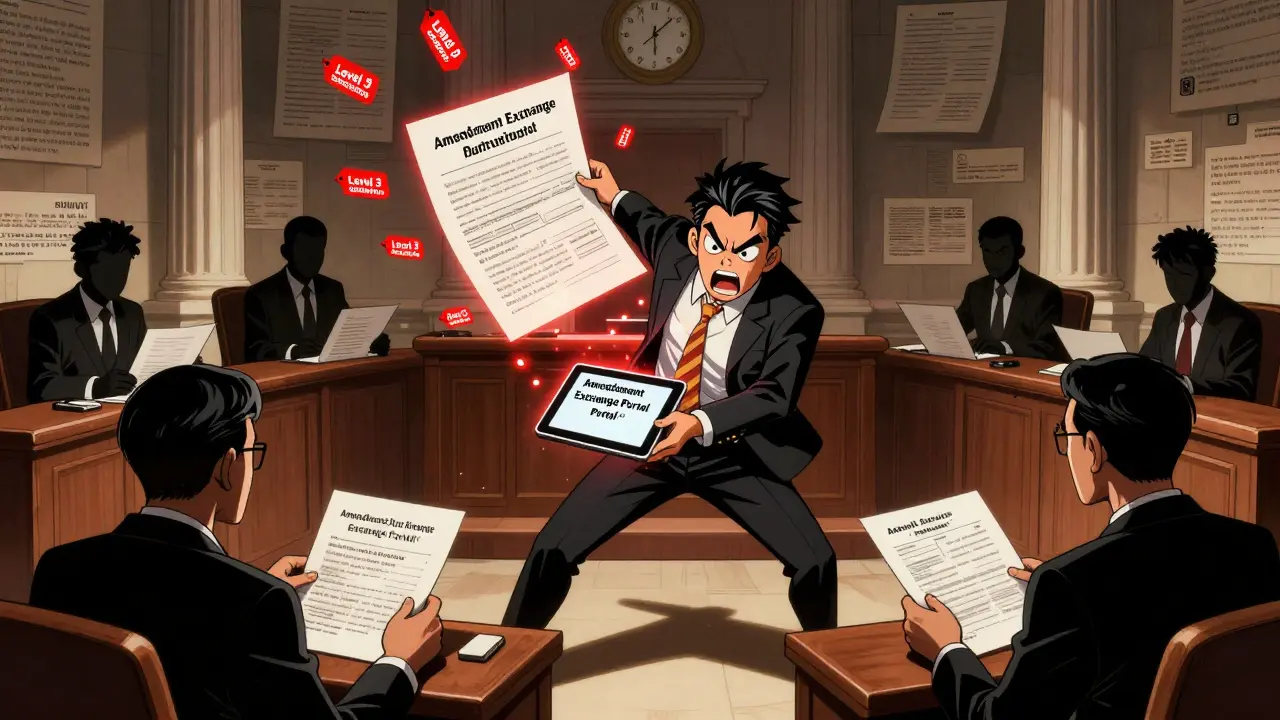
The way Congress handles amendments has changed dramatically since 2023. If you’ve ever wondered why some bills seem to move faster through the House while others get stuck in procedural limbo, the answer lies in the overhaul of substitution rules. These aren’t just technical tweaks-they’ve reshaped how laws are made, who gets to shape them, and how quickly Congress can respond to crises.
What Exactly Is Amendment Substitution?
Amendment substitution is when a lawmaker replaces an existing proposed change to a bill with a new version. Think of it like editing a document: instead of adding a comment or inserting a new paragraph, you delete the whole section and paste in a completely rewritten one. Before 2023, any member could do this on the floor with little notice. Now, it’s a tightly controlled process.
The shift started with H.Res. 5, adopted on January 3, 2025, which set the new standing rules for the 119th Congress. This wasn’t a minor update-it was a full system reboot. The old system let members swap amendment text freely, sometimes right before a vote. That led to chaos: last-minute changes, surprise policy shifts, and delays that dragged out debates for hours. The new system was designed to fix that.
The New Rules: How Substitution Works Today
Under the current rules, any substitution must be filed at least 24 hours before a committee meeting. It can’t be done verbally or on the fly. Everything goes through the Amendment Exchange Portal, an online system launched on January 15, 2025. You don’t just upload a new version-you must tag every line you’re replacing with exact line numbers from the original text. You also have to explain why you’re making the change and whether it counts as a "germane modification" under Rule XVI.
Once filed, the request goes to a new substitution review committee inside each standing committee. This group has five members: three from the majority party, two from the minority. They have just 12 hours to approve or reject the substitution. No extensions. No delays. If it’s not approved in that window, it’s dead.
Changes are now ranked by severity:
- Level 1: Minor wording edits-like fixing a typo or clarifying phrasing.
- Level 2: Procedural changes-adjusting timing, scope, or administrative details.
- Level 3: Substantive policy shifts-adding new funding, changing legal standards, or altering core intent.
Approval thresholds vary by level. Level 1 and 2 only need a simple majority. But Level 3? It now needs 75% approval from the review committee. That’s up from 50% under the old rules.
Impact on Speed and Efficiency
The results are clear: things are faster. In the first quarter of 2025, amendment processing time dropped by 37% compared to the same period in 2024. Bills passed committee markup 28% more often. That’s not a coincidence-it’s the direct result of cutting down endless floor debates.
The Senate still operates under looser rules. There, you only need 24 hours’ notice and no committee review. That means substitution in the Senate is 43% faster than in the House. But that speed comes with trade-offs. The Senate still sees more "poison pill" amendments-changes designed to kill a bill rather than improve it.
The House system sacrifices some flexibility for control. It’s why, in May 2025, 67% of disaster relief amendments required special rule waivers. When emergencies hit, the 24-hour filing window became a bottleneck. Lawmakers couldn’t respond quickly enough.
Who Benefits? Who Gets Left Out?
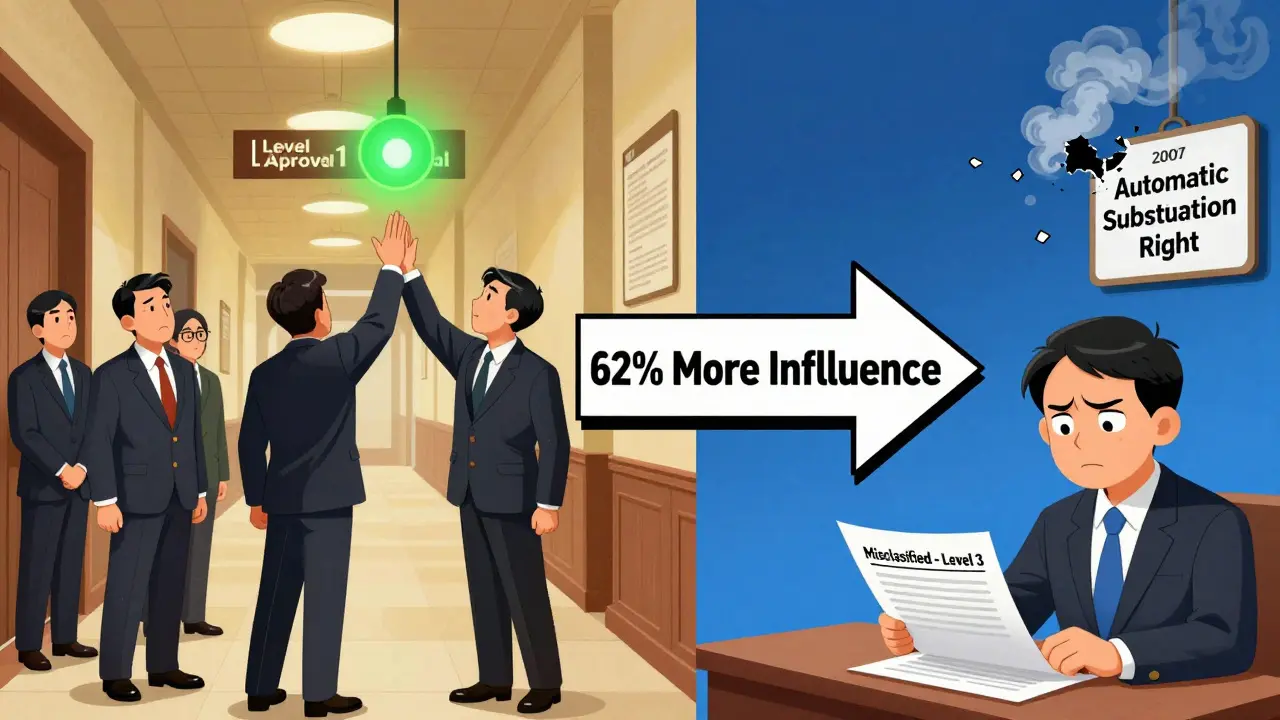
The majority party has gained enormous control. According to a Brookings Institution analysis in April 2025, the new rules give the majority party 62% more influence over substitutions than under the 117th Congress. The old "automatic substitution right"-which let any member swap text without approval-was scrapped. That right had existed since 2007.
Minority members say they’re being shut out. A Congressional Management Foundation survey of 127 committee staff found that 83% of minority staff called the system "restrictive of legitimate input." One Democratic lawmaker, Rep. Pramila Jayapal, had her substitution to H.R. 1526 rejected because the portal misclassified her edits as Level 3 instead of Level 2. She had to appeal, and the process took two extra days.
On the flip side, Republican members like Rep. Tony Gonzales say the system stopped "last-minute sabotage amendments." In the defense authorization markup, he says the new rules prevented surprise changes that would’ve derailed the bill.
There’s also a hidden cost: training. Committee staff report an average of 14 hours of training just to understand the new system. In January 2025, 43% of first-time filers submitted non-compliant requests. By May, that number dropped to 17% after House training sessions improved clarity.
Controversy and Legal Challenges
Not everyone sees this as progress. Critics argue the rules concentrate power in party leadership and weaken the minority’s voice. Sarah Binder of Brookings called it a "fundamental undermining" of democratic deliberation. The Constitutional Accountability Center even filed an amicus brief in May 2025, arguing the rules may violate the First Amendment by restricting how lawmakers can express their views.
Supporters counter that the old system was broken. Frances Lee of the American Enterprise Institute found that 78% of committee chairs felt markups were more productive. The Wall Street Journal called the changes a needed correction to a "free-for-all." The Atlantic, however, labeled them a "dangerous erosion of democratic deliberation."
Legal scholars are watching closely. The Brennan Center warns the rules could trigger a constitutional challenge based on the Presentment Clause. If a bill passes with substitutions that weren’t properly reviewed, could it be invalidated? That’s a question courts may have to answer.

What’s Next? The Future of Substitution
Changes are still unfolding. In June 2025, H.R. 4492-the Substitution Transparency Act-was introduced. It would force the review committees to publish their deliberations within 72 hours. Right now, those discussions are private. Transparency advocates say this is essential for accountability.
Meanwhile, the Senate is quietly considering its own rules overhaul. A July 2025 GOP draft bill tried to standardize substitution across both chambers, but the parliamentarian ruled key parts violated the Byrd Rule, which blocks policy changes in budget bills.
By 2026, the Congressional Budget Office projects amendment consideration time will drop from 22 minutes to 14 minutes per amendment. That’s a win for efficiency-but at what cost? Lobbying firms have already shifted strategies. In early 2025, 63% restructured their teams to focus on committee staff instead of floor votes. Money is flowing to influence the review committees, not the full chamber.
State legislatures are following suit. The National Conference of State Legislatures reports that 78% of states implemented similar substitution restrictions between 2023 and 2025. This isn’t just a federal trend-it’s a nationwide shift toward centralized control.
What This Means for You
If you’re not a lawmaker, why does this matter? Because these rules determine what laws get made-and what gets blocked. A single substitution can turn a modest bill into a sweeping policy change. Or kill it entirely.
These changes affect everything from healthcare funding to environmental regulations. When substitution becomes harder to challenge, public input becomes harder to influence. The system may be more efficient, but it’s also less open.
As we move into 2026, the big question isn’t whether the rules will stay-they likely will. It’s whether the public will demand more transparency, or accept this as the new normal.
What is amendment substitution in Congress?
Amendment substitution is the process where a legislator replaces an existing proposed change to a bill with a new version. Before 2025, this could be done with little notice. Now, it requires electronic filing 24 hours in advance, detailed metadata, and approval from a committee review panel. The goal is to reduce last-minute changes and increase legislative efficiency.
How did the 2025 rules change the substitution process?
The 2025 rules eliminated the automatic right to substitute amendments. Now, all substitutions must be filed through the Amendment Exchange Portal, include line-by-line metadata, and be reviewed by a committee of five members (3 majority, 2 minority). Approval thresholds increased, especially for Level 3 changes, which now require 75% committee approval. Processing time dropped by 37% in early 2025.
What are Level 1, Level 2, and Level 3 substitutions?
Level 1 substitutions are minor wording fixes, like correcting grammar. Level 2 are procedural changes, such as adjusting deadlines or scope. Level 3 are substantive policy changes-like adding funding, altering legal standards, or changing the bill’s core purpose. Level 3 changes require 75% committee approval, while Levels 1 and 2 need only a simple majority.
Why is the Senate’s substitution process different?
The Senate still allows substitution with only a 24-hour notice and no committee review. This makes the Senate’s process 43% faster than the House’s. But it also means more unpredictable changes. The House system prioritizes control and predictability, while the Senate values flexibility-even at the cost of potential disruption.
Are there legal challenges to the new substitution rules?
Yes. The Constitutional Accountability Center filed an amicus brief in May 2025 arguing the rules may violate the First Amendment by restricting how lawmakers can amend legislation. Legal experts also warn that if a bill passes with improperly reviewed substitutions, it could face challenges under the Constitution’s Presentment Clause. These issues may end up in court.
How have lobbying strategies changed because of these rules?
In early 2025, 63% of major lobbying firms restructured their teams to focus on committee staff instead of floor votes. Since substitutions are now decided behind closed doors by small review panels, lobbyists shifted resources to influence those panels directly. Spending on committee-specific lobbying rose 29% in the first half of 2025.
Will these rules last beyond 2026?
The rules are likely to remain unless there’s a major political shift. The House Rules Committee has already refined them once, in July 2025, after criticism over inconsistent Level 3 classifications. The Heritage Foundation predicts they’ll become permanent, while the Brennan Center warns they could trigger a backlash after the 2026 elections, especially if public pressure grows over transparency.

13 Comments
Honestly? This whole system feels like Congress decided to turn lawmaking into a corporate compliance checklist. I get the need for order, but now it’s like you need a PhD in parliamentary procedure just to propose changing a comma. And don’t even get me started on the ‘Level 3’ nonsense-someone’s gonna get buried under a typo that gets misclassified as a policy shift. 🤦♂️
This is what happens when you let bureaucrats think they’re smarter than democracy. You think this is efficiency? It’s control. The majority party is now the sole gatekeeper of what gets seen, heard, or passed. They’re not fixing the system-they’re weaponizing it. And don’t tell me about ‘last-minute sabotage’-that’s just code for ‘we don’t want you to have a voice.’
Fascinating. The substitution protocol now operates under a tripartite classification schema (L1-L3) with tiered quorum thresholds-essentially a parliamentary meritocracy. The 75% threshold for L3 amendments is a classic supermajoritarian maneuver, designed to entrench majority control while maintaining the illusion of bipartisanship. Also, the Amendment Exchange Portal? More like a Kafkaesque bureaucratic black hole. 😅
I’ve been watching this evolve, and honestly? It’s not perfect, but it’s better than the free-for-all we had before. I’ve seen bills get gutted by surprise amendments that no one saw coming. Now at least there’s a paper trail. Yeah, it’s slower for some, but it’s fairer. And the training? Worth it. We’re not kids anymore-legislation needs structure.
So let me get this straight: you spent $2 million building a portal so lawmakers can’t change a word without a committee vote… but the Senate still lets them do whatever they want? Classic. House: ‘We’re serious about process.’ Senate: ‘Hold my beer.’
This is not reform. This is surrender. The Founders never intended for the legislative process to be a corporate compliance audit. The Constitution does not require a 24-hour notice for amendments-it requires debate. This system is a betrayal of republican principles. We are no longer a nation of laws-we are a nation of forms, procedures, and party discipline. And that is not freedom.
The Level 1/2/3 taxonomy is actually quite elegant. L1: syntactic; L2: procedural; L3: substantive. The 75% threshold for L3 aligns with the constitutional standard for overriding vetoes, which makes sense-major policy shifts should require broad consensus. The real issue is implementation: 17% error rate by May is impressive improvement from 43%. The portal’s metadata schema is surprisingly robust.
I work with state legislatures, and I’ve seen this exact model roll out in 78% of them. It’s not just federal-it’s a whole shift in how government works. People think it’s about control, but honestly? It’s about survival. We’re drowning in bad bills because of last-minute chaos. This isn’t perfect, but it’s the best we’ve got. And yes, the training sucks-but it’s better than watching a bill die because someone misspelled ‘environmental’.
You think this is about efficiency? Wake up. The real reason they did this is so lobbyists can slip amendments through committee meetings without anyone noticing. 63% of firms shifted focus to committee staff? That’s not transparency-that’s corruption with a spreadsheet. And the ‘Amendment Exchange Portal’? Probably run by a contractor who got paid $8 million to build a glorified Google Form. #DeepStateTech
Look, I get the frustration. But if you’ve ever sat through a 12-hour markup where someone tries to add a clause about space lasers to a farm bill, you’ll understand why this had to happen. It’s not perfect, but it’s cleaner. And the fact that minor changes are still easy? That’s the win. We don’t need to kill every bill because someone typed ‘and’ instead of ‘or.’ Let’s celebrate the small fixes.
You Americans think this is innovation? This is just centralized control dressed up as ‘modernization.’ In Nigeria, we have a 10-minute window to propose amendments-no portal, no committee, no metadata. We don’t need your bureaucracy to make laws. We need democracy. You’ve turned deliberation into a corporate audit. This isn’t progress-it’s colonialism with PowerPoint slides.
I just read through all this. Honestly? I’m tired. I don’t know who to believe anymore. Everyone’s right, and everyone’s wrong. I just wish we could talk about the people who get hurt when bills get stuck-not just the politics.
Let me tell you what’s really going on here. This isn’t about efficiency. This is about power. The majority party doesn’t want you to know this, but the substitution review committee? It’s not even real. The five members? They’re handpicked by leadership. The 12-hour window? It’s a joke-most of them meet in private Zoom rooms before the clock even starts. The portal? It’s a theater. The votes are already decided. They just make you think you have a voice. And the worst part? They’re proud of it. They call it ‘order.’ I call it a coup. And it’s happening right under your nose. You think this is about bills? It’s about who gets to decide what matters. And you? You’re not even on the list.
Write a comment