
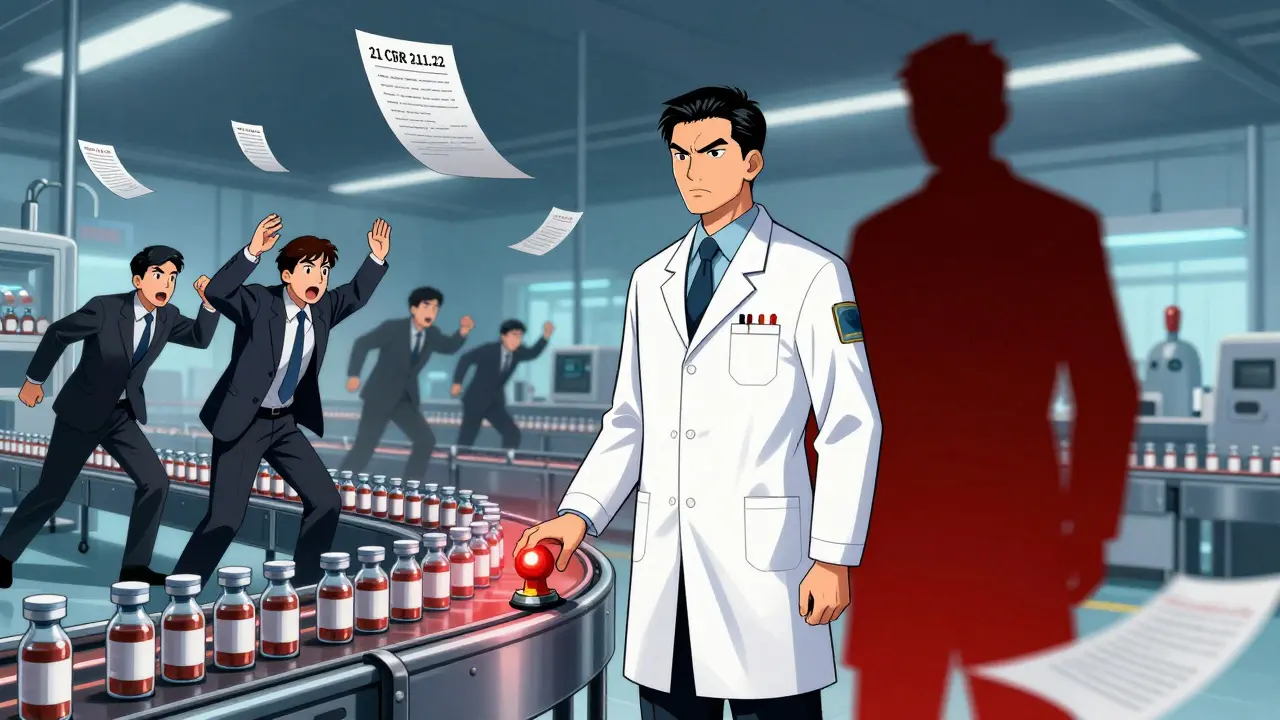
When a batch of medicine is released to the public, no one should be deciding its safety based on how fast the line is running or how much money the plant is trying to save. That’s the whole point of a quality assurance unit - it exists to say no, even when it’s inconvenient. And it has to be independent to do that job right.
What a Quality Assurance Unit Actually Does
A quality assurance unit (QU) isn’t just another department that checks paperwork. It’s the final gatekeeper. In pharmaceutical manufacturing, the QU has legal authority to approve or reject every component, every container, every label, and every finished product. This isn’t advice. This is power. Under 21 CFR 211.22, the QU must have the final say. No exceptions.They don’t just look at the end product. They review every step: how raw materials are stored, whether equipment was cleaned properly, if environmental controls stayed within limits, if the batch records match what actually happened on the floor. If something doesn’t add up, they can - and must - stop the line. That’s not a suggestion. It’s the law.
In nuclear facilities, the same principle applies. Independent oversight isn’t optional. It’s the difference between a controlled shutdown and a disaster. The International Atomic Energy Agency (IAEA) made this clear after Three Mile Island. If the people checking safety are also the ones running the plant, conflicts become inevitable.
Why Independence Isn’t Just a Good Idea - It’s the Law
Many companies try to cut corners by putting the quality unit under the production manager. It seems logical: if the same person controls both output and quality, they’ll be more efficient. But that’s exactly the problem. When your bonus depends on hitting production targets, do you really want that same person deciding whether a batch is safe?The FDA laid this out clearly in 2006: quality decisions must be objective. Not influenced by production pressure. Not swayed by deadlines. Not compromised by budget cuts. And they’ve been enforcing it ever since. In 2024, 68% of FDA warning letters cited failures in QU independence - up from just 29% in 2020. That’s not a coincidence. It’s a crackdown.
One company in Ohio tried merging their QA and production roles during a staffing shortage. Within three months, two critical deviations slipped through. The batches were released. The FDA found out. The plant got shut down for six weeks. The cost? Over $2 million in lost production and fines. The real cost? Patient trust.
Regulators don’t care if you’re busy. They don’t care if you’re small. If your quality unit reports to someone who’s responsible for meeting output targets, you’re in violation. Period. The FDA’s message is blunt: independence isn’t a best practice. It’s a requirement.
How Independence Actually Works in Practice
Independent doesn’t mean isolated. It means reporting up, not sideways.Effective QUs report directly to the CEO, the board, or a senior executive outside the production chain. At Merck, the quality unit head sits in the same weekly leadership meeting as the plant manager - but they don’t report to him. They report to the Chief Quality Officer, who reports to the CEO. That’s how you keep pressure out.
They also need direct access to escalate issues without going through production management. If a line operator spots a contamination risk, they should be able to alert the QU without asking permission from their supervisor. In 92% of facilities with zero FDA 483 observations, this path was documented and protected.
The QU doesn’t need to be huge. ISPE benchmarks show that 8-12% of manufacturing staff should be in quality roles. But every one of them needs training in GMP, statistical process control, and conflict resolution. The average QU employee has over eight years of industry experience. They’re not entry-level. They’re experts.
Documentation matters. If you can’t show an org chart proving the QU’s independence, you’re already in trouble. In 95% of warning letters, the FDA cited missing or unclear reporting lines. No one’s guessing anymore. If it’s not written down, it doesn’t exist.

What Happens When Independence Fails
The consequences aren’t theoretical. They’re real, costly, and sometimes deadly.A 2023 FDA analysis found that 63% of data integrity violations in pharma manufacturing came from facilities where quality and production were too closely tied. That means falsified records, skipped tests, hidden deviations - all because someone was afraid to say no.
Smaller companies are hit hardest. FDA data shows 42% of warning letters to facilities under 50 employees involve QU independence failures. Why? Because they can’t afford a separate team. But here’s the truth: you can’t afford not to have one.
That’s why third-party oversight services are growing at 14.2% annually. A small pharma startup in Toronto now uses a contracted QU from a licensed provider. They pay less than hiring full-time staff, and they get an objective, audit-ready team. No internal politics. No pressure. Just compliance.
Even in nuclear plants, where oversight is even stricter, the solution is the same: separation. The IAEA requires four layers of oversight - including independent review by people who don’t operate the equipment. No one gets to be judge and jury.
Real-World Examples: Success vs. Failure
Eli Lilly’s 2024 quality culture program didn’t merge teams. Instead, they trained production staff as “quality ambassadors.” These were line workers who learned QU protocols, could flag issues early, and acted as liaisons - but they didn’t make release decisions. The result? A 40% improvement in quality culture scores. No one lost their job. No one got fired. But quality went up.Compare that to a mid-sized generic drugmaker in India. In 2023, their production manager also signed off on batch releases. They were cutting corners to meet export deadlines. The FDA found 17 batches with missing stability data. All were shipped. The company lost its export license. Their biggest customer dropped them. They’re still trying to rebuild.
It’s not about being punitive. It’s about being smart. When the QU has real authority, deviations get caught before they become recalls. FDA data shows independent QUs resolve critical issues 28% faster than integrated teams. That’s not just compliance. That’s cost savings.
The Future: Digital Manufacturing and AI
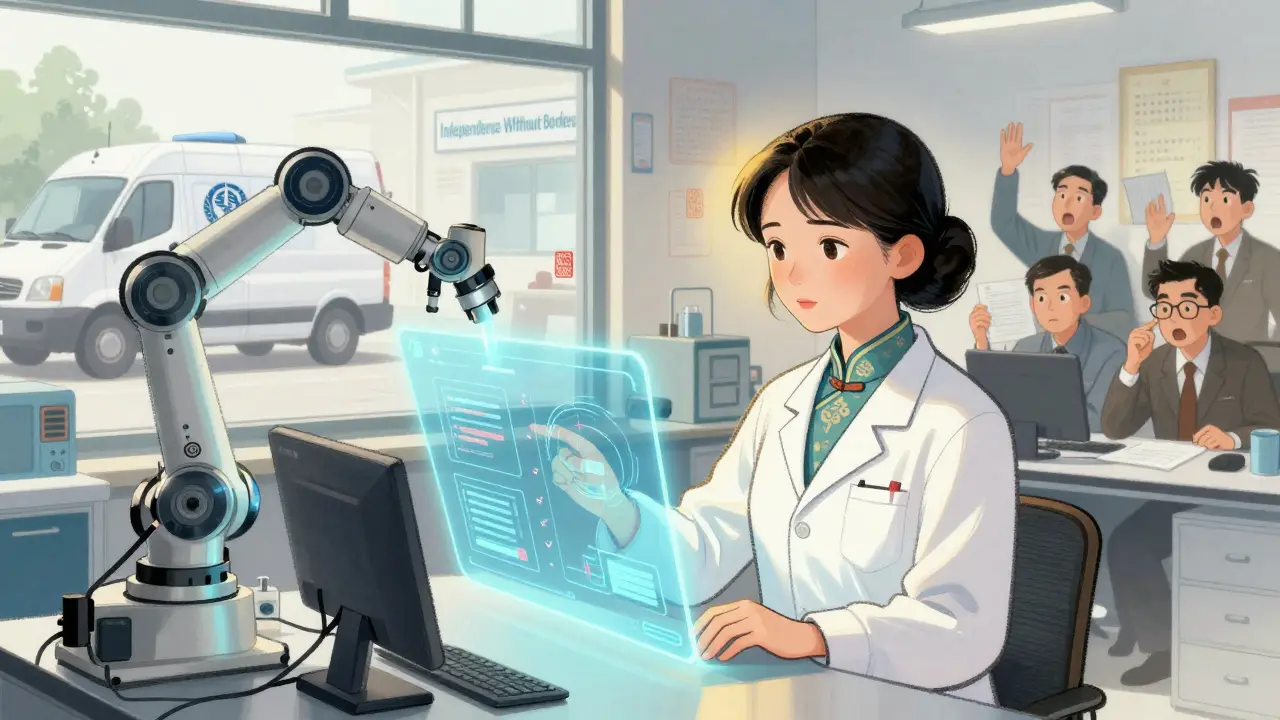
New tech is changing how quality is monitored. AI systems now analyze real-time sensor data to predict contamination risks. But here’s the catch: if the AI is trained by the production team, it learns to optimize for speed - not safety.The FDA’s January 2025 draft guidance on digital manufacturing makes this clear: algorithmic decisions must still be overseen by an independent human. Even if the system flags a problem, the QU must validate it. No automation can replace the judgment of an independent reviewer.
Europe’s 2024 revision of EudraLex goes even further: quality units must never be organizationally subordinate to production - under any circumstances. That’s the standard now. Not a suggestion. A rule.
The future won’t eliminate independence. It will make it more critical. As manufacturing gets faster and more complex, you need a clear, unshakable voice saying: stop. And that voice can’t be the same one telling you to go faster.
What You Need to Do Today
If you’re in manufacturing - especially pharma - here’s your checklist:- Is your QU reporting to someone who’s responsible for production output? If yes, fix it.
- Can your QU halt production without approval from manufacturing leadership? If not, you’re not compliant.
- Is there a documented org chart showing the QU’s direct line to executive leadership? If not, create one.
- Do your QU staff have the authority to reject batches - and the training to back it up? If not, invest in them.
- Are you using third-party oversight because you’re too small to hire full-time? That’s smart - not a weakness.
You don’t need to be perfect. But you need to be independent. The regulators aren’t asking for more paperwork. They’re asking for courage. The courage to say no - even when it costs you.
Can a quality assurance unit report to the production manager?
No. Regulatory agencies like the FDA and EMA require that the quality assurance unit operate independently of production. If the QU reports to the production manager, it creates a conflict of interest where efficiency goals could override safety standards. This is a common violation and a top reason for FDA warning letters.
What authority does a quality assurance unit have?
A quality assurance unit has the legal authority to approve or reject all components, packaging, in-process materials, and finished products. They can halt production, reject batches, and require investigations into deviations. Their decisions are final and must not be overridden by production or management.
How big should a quality assurance unit be?
Industry benchmarks suggest the QU should make up 8-12% of the total manufacturing workforce. The exact size depends on facility complexity, but the key is having enough trained staff to review all critical processes without being overwhelmed. Facilities with fewer than 1 QU staff per 15 production workers often see repeat compliance issues.
What happens if a quality unit doesn’t have independence?
Without independence, quality decisions become subject to production pressure. This leads to skipped tests, falsified records, delayed investigations, and ultimately, unsafe products reaching patients. Regulatory agencies respond with warning letters, plant shutdowns, fines, and loss of market access. In 2024, 68% of FDA warning letters cited QU independence failures.
Can small manufacturers afford an independent quality unit?
Yes. Many small manufacturers use third-party quality oversight services. These providers offer trained, independent quality professionals on a contract basis. This is often more cost-effective than hiring full-time staff and ensures compliance without internal bias. The third-party quality market is growing at 14.2% annually as demand increases.

15 Comments
Finally someone gets it. I've seen plants where QA reports to production and it's a disaster waiting to happen. The FDA isn't messing around anymore. If your org chart doesn't show QA reporting to the CEO or CQO, you're already on the list.
My cousin works at a small pharma startup in Ohio. They hired a third-party QA team last year. Costs less than one full-time hire, and now they passed their audit with zero findings. Sometimes the smartest move is admitting you can't do it all in-house.
Let me be clear: if your QA unit can't say 'no' without HR breathing down their neck, you're not in compliance-you're in denial. The FDA doesn't care about your quarterly targets. They care about whether your pills will kill someone. And they're watching. Every. Single. Day.
They’re hiding something. Always. The FDA’s 68% stat? That’s just the tip. What about the ones they didn’t catch? The ones where the QA head got ‘promoted’ after saying no too many times? The ones where the plant manager’s brother-in-law runs the QA department? This isn’t about compliance-it’s about control.
So let me get this straight… we’re paying people to say no? And that’s the expensive part? 🤦♀️ I’d rather pay a QA person $120k than a lawsuit $120M. Also, who’s the genius who thought merging QA and production was a ‘streamlining’ move? 🙃
Who decided independence was the answer? Maybe the problem isn’t structure-it’s culture. What if we trained everyone to care? What if we made safety the *only* KPI? Why are we outsourcing morality to a department? Why not just… fix the system?
Third-party QA? 😎 I mean… if you're a startup trying to look legit, sure. But if you're actually scaling? You need internal muscle. Not some consultant who shows up once a quarter with a clipboard and a PowerPoint. Real QA lives on the floor. Real QA knows the machines. Real QA doesn’t need to be ‘independent’-they need to be respected.
Wait so you're telling me that if someone in production sees a contamination risk, they can't tell their boss first? That's insane. Who's gonna stop them from getting fired? Who's gonna protect the whistleblower? This system is designed to punish the people who care the most.
Look. I’ve been in this industry for 27 years. I’ve seen plants shut down. I’ve seen people go to jail. I’ve seen patients die because someone was afraid to say no. If you think this is about paperwork, you’re not just wrong-you’re dangerous. This isn’t a policy. It’s a moral imperative.
Let me just say-this is why I love this industry. People think QA is bureaucracy. It’s not. It’s the last line of defense. It’s the person who stays late to recheck a batch because the log didn’t match. It’s the one who signs the form that says ‘I know this is wrong, but I’m not signing off.’ That’s not a job. That’s a calling.
I used to work in a facility where QA reported to production. We had a batch of insulin that failed sterility testing. The production manager overruled it. Said it was a ‘one-off.’ Three weeks later, a patient had a severe reaction. We never found out why. But I’ll never forget the look on her mother’s face at the hearing. No one should have to live with that.
they say independence but what about the truth? the qa unit is just another tool for the rich to control the poor. the workers who see the problems are silenced. the qa people? they’re just cogs. the real power is still with the execs who care about profit. this whole thing is a show. a very expensive, very sad show.
My dad’s a retired QA manager. He used to say, ‘If you’re not getting heat from production, you’re not doing your job.’ He meant it. He got fired twice. But he never stopped checking the logs. I’m proud of him. I hope more people like him are still out there.
AI can predict contamination but can't say no. Human with backbone can. 😎👏 #QAOverAI
Just saw a small plant in Tennessee use a hybrid model-internal QA with external audit support. They saved 40% on overhead and passed every inspection. No one got fired. No one got scared. Just better checks. It’s not about size. It’s about clarity.
Write a comment