
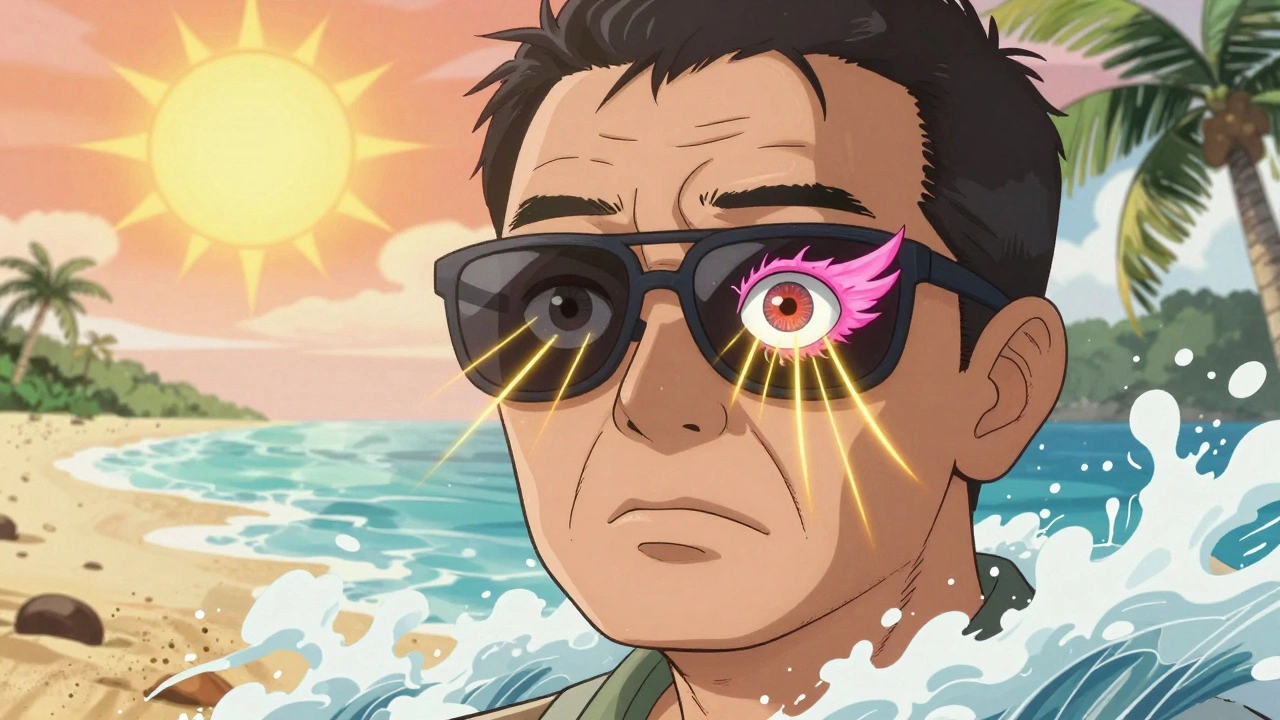
What Is Pterygium, and Why Does It Happen?
Pterygium is a noncancerous growth on the eye that starts on the white part (sclera) and creeps toward the cornea, often shaped like a small wing. It's commonly called "Surfer's Eye" because it's so frequent in people who spend a lot of time outdoors in sunny, windy, or sandy environments. This isn't just a cosmetic issue-it can blur your vision, make contact lenses uncomfortable, and cause constant irritation.
The growth is made of thickened, fleshy tissue with visible blood vessels. It usually begins on the side of the eye closest to your nose-about 95% of cases start there-and grows slowly, sometimes taking years to reach the center of your vision. In early stages, it might look like a small pink patch. In advanced cases, it can cover part of the cornea and distort your sight, causing astigmatism or making it hard to focus.
What causes it? The strongest link is ultraviolet (UV) light. People living within 30 degrees of the equator have more than double the risk. Studies show that if you’ve been exposed to over 15,000 joules of UV radiation per square meter-roughly the amount you’d get from 10 years of daily outdoor work without eye protection-you’re 78% more likely to develop pterygium. Wind, dust, and dryness make it worse by irritating the eye surface and speeding up tissue changes.
How Sun Exposure Makes It Grow
It’s not just about sunny beach days. UV damage builds up over time. Even on cloudy days, up to 80% of UV rays still reach your eyes. If you’re outside for hours-surfing, fishing, farming, or even commuting without sunglasses-you’re slowly accumulating damage. The conjunctiva, the thin membrane covering the white of your eye, responds to this constant stress by growing extra tissue. That’s the pterygium.
Research from the University of Melbourne found that outdoor workers in tropical areas have three times the risk compared to office workers. Australia has the highest rates-23% of adults over 40 have it. In the U.S., rates are lower but still significant in states like Florida, Texas, and Arizona. Men are more commonly affected than women, likely because they’re more likely to work outdoors and less likely to wear protective eyewear.
One big myth is that pterygium is caused by saltwater or sand. That’s not true. It’s UV light. That’s why someone who works on a construction site in Arizona might develop it just as easily as a surfer in Hawaii. The environment matters less than the amount of unprotected sun exposure over decades.
How Doctors Diagnose It
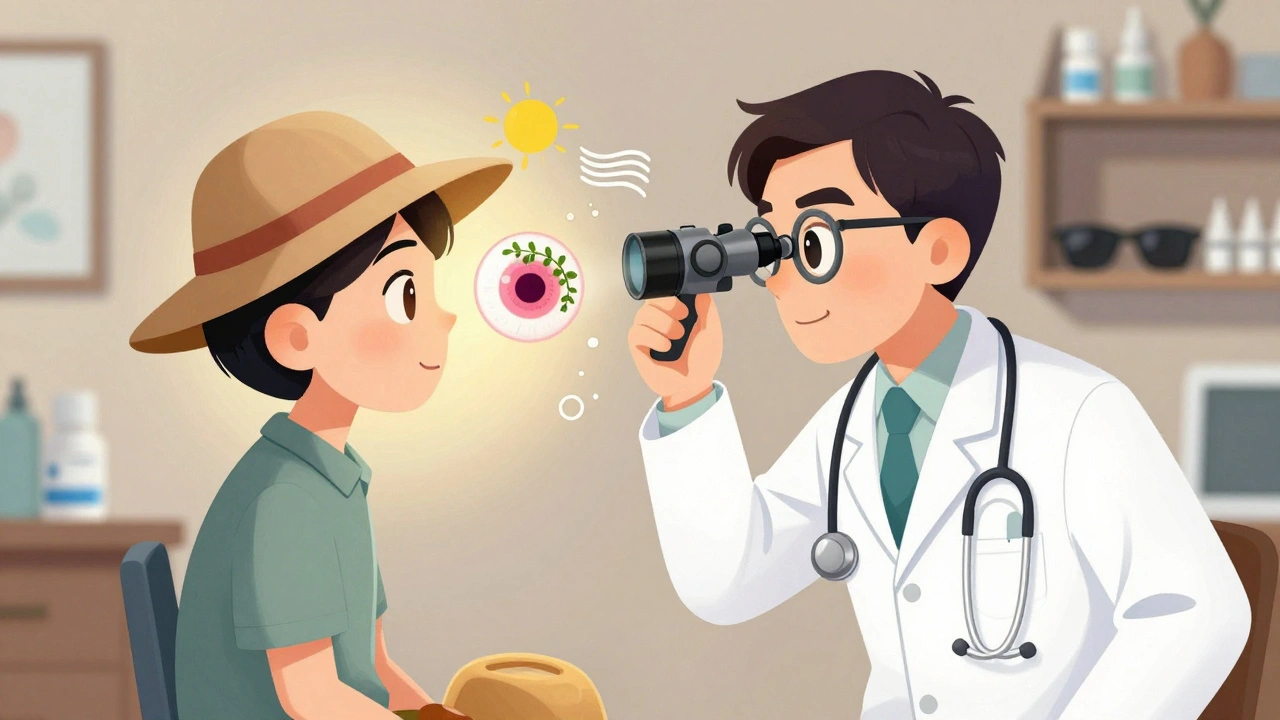
You don’t need blood tests or scans. A simple eye exam with a slit-lamp-where the doctor uses a bright light and magnification up to 40x-is all it takes. They’ll look for the classic triangular shape, the pinkish color, and whether the growth is crossing from the sclera onto the clear part of your eye (the cornea). If it’s just a yellowish bump on the white of the eye and not touching the cornea, it’s a pinguecula, not a pterygium. That’s an important difference: pinguecula stays on the conjunctiva, pterygium moves onto the cornea and can threaten vision.
Doctors track growth by measuring the width at the base. A new pterygium might be 1-2 millimeters wide. If it’s growing more than 0.5 mm per year, it’s considered active. Many people don’t notice it until it starts affecting vision or feels gritty, like sand is in the eye. That’s why regular eye check-ups are key, especially if you’re over 40 and spend time outdoors.
When Surgery Becomes Necessary
Most pterygia don’t need surgery. If it’s small, not growing, and not bothering you, your doctor might just recommend lubricating eye drops and UV protection. But if it’s:
- Blocking your vision
- Causing constant redness or irritation
- Making it impossible to wear contact lenses
- Changing the shape of your cornea and causing astigmatism
then surgery is the only way to fix it. The American Optometric Association says surgery is only recommended in "serious cases"-and for good reason. The biggest problem isn’t the surgery itself-it’s the chance it comes back.
Without extra treatments, pterygium returns in 30-40% of cases. That’s why modern techniques focus on preventing recurrence. The gold standard now is conjunctival autograft: the surgeon removes the pterygium and replaces it with a small piece of healthy conjunctiva taken from another part of your eye (usually under your upper eyelid). This reduces recurrence to about 8.7%.
Surgical Options and What Works Best
There are three main surgical approaches:
- Conjunctival autograft - The most effective. Uses your own tissue to cover the area. Recurrence rate: 8.7%. Recovery: 2-4 weeks.
- Amniotic membrane transplant - Uses donated tissue from the placenta. Newer, less invasive. Success rate: 92% in preventing regrowth, according to European guidelines from June 2023. Best for recurrent cases.
- Excision with mitomycin C - The surgeon removes the growth and applies a mild chemotherapy drug (mitomycin C) to kill leftover cells. Recurrence drops from 40% to 5-10%. But it carries a small risk of corneal thinning or delayed healing.
Most surgeons now combine techniques. For example, they might do an autograft and add mitomycin C for high-risk patients. The procedure takes about 30-45 minutes, is done under local anesthesia, and you go home the same day.
Post-op care is critical. You’ll need steroid eye drops for 4-6 weeks to reduce inflammation. Many patients say the drops are harder to stick with than the surgery itself. One patient on RealSelf.com said, "The surgery took 35 minutes, but the steroid drops regimen for 6 weeks was more challenging than expected."
Recovery and What to Expect
After surgery, your eye will be red, watery, and sensitive to light for the first week. It might feel like you have something stuck in it. That’s normal. Most people return to desk work in 3-5 days, but avoid swimming, dusty areas, and direct sun for at least 4 weeks.
Full healing takes 2-3 months. During that time, your eye may still look a little pink or uneven. That fades. About 78% of patients report quick recovery, and 65% notice immediate vision improvement. But 42% say discomfort lasts 2-3 weeks, and 37% are bothered by the redness during healing. Cosmetic concerns are real-some people feel self-conscious until the redness fades.
Follow-up visits are non-negotiable. Your doctor will check for signs of regrowth. If you stop using your drops too early or go out in the sun without sunglasses, you’re putting yourself at risk.
How to Prevent It (And Stop It From Coming Back)
Prevention is easier than surgery. If you’ve had it removed, UV protection isn’t optional-it’s essential. Here’s what works:
- Wear sunglasses labeled UV400 or that block 99-100% of UVA and UVB rays. ANSI Z80.3-2020 is the standard to look for.
- Choose wraparound styles-they block side exposure.
- Wear a wide-brimmed hat (at least 3 inches) every day you’re outside.
- Don’t wait for a sunny day. UV damage happens even when it’s cloudy.
- Use lubricating eye drops if your eyes feel dry, especially in windy or air-conditioned environments.
One Reddit user, "OutdoorPhotog," shared that after starting daily UV-blocking sunglasses, their pterygium stopped growing for two years straight. That’s the power of prevention.
For people who already have it, protecting your eyes won’t shrink the growth-but it can stop it from getting worse. That’s worth doing, even if you’re not planning surgery.

What’s New in Treatment
There’s exciting progress beyond surgery. In March 2023, the FDA approved OcuGel Plus, a preservative-free lubricant designed specifically for post-surgery patients. In trials, it gave 32% more relief than standard eye drops.
Researchers are also testing topical rapamycin, a drug that blocks cell growth. Early trials show a 67% drop in recurrence at 12 months compared to placebo. It’s still in Phase II, but if approved, it could become a daily drop to prevent regrowth-no surgery needed.
Laser-assisted removal is on the horizon too. By 2027, 78% of eye surgeons expect to use lasers to remove pterygium with more precision and less tissue damage. This could mean faster healing and lower recurrence.
Who’s at Risk and Where to Get Help
If you’re over 40, live near the equator, work outside, or surf, fish, or ski regularly without eye protection-you’re at risk. Men are more likely to develop it than women. Rural communities in developing countries often lack access to treatment: only 12% have surgical options, compared to 89% in urban areas of developed nations.
Start with your eye doctor. If you notice a pinkish growth on your eye, get it checked. Don’t wait until it blurs your vision. The earlier you catch it, the more options you have.
For support, check out the Pterygium Support Network on Facebook (over 5,200 members) or the American Optometric Association’s patient education site, which has 12 free videos on prevention and care.
When to See a Doctor
See an eye specialist if you notice:
- A pink or fleshy growth on the white of your eye
- Blurred or distorted vision
- Chronic redness or a gritty feeling
- Difficulty wearing contact lenses
- Any change in the size or shape of an existing growth
Even if it doesn’t hurt, it can still be growing. A yearly eye exam is the best way to catch it early.

9 Comments
I got pterygium after years of surfing without sunglasses 😅 Talk about a wake-up call! Now I wear my UV400s like a second skin-even on cloudy days. Prevention is WAY easier than surgery. 🌞😎
my eye has been red for months and i thought it was just dryness... until i looked in the mirror and saw this weird pink wedge. i’m scared to go to the doctor but this post made me realize i can’t ignore it anymore. 💔
The pathophysiology is well-documented: chronic UV-induced conjunctival fibrovascular proliferation mediated by MMP-9 upregulation and TGF-β signaling. The autograft technique’s 8.7% recurrence rate aligns with meta-analyses from the Journal of Cataract & Refractive Surgery, 2022. Mitomycin C remains a double-edged sword-efficacy versus endothelial toxicity risk.
Amniotic membrane transplants show promising cytokine modulation, but long-term data is still limited. We’re moving toward targeted anti-angiogenic therapies, which could revolutionize non-surgical management.
I had this removed last year and it changed my LIFE. I thought I’d be stuck with blurry vision forever-turns out, I just needed to stop being lazy about sunglasses. Surgery was a breeze, the drops were the real nightmare, but now I see like I’m 25 again. Don’t wait like I did. Protect your eyes TODAY. You won’t regret it. 💪👁️
my dad had this and he swore by the wraparounds and hat combo. he’s 72 now and his pterygium hasn’t grown since 2010. he says the key is consistency-not just when it’s sunny. i started doing the same and honestly, it’s become part of my routine. no big deal, just smart.
also, the facebook group helped me feel less alone. weirdly comforting to see other people’s before-and-afters.
Let’s be real-most of these cases are preventable. People walk around like they’re in a sauna with zero eye protection and then act shocked when their eyes turn into a nature documentary. This isn’t ‘bad luck.’ It’s negligence wrapped in a Hawaiian shirt. The fact that 23% of Australians have it should be a national embarrassment, not a cultural badge.
So basically if you’re not wearing shades like a Hollywood extra you’re just asking for a third eyelid? Lmao. I mean, I get it, UV bad. But come on. The fact that people think saltwater causes this? Bro. I surf every weekend and I’ve got zero growth. My sunglasses cost more than my surfboard. Priorities, people.
I’m curious-how many of these cases are misdiagnosed as pinguecula? The article says the difference is whether it’s crossing the cornea, but in early stages, even some optometrists might miss it. Is there a standardized measurement protocol beyond visual estimation? I’ve seen patients told it’s harmless when it’s clearly progressing.
just got my first pair of UV400s yesterday. they’re not sexy but my eyes feel better already. also started wearing a hat. who knew being a responsible adult could feel this good? 🙌😎
Write a comment