
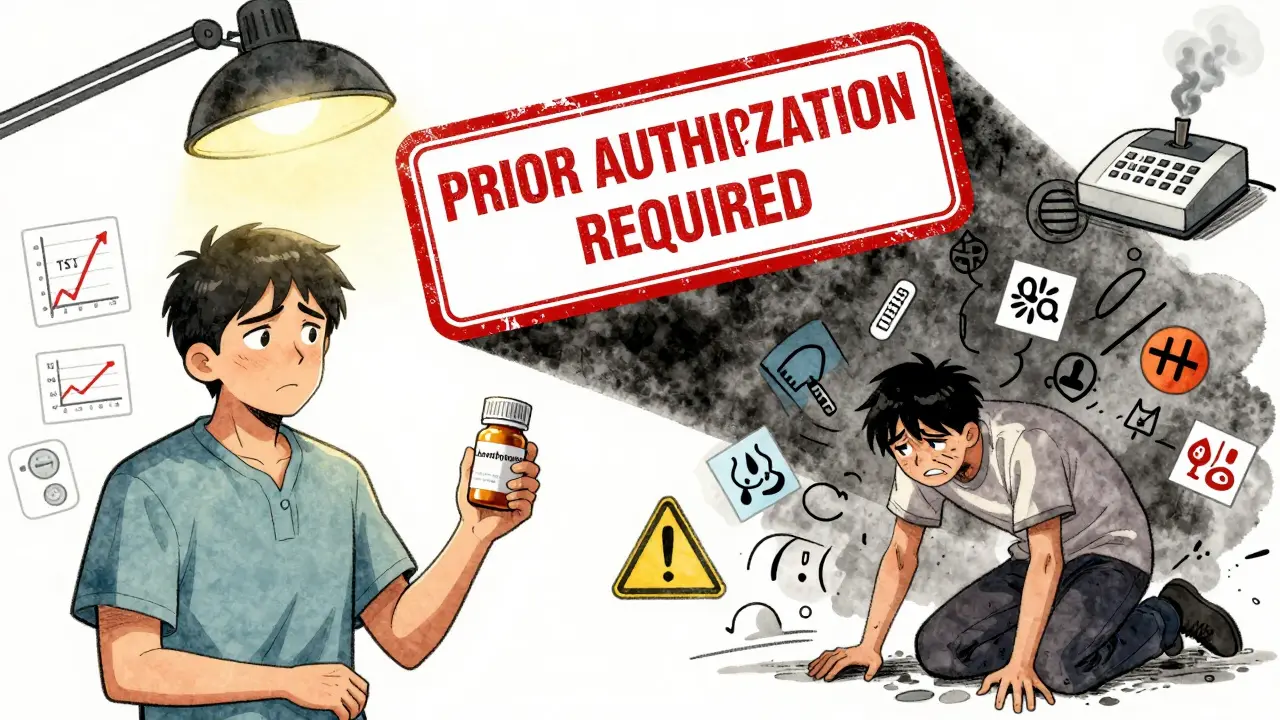
When you’re taking a medication for epilepsy, hypothyroidism, or another condition that demands extreme precision, the last thing you should worry about is whether your insurance will approve your prescription. But for NTI drugs - narrow therapeutic index medications - that’s exactly what many patients face. These aren’t ordinary pills. Even tiny changes in dosage or formulation can cause seizures, toxic reactions, or complete treatment failure. And yet, insurers often treat them like any other brand-name drug with a generic alternative. That’s where the problem begins.
What Makes NTI Drugs Different?
NTI drugs have a razor-thin line between working and causing harm. The FDA defines them as medications where small differences in blood concentration - even 10% - can lead to serious therapeutic failures. That’s why switching from a brand-name drug to a generic, even if it’s technically "bioequivalent," can be dangerous.
Common examples include:
- Levothyroxine (for hypothyroidism)
- Phenytoin and carbamazepine (for epilepsy)
- Cyclosporine (for organ transplant patients)
- Warfarin (for blood clot prevention)
- Propranolol (for certain heart and seizure conditions)
DrugBank lists around 37 medications in this category. These aren’t rare. Millions of Americans rely on them daily. But because they’re often older drugs with generic versions available, insurers assume they’re interchangeable. They’re not.
Why Do Insurers Require Prior Authorization for Brand-Name NTI Drugs?
Most of the time, insurers use prior authorization to block brand-name drugs when cheaper generics exist. It’s a cost-control tool. But with NTI drugs, the logic flips. Insurers often require prior authorization to approve the brand - not to deny it.
Why? Because they’re afraid of being stuck with a costly brand prescription if the patient doesn’t truly need it. So they force doctors to prove medical necessity: lab results, TSH levels for thyroid patients, seizure logs for epilepsy, or documented adverse reactions to generics. It’s meant to prevent "unnecessary" use - but it often delays care when it’s most critical.
Take levothyroxine. A 2024 Reddit post from a neurologist reported that 73% of brand-name requests for this drug were initially denied, even when patients had TSH levels swinging by 300% after switching to generics. That’s not just inconvenient - it’s dangerous.
How Do Insurance Policies Actually Work?
There’s no national standard. Every insurer sets its own rules - and they contradict each other.
Health Net, for example, explicitly states that brand-name NTI drugs "may be listed on the Formulary at a higher tier and do not require prior approval." That means if you’re on brand-name Keppra or Synthroid, you should get it without jumping through hoops - and many plans follow this model.
But others? They treat NTI drugs like any other brand. Medicare Part D calls it a "coverage determination." Medicaid requires a response within 24 hours for urgent cases - but in practice, delays are common. Some states, like California, have passed laws (AB-1428, effective January 2025) that ban prior authorization for NTI drugs if the patient was previously stable on the brand. Others, like Mississippi, still require a universal paper form faxed or uploaded through a portal.
And here’s the kicker: even when prior authorization is required, approval rates are high - 82.4% after initial denial, according to a 2023 study. That means insurers aren’t saying "no" because the drug isn’t needed. They’re saying "no" because they want paperwork.
The Human Cost of Delays
Behind every denied request is a patient who didn’t get their medication on time.
A 2024 survey by Patients Rising found that 68% of people taking NTI drugs experienced delays longer than 72 hours. Nearly 3 in 10 reported adverse events - seizures, hospitalizations, extreme fatigue - directly tied to those delays. One patient on HealthUnlocked described how a single denial led to a grand mal seizure. After that, her insurer automatically approved future brand-name requests. That’s not policy - that’s a wake-up call.
The American Academy of Neurology studied 2,450 epilepsy patients and found that unnecessary barriers to brand-name antiepileptic drugs contributed to preventable seizures in 18.7% of cases. That’s not a statistic. That’s someone’s child, parent, or sibling having a seizure because their insurance demanded a form they didn’t know existed.
What Doctors and Pharmacies Are Up Against
It’s not just patients who suffer. Doctors and pharmacists are drowning in paperwork.
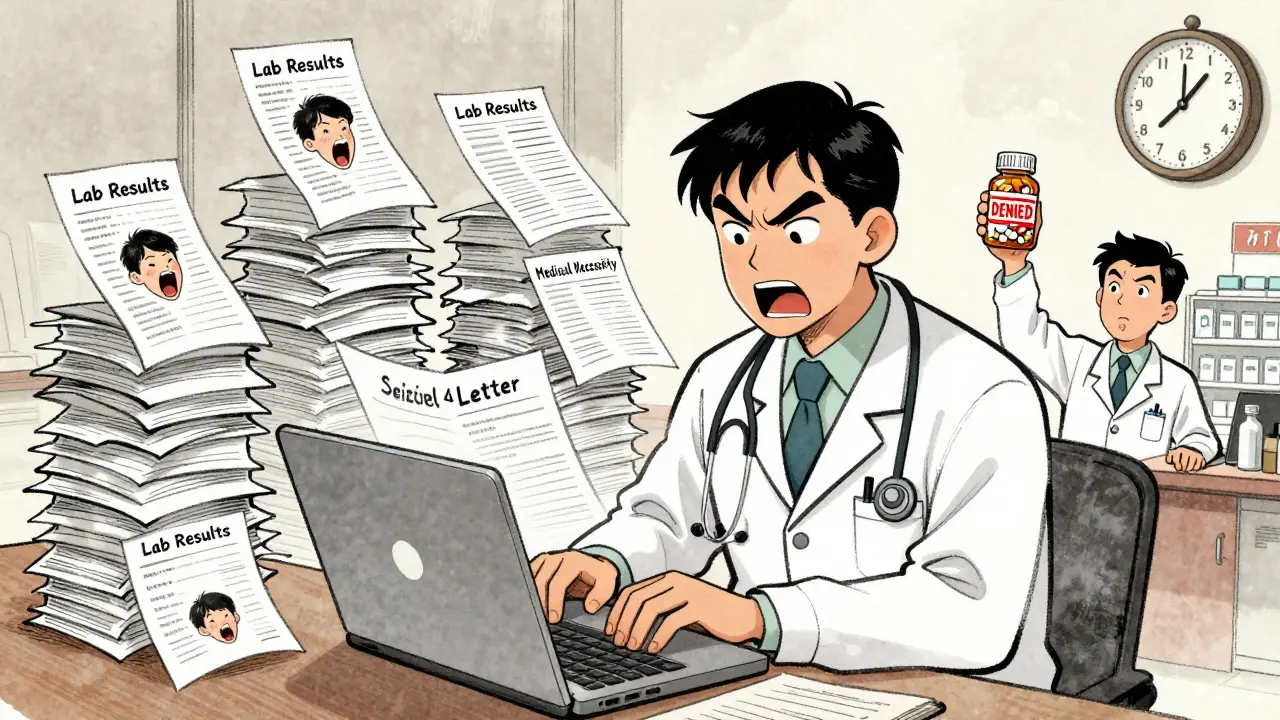
A 2023 MGMA survey found that physician practices spend an average of 16.3 hours per week just managing prior authorizations. That’s nearly two full workdays. For each NTI drug request, they must submit lab results, diagnosis codes, clinical notes, and sometimes even letters of medical necessity. Some states require faxing forms. Others demand uploads to a portal that crashes during peak hours.
Electronic prior authorization systems have cut processing times by 42%, but NTI requests still take 22% longer than standard ones because of the extra documentation needed. Pharmacists, meanwhile, face angry patients showing up at the counter, confused why their prescription was held up for days.
Change Is Coming - But Slowly
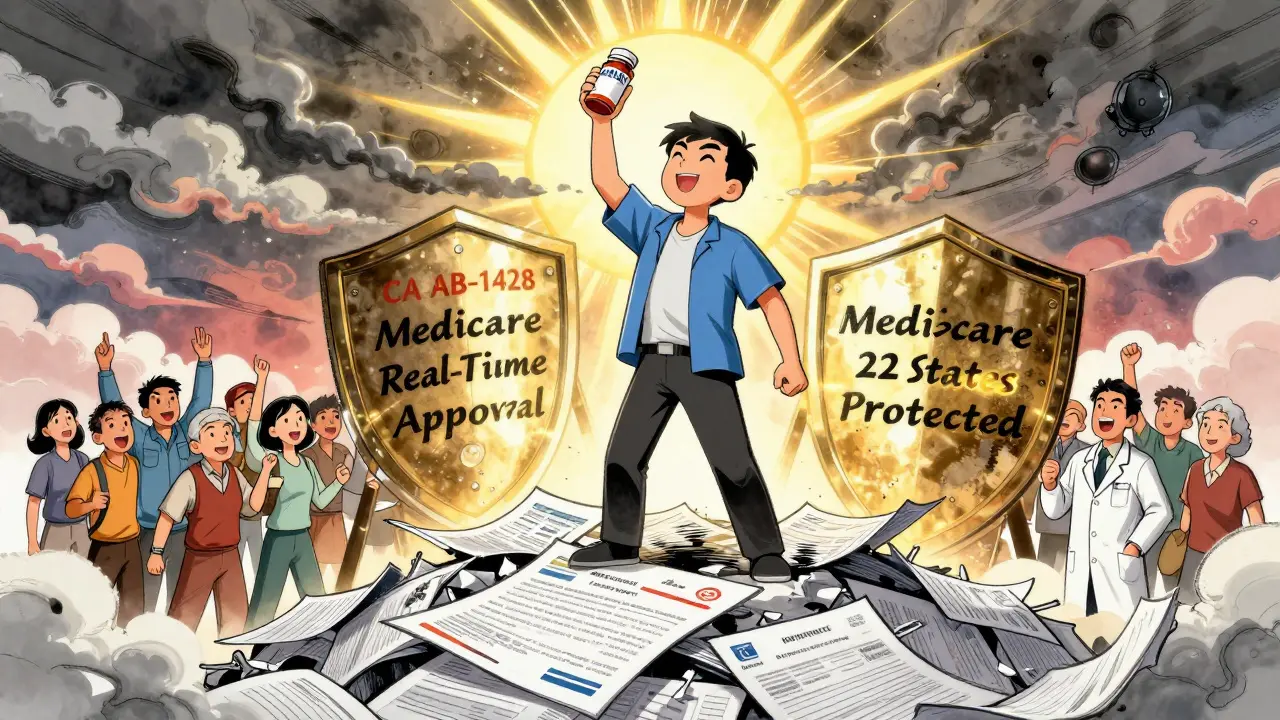
Pressure is mounting. In 2024, Congress passed the Improving Seniors’ Timely Access to Care Act, which requires Medicare Advantage plans to give real-time electronic decisions - including for NTI drugs. That’s a game-changer.
At the state level, 18 states now require automatic approval if an insurer doesn’t respond within the legal timeframe. That’s up from just 7 in 2022. Twenty-two states have passed laws limiting prior authorization for NTI drugs outright. And the 21st Century Cures Act has forced insurers to make their criteria public - leading to a 37% increase in first-time approvals.
Industry analysts predict that by 2026, 75% of commercial health plans will eliminate prior authorization for established NTI drug categories. Why? Because the safety risks are too high, and the cost of hospitalizations from medication errors far outweighs the savings from switching to generics.
What You Can Do Right Now
If you’re taking an NTI drug and your insurer is making you jump through hoops, here’s what works:
- Ask your doctor to write "medically necessary" on the prescription. Some states, like North Carolina, require this for approval.
- Submit documentation upfront. Include recent lab results, seizure logs, or records of past adverse reactions to generics.
- Use electronic prior authorization. If your doctor’s office uses a portal like NCTracks or Gainwell, insist on it. It’s faster than faxing.
- Appeal immediately. If denied, file an appeal the same day. Most approvals come after the first denial.
- Know your state’s rules. Check if your state has laws protecting NTI drug access. Many do now.
And if your insurer still won’t budge? Contact your state’s insurance commissioner. These delays aren’t just bureaucratic - they’re life-threatening.
Why This Matters Beyond Your Prescription
This isn’t just about thyroid pills or seizure meds. It’s about trust in the system. When insurers treat life-saving medications like cost centers, they’re not saving money - they’re shifting risk to patients. The data shows that for NTI drugs, the cost of denying care is higher than the cost of approving it.
It’s time to stop pretending generics are interchangeable for these drugs. They’re not. And patients shouldn’t have to risk their health to prove it.
What are NTI drugs, and why are they different from other medications?
NTI drugs, or narrow therapeutic index drugs, have a very small margin between the effective dose and the toxic dose. Even minor changes in how the drug is absorbed - like switching from a brand to a generic - can cause serious side effects or treatment failure. Examples include levothyroxine for thyroid disorders and phenytoin for epilepsy. Unlike most medications, these aren’t interchangeable.
Why do insurers require prior authorization for brand-name NTI drugs when generics are available?
Insurers require prior authorization to ensure the brand-name version is truly medically necessary, not just preferred. They assume generics are safe substitutes, so they want documentation - like lab results or past adverse reactions - before approving the more expensive brand. But this process often delays care, even though studies show patients do worse on generics for these drugs.
Is it true that some insurers don’t require prior authorization for NTI drugs?
Yes. Some insurers, like Health Net, list brand-name NTI drugs on their formulary at a higher tier and explicitly state they don’t require prior authorization. Other plans, especially Medicaid programs in certain states, have adopted similar policies. But rules vary widely by insurer and state, so it’s important to check your specific plan’s formulary.
How long does prior authorization for NTI drugs usually take?
On average, it takes 3.2 business days to process a prior authorization request for NTI drugs - longer than for standard medications. Electronic submissions are faster, but even then, delays are common. In urgent cases, Medicaid is required to respond within 24 hours and provide a 72-hour emergency supply, but many patients still face longer waits.
What should I do if my NTI drug request is denied?
File an appeal immediately. Most approvals happen after the first denial. Work with your doctor to submit all supporting documentation - lab results, seizure logs, or records of past reactions to generics. If you’re on Medicaid or Medicare, you have the right to a fast-track review. If delays continue, contact your state’s insurance commissioner or patient advocacy groups like Patients Rising.
Are there laws protecting access to brand-name NTI drugs?
Yes. As of 2025, 22 states have passed laws limiting prior authorization for NTI drugs. California’s AB-1428, effective January 2025, bans prior authorization for these drugs if the patient was previously stable on the brand. Eighteen states now require automatic approval if insurers don’t respond within a set time. Federal law also requires Medicare Advantage plans to give real-time decisions starting in 2025.

11 Comments
Let’s be real-this isn’t about cost control. It’s about systemic dehumanization wrapped in bureaucratic legalese. Insurers treat NTI drugs like they’re interchangeable widgets, ignoring the fact that a 10% fluctuation in blood concentration can turn a stable patient into a seizure statistic. We’re not talking about aspirin here. We’re talking about people whose brains rely on milligram precision. And yet, the system demands lab reports, faxed forms, and emotional appeals just to keep someone alive. This isn’t healthcare. It’s a performance art where the patient is the prop.
Oh sweet mercy, another post about how insurance companies are monsters. 🙄 Look-I get it, the system sucks. But let’s not pretend every generic is a death sentence. Some people switch just fine. Maybe instead of demanding brand names as a right, we push for better generic manufacturing standards? Or better yet-why are we still using 1970s drugs with no modern alternatives? Maybe the real problem is pharmaceutical stagnation, not prior auth.
THIS IS A BIG PHARMA COVER-UP!! 🤫💉 Big Pharma doesn’t want you to know that generics are laced with fillers from China that cause seizures! They pay off the FDA and insurers to keep you on expensive brand names so they can charge $500 a pill. That’s why your doctor won’t help you-because they’re on the payroll! I’ve got a cousin who switched to levothyroxine generic and started hallucinating. She’s now living in a tin foil hat bunker. They’re watching us. Don’t trust the system. 🛡️🔥
Man, I’ve seen this firsthand working in a pharmacy in Ohio. Old lady comes in, crying because her Synthroid got denied. She’s 78, has a pacemaker, and the generic made her heart race like she ran a marathon. We had to call the doc, fax a form, wait two days. She missed her bridge game. That’s not healthcare. That’s cruelty with a clipboard. And don’t even get me started on the portal that crashes every time you click ‘submit’.
STOP! STOP! STOP! This is why America is falling apart!! We let bureaucrats decide who lives and who dies!! I have a neighbor-her son had a seizure because the insurance denied his carbamazepine!! They made him wait 5 days!! 5 DAYS!! And now they want to make it easier to switch to generics?? NO!! We need to ban ALL generics for NTI drugs!! Send the forms to Congress!! Burn the servers!! THIS IS A CRIME AGAINST HUMANITY!!
Let’s cut through the emotional noise. The data shows 82.4% of denials are overturned on appeal. That means the system is working-just inefficiently. The real issue is lack of standardization. If every insurer used the same digital platform with auto-approval triggers for stable patients, this wouldn’t be a problem. Blaming insurers is lazy. The problem is fragmented infrastructure. Fix the tech, not the policy. And stop dramatizing every delay as a death sentence. Most cases are resolved within 72 hours.
What if we stopped seeing this as a battle between patients and insurers, and started seeing it as a failure of imagination? We’re clinging to 1950s pharmacology while the world moves on. Why aren’t we investing in next-gen NTI formulations? Why aren’t we funding bioequivalence studies that go beyond AUC and Cmax? The system punishes patients because we’ve stopped asking deeper questions. This isn’t about paperwork. It’s about whether we value precision-or just profit.
They’re lying to us. I know this because my cousin’s friend’s neighbor’s sister took a generic warfarin and her blood turned to sludge. She was in the ICU for 11 days. And the insurance company? They sent her a $10 coupon for a new toothbrush. That’s not a mistake. That’s a design. They want you to suffer so you’ll give up. They don’t care if you die. They just want you to stop filing claims. And now they’re pushing ‘electronic prior auth’-that’s just a fancy way to make you wait longer. The AI bots are trained to deny. The system is rigged. You think your doctor’s helping? They’re just another cog. Wake up. They’re watching your TSH levels.
In India, we don’t have this problem-because we don’t have insurance. We pay out of pocket. And guess what? People get their meds on time. No forms. No delays. No bureaucracy. The system here is broken because it’s built on profit, not care. You don’t need more laws-you need less middlemen. Let doctors prescribe. Let patients pay. Simple. Not perfect. But human.
While the emotional weight of this issue is undeniable, the structural inefficiencies are the true obstacle. The absence of a unified electronic prior authorization framework across payers creates redundant administrative burdens. Standardizing data fields, integrating with EHRs, and implementing AI-driven pre-validation for stable patients would reduce processing time by over 60%. Policy change without technological alignment is performative. We must advocate for interoperability-not just exemptions.
My aunt’s on levothyroxine. Switched to generic once. Ended up in the ER with a heart rate of 140. She’s been on brand ever since. The insurance fought it for 10 days. She cried every morning waiting. Now they auto-approve her because she’s a known case. But what about the next person? The one who doesn’t have a family member who knows how to fight the system? This isn’t about politics. It’s about the guy who shows up at the pharmacy with a paper form and no clue what to do next. We need a button. One button. ‘I’m stable on brand-approve.’ That’s it. No forms. No fax. No drama. Just… approve.
Write a comment