
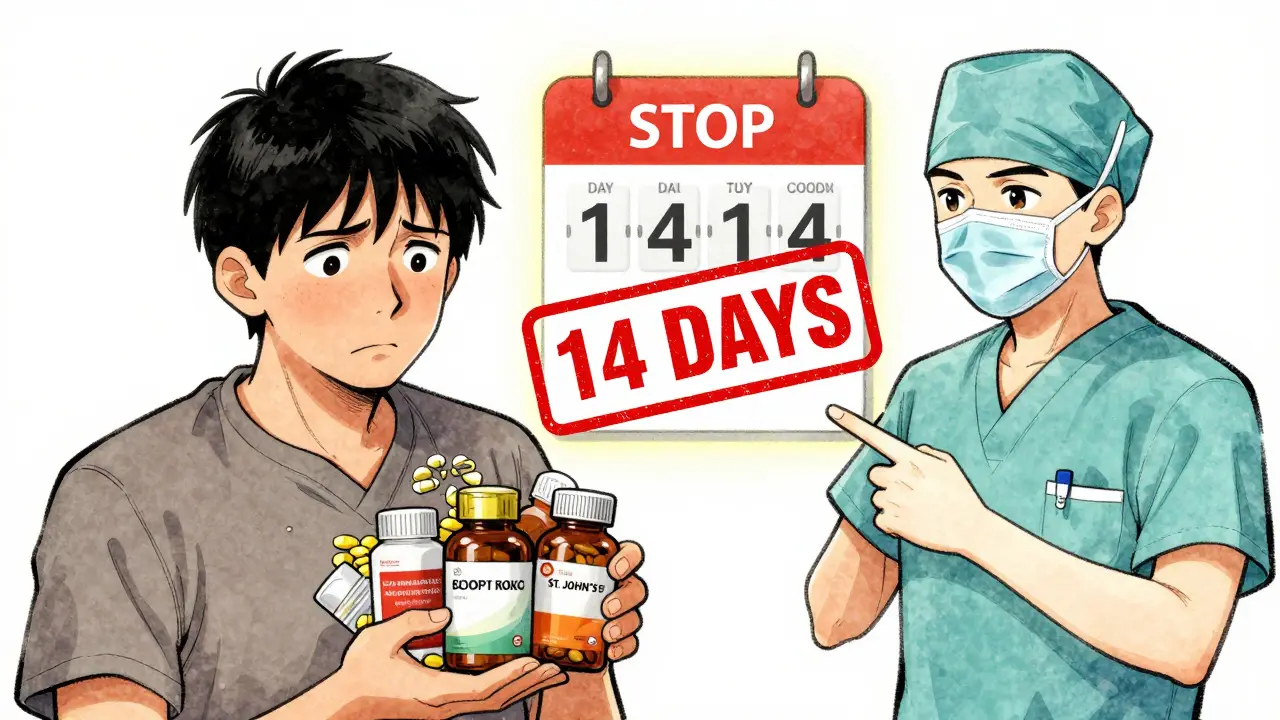
Every year, millions of Americans walk into surgery thinking they’re doing everything right-eating well, taking their vitamins, staying healthy. But what they don’t realize is that the very supplements they trust could be putting them at risk. A simple fish oil capsule, a daily ginkgo tablet, or even a multivitamin with high-dose vitamin E might seem harmless. In the operating room, however, these can trigger dangerous bleeding, spike blood pressure, or interfere with anesthesia in ways that aren’t obvious until it’s too late.
Why Surgeons Can’t Rely on Patients to Speak Up
Patients rarely volunteer information about supplements. In a 2021 study across multiple hospitals, only 39% of patients mentioned taking any supplements during pre-surgical interviews. Why? Because most don’t consider them ‘medications.’ They see fish oil as ‘just a health food.’ St. John’s Wort? ‘It’s natural, so it’s safe.’ Garlic pills? ‘I take them for my colds.’ This mindset is dangerous. A 2018 study in JMIR Research Protocols found that 22% of patients made errors when reporting their supplement use. Some forgot. Others didn’t know the names. One woman said she took ‘something for her joints’-turns out it was a 1,200 mg glucosamine-chondroitin blend with added ginger, which increases bleeding risk. Surgeons can’t afford guesswork. That’s why structured screening is no longer optional-it’s standard.The 14-Day Rule (and the Exceptions)
Most hospitals now follow a 14-day discontinuation rule for herbal and nutritional supplements before surgery. This isn’t arbitrary. It’s based on how long it takes for substances like fish oil, ginkgo, and vitamin E to clear from the bloodstream and stop affecting clotting. A 2023 update from the Hospital for Special Surgery confirms this timeline for high-risk items:- Fish oil (180mg EPA + 120mg DHA per capsule): Stop 14 days out. Can increase blood loss by up to 50%.
- Vitamin E (d-alpha-tocopherol, especially above 400 IU): Stop 14 days out. Interferes with platelet function.
- Ginkgo biloba: Stop 14 days out. Strong anticoagulant effect.
- Garlic supplements: Stop 14 days out. Can cause prolonged bleeding even at low doses.
- Ginseng: Stop 14 days out. May cause hypoglycemia or interact with anesthesia.
- St. John’s Wort: Stop 14 days out. Induces liver enzymes that reduce anesthesia effectiveness by 30-40%.
How Supplements Interfere With Surgery
It’s not just bleeding. Supplements can mess with your heart, your blood pressure, your liver, and your brain’s response to anesthesia. - Anticoagulant effects: Fish oil, garlic, ginkgo, and vitamin E thin the blood. In surgery, that means more bleeding, longer procedures, and higher transfusion rates. - Anesthesia interference: St. John’s Wort speeds up liver metabolism, causing anesthetics like propofol and sevoflurane to break down too fast. Patients wake up sooner than expected-or worse, they’re under-dosed and feel pain during surgery. - Blood pressure swings: Ginseng and ephedra-containing products can cause dangerous spikes or drops in blood pressure during anesthesia induction. - Glucose control: Some herbal blends affect insulin sensitivity. In diabetic patients, this can lead to hypoglycemia during fasting or hyperglycemia post-op. A 2017 randomized trial in Clinical Nutrition showed that properly managing pre-op supplements reduced complications by 22%. That’s not a small number-it’s the difference between a smooth recovery and a stay in the ICU.
Different Surgeries, Different Rules
Not all surgeries are the same. A plastic surgeon needs to know every detail because even a tiny bleed can ruin symmetry. A general surgeon might be more lenient with basic multivitamins. Orthopedic surgeons care about bone healing. Bariatric teams focus on protein and metabolic stability.- Plastic surgery: Strict 14-day stop for all herbal supplements. No exceptions. Bleeding in facial or breast surgery can mean revision surgery.
- Orthopedic surgery: Calcium and vitamin D allowed. Iron supplements may be continued if patient is anemic.
- Bariatric surgery: All supplements stopped except those for comorbidities (like thyroid meds). Protein intake must be 60-80g daily for 2 weeks before.
- Cardiac surgery: Omega-3s and CoQ10 often stopped, but magnesium may be continued if patient has arrhythmias.
What Surgeons Should Ask (and How to Ask It)
Asking, “Do you take any supplements?” is useless. Patients say no. Even if they’re honest, they don’t know what counts. The American College of Surgeons recommends using a list of 25 high-risk supplements and asking about each one by name. The Hospital for Special Surgery’s 2023 protocol includes five direct questions:- Which supplements do you take every day?
- How many days or weeks before surgery should you stop them?
- Could any of them cause bleeding or interfere with anesthesia?
- Can you take your usual medications on the day of surgery?
- When can you start them again after surgery?
Why Compliance Is Still a Problem
Even with clear guidelines, only 58-67% of patients follow pre-op supplement instructions. Why? Three reasons: 1. They don’t think it matters. “It’s just a vitamin.” 2. They’re confused by labels. A Mayo Clinic study found 32% of patients thought fish oil was a “food,” not a supplement. 3. They’re afraid of withdrawal. Some stop supplements cold turkey and feel tired, anxious, or have headaches-so they restart them before surgery. One clinic in Portland improved compliance from 47% to 83% by giving patients a printed, color-coded handout with exact stop dates and what to expect. Simple. Visual. Clear.
The Regulatory Mess
Here’s the big problem: supplements aren’t drugs. Thanks to the Dietary Supplement Health and Education Act of 1994 (DSHEA), they don’t need FDA approval before hitting shelves. That means two bottles of “turmeric extract” can have wildly different curcumin levels-up to 300% variation, according to a 2019 JAMA Internal Medicine analysis. One might be safe. The other could be a hidden anticoagulant. Manufacturers don’t have to list side effects. They don’t have to prove safety for surgery. And patients have no way of knowing. That’s why surgeons can’t rely on labels. They have to rely on evidence-and their own knowledge.What’s Changing in 2026
The field is evolving fast. In October 2023, the FDA released draft guidance proposing stricter labeling for supplements with known surgical risks. The American Society of Anesthesiologists launched a mobile app in early 2024 that lets surgeons check real-time interactions between supplements and anesthetics. The STAR (Supplement Transparency and Reporting) guidelines, published in Annals of Surgery, are now adopted by 37 major surgical associations. They require:- Standardized documentation of every supplement, dose, and frequency
- Electronic alerts in EHRs when a patient is on high-risk supplements
- Pre-op checklists signed by both patient and provider
Bottom Line: It’s Not Optional
Pre-surgical supplement disclosure isn’t a formality. It’s a life-saving step. The data is clear: patients who disclose and follow discontinuation guidelines have fewer complications, shorter hospital stays, and better outcomes. Surgeons who skip this step aren’t just cutting corners-they’re gambling with patient safety. The cost of a missed supplement isn’t just a delayed surgery. It’s a blood transfusion. A return to the OR. A week in the ICU. A family left wondering why this happened. The solution isn’t more rules. It’s better questions. Clear instructions. Patient education. And a culture where no one assumes a supplement is harmless just because it’s natural.Pre-surgical supplement disclosure isn’t about control. It’s about care.

12 Comments
Let me get this straight - people think popping fish oil is like drinking orange juice? Jesus. I’ve seen patients come in with 17 different supplements, all labeled ‘natural,’ and then act shocked when they bleed out on the table. This isn’t ‘alternative medicine,’ it’s a goddamn pharmacology minefield. If your ‘wellness routine’ can make your liver metabolize anesthesia like it’s a damn energy drink, you don’t get to call it ‘safe.’
And don’t even get me started on St. John’s Wort. That shit’s a CYP450 bulldozer. Surgeons aren’t magicians - we can’t magic away drug interactions because someone read a blog about ‘cleansing their soul with herbs.’
DSHEA is a joke. A corporate loophole dressed up as freedom. You wouldn’t let someone walk into an ER with a backpack full of unregulated chemicals and say ‘it’s just a supplement.’ So why the hell are we letting them walk into an OR?
Stop calling it ‘natural.’ Call it what it is: unregulated, untested, and potentially lethal. And if your doctor doesn’t ask you by name about every bottle in your cabinet, find a new one.
This is such an important post - thank you for laying it out so clearly. I’m a nurse in Delhi, and I see this exact issue every week. Patients will say, ‘I take ashwagandha for stress,’ or ‘turmeric for inflammation,’ and they genuinely don’t realize these are potent bioactive compounds. Many don’t even know the names of what they’re taking - just the brand or color of the pill.
At our hospital, we started asking patients to bring their supplements in a ziplock bag to pre-op. It changed everything. One woman brought a bottle labeled ‘Immunity Boost’ - turned out it had high-dose vitamin E and kava. We delayed her surgery, and she later told us she’d been taking it for anxiety since her husband passed. We didn’t just prevent a bleed - we gave her space to talk.
Education isn’t about scaring people. It’s about listening, then guiding. A simple handout with icons - red for stop, green for keep - made compliance jump from 40% to 80% in our unit. Small changes, huge impact.
Ugh. Another ‘evidence-based’ diatribe masquerading as medical wisdom. The 14-day rule? Arbitrary. Based on outdated pharmacokinetic models from the 90s. Modern herbal pharmacology has moved far beyond ‘stop everything’ protocols. The real issue is lazy clinicians who refuse to engage with nutrigenomics or phytochemical dynamics. You can’t treat a complex phytochemical matrix with a blunt 14-day cutoff - it’s reductionist pseudoscience dressed in white coats.
And don’t get me started on the FDA. DSHEA isn’t the problem - it’s the fact that regulatory bodies refuse to acknowledge that botanicals operate through polypharmacological networks, not single-molecule pharmacodynamics. You’re treating a symphony like a kazoo.
Bro. I took ginkgo for ‘brain fog’ before my knee surgery. Didn’t tell anyone. Got out of the hospital in 2 days. No bleed. No drama. So yeah, maybe your ‘14-day rule’ is just fear-mongering. I’m not some dumbass who needs a checklist. I’m a grown man. I know my body.
Also, vitamin D? I take 5000 IU. No one told me to stop. Still walked out fine. You people are overcomplicating shit.
Wait wait wait - so you’re telling me garlic pills can make me bleed? I’ve been takin’ them since 2018 for my colds and my cholesterol. My doc never said nothin’. Maybe I shoulda told him? I thought it was like, just food. Like, garlic is a vegetable right? So why’s it dangerous? I’m confused. Also, I take magnesium for cramps. Is that bad too? I thought that was good? I don’t know anymore. My head hurts.
Stop taking supplements. Just stop. You don’t need them. You’re just wasting money and risking your life. Done.
As a Filipina-American who grew up with my lola giving me turmeric milk for everything - cough, cold, ‘bad energy’ - I get why people don’t see supplements as ‘medicine.’ In our culture, food = healing. But this post? It bridges that gap. I showed it to my mom. She didn’t know ginger in her tea could affect blood thinners. Now she checks labels. That’s real change.
And yes, the FDA’s hands are tied by DSHEA. But maybe we need a ‘Supplement Transparency Act’ - like nutrition labels, but for surgical risk. Red flag icons. Simple. Visual. No jargon. Just: ‘May increase bleeding.’ That’s all people need.
Let’s be real - the real problem isn’t the supplements. It’s the fact that patients are treated like dumb kids who can’t understand basic biology. You think they don’t know their own bodies? They do. But they’ve been gaslit for decades by a system that says ‘natural = safe’ and then acts shocked when it isn’t. This isn’t ignorance - it’s systemic deception.
And why are we blaming patients for not knowing that a ‘natural energy blend’ contains ephedra? Because the label says ‘organic’ and has a picture of a mountain. That’s corporate fraud. Not patient stupidity.
Surgeons need to stop acting like they’re the only ones with expertise. We’re all part of the same system. And the system is broken.
Think about it: we live in a world where you can buy a ‘miracle’ supplement with no clinical trials, no ingredient verification, and no warning labels - but if you want a prescription for a $10 generic, you need five forms, a 3-week wait, and a therapist’s note. The moral inversion here is staggering.
Supplements are the last frontier of unregulated capitalism in medicine. We’ve outsourced our health to a marketplace where profit dictates safety, not science. And now we’re surprised when people die because they trusted a bottle labeled ‘pure’ that contained a 300% overdose of vitamin K?
This isn’t about compliance. It’s about sovereignty. Who gets to decide what’s safe? The FDA? A pharmaceutical lobby? Or the person who swallows the pill?
Maybe the real question isn’t ‘Why don’t patients disclose?’ - it’s ‘Why do we let them be exposed to this?’
Oh wow. So now we’re treating ‘natural’ like it’s a moral failing? Next you’ll tell me breathing air is dangerous because it contains oxygen and we might develop free radicals. Next time someone says ‘I take vitamin C,’ just hand them a hazmat suit and a signed waiver. Maybe then they’ll understand the gravity of their ‘wellness choices.’
Also, ‘St. John’s Wort reduces anesthesia by 30-40%’ - said who? A guy in a lab coat with a PowerPoint? I’ve seen people take it for years and wake up fine. Coincidence? Or is this just another ‘medical consensus’ that sounds good on paper but fails in the real world?
Let me guess - you also think drinking coffee before surgery is a death sentence. Right? Right??
The empirical evidence supporting preoperative supplement discontinuation is robust and methodologically sound. Multiple prospective cohort studies, including those published in the Journal of Clinical Anesthesia and the British Journal of Surgery, demonstrate statistically significant reductions in perioperative hemorrhage and anesthetic dysmetabolism when standardized cessation protocols are implemented. The 14-day window is derived from pharmacokinetic half-life modeling of bioactive constituents such as ginkgolides and omega-3 fatty acids, validated through serial serum concentration assays. Moreover, the variability in supplement composition - as documented in JAMA Internal Medicine - necessitates a conservative, universal approach due to the absence of reliable batch-specific data. To advocate for individualized continuation without genetic or metabolic profiling is not merely imprudent - it is ethically indefensible in the context of surgical risk mitigation.
My dad had bypass surgery last year. He took fish oil for his heart. Didn’t tell the team. They found out during prep. He ended up in ICU for 3 days. We didn’t know supplements could do that. I’m not mad at him. I’m mad at the system that let him believe it was ‘just a vitamin.’
Can we just… make a checklist? Like, a simple one-page thing with pictures? Not a 20-page PDF. Just: ‘Here’s what to stop. Here’s what to keep. Here’s why.’
And maybe, just maybe, stop calling people ‘non-compliant’ and start asking, ‘What did you think this was?’
Write a comment