
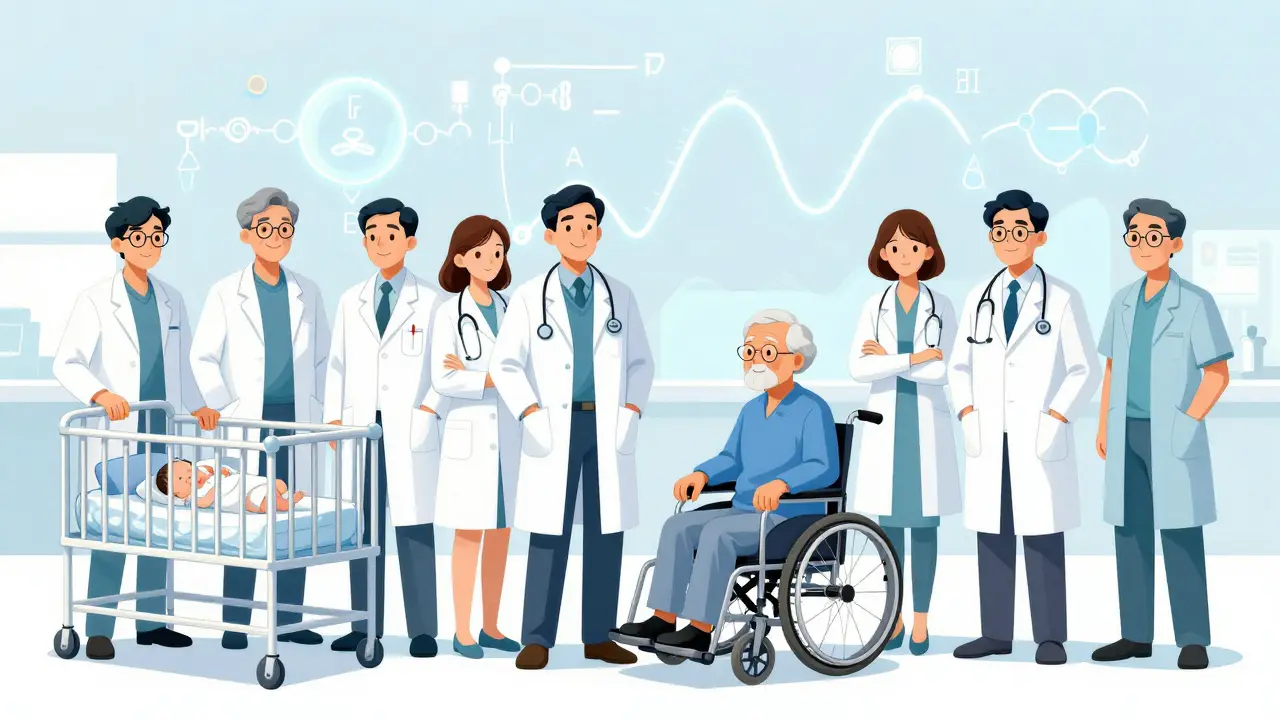
The Core Logic of PopPK for Equivalence
Traditional bioequivalence is a bit like comparing two runners on a flat track; if they finish at the same time, they're equal. But PopPK is more like analyzing how different runners handle a mountain trail. It looks at the "noise" in the data and separates it into two categories: between-subject variability (BSV) and residual unexplained variability (RUV).When we talk about proving equivalence, we are looking for the 90% confidence intervals of geometric mean ratios for key metrics like AUC (area under the curve) and Cmax (maximum concentration). While standard studies look for a strict 80-125% range, PopPK provides a more nuanced view. It asks: "Does the drug behave the same way across different weights, ages, and organ functions?"
This is especially critical for drugs with a narrow therapeutic index. If a drug is toxic at 110% of the dose but ineffective at 90%, a simple average isn't enough. You need to know exactly how the population fluctuates. By using nonlinear mixed-effects modeling, researchers can create a mathematical map of how a drug moves through a diverse group, ensuring that the "equivalence" isn't just an average, but a reality for the individual patient.
How PopPK Differs from Traditional Bioequivalence
If you've ever looked at a standard bioequivalence study, you'll see a crossover design: 24 to 48 healthy volunteers take Drug A, wait, then take Drug B. It's clean, but it's unrealistic. PopPK flips the script by using real-world clinical data.| Feature | Traditional BE Study | PopPK Approach |
|---|---|---|
| Participant Profile | Homogeneous (Healthy Volunteers) | Heterogeneous (Actual Patients) |
| Sampling Intensity | Rich/Intensive (Many samples/person) | Sparse/Unstructured (2-4 samples/person) |
| Key Focus | Average Bioequivalence | Population Variability & Covariates |
| Sample Size | Small (typically 24-48) | Larger (typically 40+ for robust data) |
| Regulatory Path | Standardized/Predictable | Model-driven/Expert-led |

The Regulatory Shift: FDA and EMA Perspectives
For a long time, regulators were cautious about PopPK because the models can be as complex as the person building them. However, the tide has turned. In February 2022, the FDA is the U.S. Food and Drug Administration, the federal agency responsible for protecting public health by ensuring the safety and efficacy of drugs published formal guidance that explicitly acknowledges how PopPK can reduce the need for post-marketing requirements. Essentially, if your model is strong enough, the FDA may let you skip certain expensive follow-up trials.The EMA is the European Medicines Agency, the agency responsible for the scientific evaluation and monitoring of medicines in the EU has also leaned into this, emphasizing that PopPK is superior for accounting for patient characteristics. While the FDA is often seen as more receptive to "PopPK-only" arguments for equivalence, both agencies are moving toward a model-informed drug development (MIDD) framework.
Real-world data shows this is working. About 70% of new molecular entity applications between 2017 and 2021 included PopPK components. Even more impressive, some companies have reported reducing the need for additional clinical trials by up to 40% by successfully demonstrating equivalence across subgroups using these models.
Tools of the Trade: Software and Modeling
You can't do PopPK in a basic spreadsheet. It requires heavy-duty software capable of handling nonlinear mixed-effects models. NONMEM is the gold-standard software used for population pharmacokinetic and pharmacodynamic analysis, dominating regulatory submissions since 1980 . It's used in roughly 85% of FDA-submitted analyses, though competitors like Monolix and Phoenix NLME are gaining ground.The process usually follows a few specific paths:
- Parametric Methods: These assume the data follows a specific distribution, like a normal or log-normal curve. It's a more rigid but powerful way to estimate parameters.
- Nonparametric Methods: These make fewer assumptions about the distribution, which is helpful when the data is messy or doesn't fit a standard curve.
- Machine Learning Integration: As of 2025, we're seeing AI being used to detect non-linear relationships between a patient's characteristics (covariates) and how they process a drug, which was previously nearly impossible to map manually.
The learning curve here is steep. It's not uncommon for a pharmacokineticist to spend 18 to 24 months mastering these tools. One common pitfall is "overparameterization"-basically making the model too complex for the amount of data available, which leads to a "Complete Response Letter" from the FDA asking for more information.

Practical Application: When to Use PopPK for Equivalence
Not every drug needs PopPK. If you're making a simple vitamin supplement, a traditional BE study is plenty. But PopPK is a lifesaver in specific scenarios:- Renal or Hepatic Impairment: When patients have kidney or liver failure, dosing a traditional "control" group is often unethical. PopPK allows you to use data from the actual patients in their clinical environment.
- Pediatric and Neonatal Studies: You can't easily run a crossover trial on newborns. Sparse sampling from routine clinical checks provides the only viable path to prove equivalence.
- Biosimilars: Because biologics (large molecules) are so complex, proving they are "similar" to a reference product often requires the deep variability analysis that only PopPK can provide.
To succeed, you need to start early. The best teams integrate PopPK planning into Phase 1 of development. If you wait until Phase 3 and realize your data is too sparse or unstructured, you're essentially trying to build a house after you've already painted the walls.
What is the minimum sample size for a PopPK equivalence study?
While it varies based on the drug, the FDA generally suggests at least 40 participants to ensure the parameter estimation is robust. However, the real number depends on the expected variability and the statistical power needed to detect a difference.
Why is sparse sampling preferred over rich sampling?
Rich sampling (taking many blood draws from one person) is invasive and often impractical in a real clinical setting. Sparse sampling (2-4 draws) is much easier for patients and clinicians, and PopPK software can "fill in the gaps" using population trends to create a full profile.
What is the difference between BSV and RUV?
Between-Subject Variability (BSV) refers to the difference in drug exposure between two different people. Residual Unexplained Variability (RUV) is the "noise"-the difference between the model's prediction and the actual observed value for a single person. Both are used to determine if a drug's behavior is consistent enough to be called equivalent.
Can PopPK completely replace traditional bioequivalence trials?
In some cases, yes, especially for special populations or complex biologics. However, for drugs with extremely high variability, regulators may still prefer replicate crossover designs to get a more precise estimate of within-subject variability.
Which software is best for regulatory submissions?
NONMEM remains the industry standard and is used in the vast majority of FDA submissions. While Monolix and Phoenix NLME are powerful and more user-friendly, NONMEM's long history of regulatory acceptance makes it the safest bet for equivalence claims.
Next Steps for Implementation
If you're a pharmacometrician or a clinical lead looking to use PopPK to prove equivalence, your first move should be a gap analysis of your existing data. Do you have enough samples? Are the sampling times consistent enough to build a model?For those in early development, focus on collaborating with your statisticians now. Define your covariates-like creatinine clearance for renal function or body surface area for weight-before the trial begins. If you're already in the late stages and facing a regulatory hurdle, consider a "post-hoc" PopPK analysis of your existing clinical trial data to see if you can demonstrate equivalence without launching a new, expensive study.
15 Comments
Solid breakdown of the PopPK approach. For anyone getting started, I'd suggest looking into the newer versions of Monolix; the interface is way more intuitive than NONMEM for those who aren't into writing scripts for hours.
It is quite quaint that the author assumes a 24-month learning curve is a benchmark of mastery. In reality, true proficiency in nonlinear mixed-effects modeling requires a fundamental grasp of stochastic processes and Bayesian inference, which most practitioners conveniently ignore in favor of simply "fitting the model." The obsession with software tools like NONMEM is a mere symptom of a deeper intellectual laziness within the field of pharmacometrics.
Oh sure, let's just trust a mathematical map to tell us if a drug is safe for a newborn. Because nothing says "reliable" like sparse sampling and a bunch of software that's basically a black box.
Too long. Just say it's for sick people.
The gap analysis section is completely lacking!!! You can't just "start early" without a rigorous validation protocol... this is a disaster waiting to happen!!!
I really appreciate how this highlights the importance of including diverse populations, especially since for so long the medical community just ignored anyone who didn't fit the 'healthy young male' profile, and it's just wonderful to see that the FDA is finally catching up to the reality that patients come in all shapes and sizes, which makes the whole drug development process much more inclusive and safe for everyone involved in the long run!
The 90% CI range is outdated.
Wow, so we're just using "sparse sampling" now??? How convenient for the pharma companies to save money while we just hope the model works!!! 🙄✨
My mind is absolutely blown! The sheer drama of a Complete Response Letter from the FDA is the real horror story here. Imagine spending two years on a model only to have it rejected because you added one too many parameters. It's a tragedy! A total clinical catastrophe!
It is heartening to see such a focus on pediatric and neonatal care. These are often the most vulnerable patients and ensuring their drug equivalence through ethical means is a noble goal.
India is already leading in generic drug production so we don't need these fancy US models to tell us what we already know! 🇮🇳 Just use the data we have and stop overcomplicating it with software from the 80s! 🚀
The integration of Machine Learning by 2025 is an absolute triumph of modern science! We must push these boundaries with maximum intensity to ensure every single patient receives optimized dosing regardless of their physiological state! Let us embrace this technological evolution with full force!
It makes one wonder if the move toward MIDD is actually about patient safety or simply a way to quantify the uncertainty we've always felt in medicine. We are replacing clinical intuition with an algorithm.
The whole concept of "equivalence" is a philosophical lie. No two humans are identical, so a model is just a sophisticated way of guessing an average. Who cares about the 80-125% range when the actual patient's biology is chaos anyway.
This is exactly the kind of innovation that drives the pharmaceutical industry forward and empowers researchers to reach the most difficult patient groups with confidence and precision! We should all be incredibly motivated to master these tools because the ability to reduce clinical trials by 40% while increasing safety is a massive win for global health and will undoubtedly accelerate the delivery of life-saving generics to those who need them most!
Write a comment