
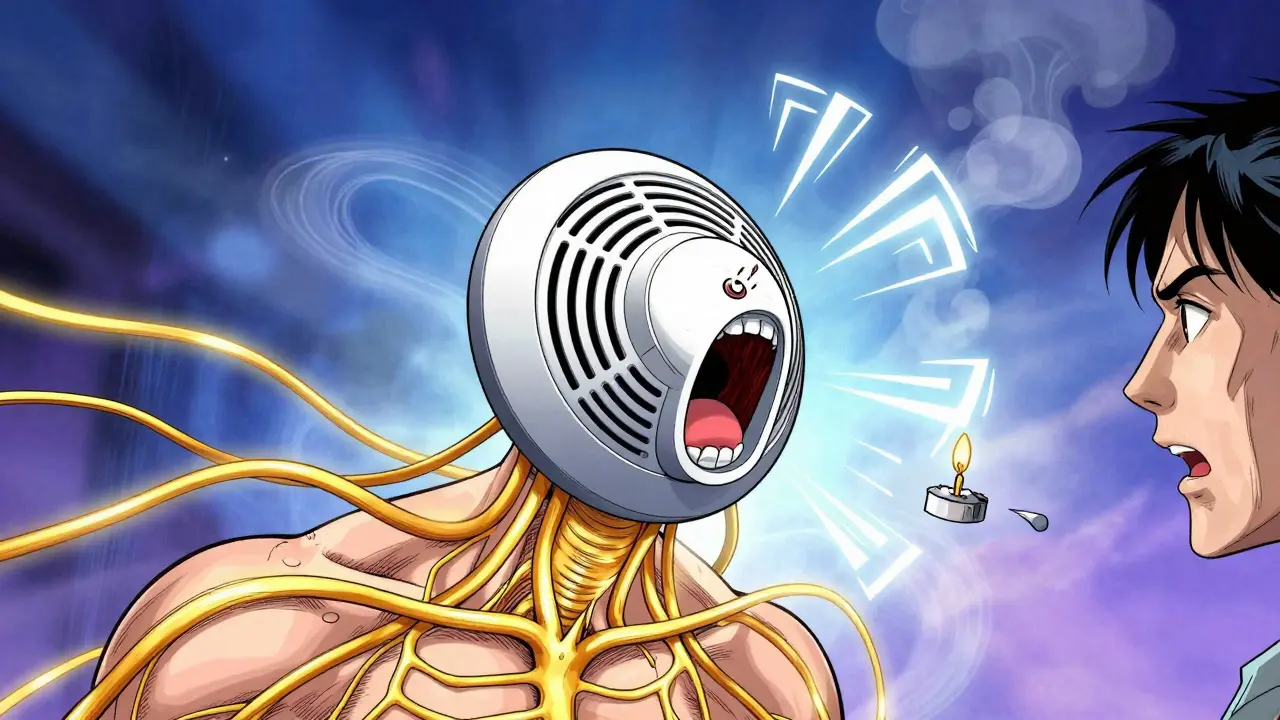
Imagine your body has a smoke alarm system designed to protect you from danger. In a healthy system, the alarm goes off when there is a fire. But what happens when the alarm becomes so sensitive that it screams every time someone lights a candle or toasts a piece of bread? That is exactly what happens in the brain of someone living with chronic pain. For years, we were told that pain equals tissue damage-that if it hurts, something is broken. But science shows us that Pain Neuroscience Education (PNE) can actually rewire this experience by teaching you that pain is often a protective output of the brain, not a direct measure of injury.
When you've been hurting for months or years, the problem usually isn't the original injury; it's that your nervous system has stayed in "high alert" mode. This process is known as Central Sensitization, a state where the brain and spinal cord become hypersensitive, amplifying signals that shouldn't be painful. PNE doesn't try to "fix" a joint or a muscle; instead, it targets the brain's perception of threat to lower the volume of that smoke alarm.
The Shift from Tissue Damage to the Neuromatrix
For decades, the medical world relied on the biomedical model. If you had back pain, a doctor looked at an MRI, saw a bulging disc, and told you that was the cause. The problem? Many people with perfectly healthy spines feel intense pain, and many people with "terrible" MRIs feel nothing at all. This is where the Biopsychosocial Model comes in. It suggests that pain is a cocktail of biological, psychological, and social factors.
PNE introduces the concept of the Neuromatrix, a network of neurons in the brain that decides whether a sensation is dangerous. When you learn that your pain is a result of a sensitive nervous system rather than ongoing tissue damage, the "threat value" of the pain drops. Research using fMRI scans has shown that after PNE, there is a 22% reduction in activation in the insular cortex-the part of the brain that processes the emotional weight of pain.
How PNE Actually Works in Practice
You won't find PNE in a pill bottle or a surgery suite. It is a conversational therapy, usually delivered by a physical therapist or psychologist. Instead of focusing on anatomy, the provider uses metaphors and visual aids to explain how Neuroplasticity-the brain's ability to change-can be used to "unlearn" pain.
A typical session lasts about 30 to 45 minutes. You might hear the "sensitive smoke alarm" analogy or learn why stress and anxiety make your physical pain feel worse. By reducing Pain Catastrophizing (the tendency to assume the worst about your pain), you stop fearing movement. This breaks the cycle of fear-avoidance, where you stop moving to avoid pain, which actually makes your joints stiffer and your brain more sensitive.
| Feature | Biomedical Model | Pain Neuroscience Education (PNE) |
|---|---|---|
| Core Belief | Pain = Tissue Damage | Pain = Protective Brain Output |
| Focus | Anatomy & Imaging (MRI/X-ray) | Nervous System Sensitivity |
| Patient Role | Passive recipient of treatment | Active learner and manager |
| Goal | Fix the structural "leak" | Reduce threat and increase function |
Combining Education with Action
While understanding the science is a huge first step, the real magic happens when you pair it with movement. Data suggests that while PNE alone can reduce pain intensity by about 1.7 points on a 10-point scale, combining it with exercise or manual therapy can boost those outcomes by an additional 30-40%. This is because you are providing your brain with "safe" evidence. When you move a joint that you've been afraid to touch and realize it doesn't actually break, you are teaching your brain that the alarm was a false positive.
For example, a nurse dealing with fibromyalgia might use a 6-session PNE program to understand why her whole body feels tender. By combining this with "graded activity"-slowly increasing movement-she can shift from taking multiple pills a day to almost none. The education removes the fear, and the movement proves the safety.
Who Should Use PNE and Who Should Skip It?
PNE is a powerhouse for chronic conditions like persistent low back pain or fibromyalgia. In fact, it has been shown to improve disability scores by nearly 5 points on the Roland-Morris scale, far outpacing traditional "your-disc-is-slipped" education. However, it isn't a magic bullet for everything.
If you have acute pain-like a broken leg or a fresh surgical incision-PNE is less effective because, in those cases, there actually is significant tissue damage that needs to be addressed. Additionally, people with severe cognitive impairments may find the complex neurophysiology hard to grasp, making the approach less effective. The goal is to change your thinking; if you can't process the concepts, the threat value remains high.
Getting Started: The Path to a Different Experience
If you are struggling with pain that won't go away, look for a provider who mentions the "biopsychosocial" approach or is certified in PNE through organizations like the International Spine and Pain Institute. Don't be surprised if they don't spend much time looking at your X-rays; they are more interested in how your brain is interpreting those signals.
You can also explore digital tools. The "Pain Revolution" app is a great example of how these concepts are moving into the digital space, allowing people to learn about their nervous system at their own pace. The key is to stop asking "What is wrong with my body?" and start asking "Why is my brain producing this signal?"
Does PNE mean the pain is all in my head?
Absolutely not. The pain is very real. PNE simply explains that the source of the pain has shifted from the injury site to the nervous system. Your brain is producing a real pain signal, but it's doing so to protect you, even if the original injury has already healed.
How long does it take to see results with PNE?
It varies, but many patients report a shift in perspective within the first 3 to 6 sessions. While it doesn't always eliminate pain instantly, it typically reduces the fear associated with pain, which allows people to return to activities like walking or working much faster.
Can I do PNE on my own?
You can learn the concepts through books like the 'Explain Pain Handbook' or apps, but it's most effective with a clinician. A therapist can tailor the metaphors to your specific life experience and help you safely introduce movement so you don't trigger a flare-up.
Is PNE better than Cognitive Behavioral Therapy (CBT)?
They are different tools for different jobs. PNE focuses specifically on the biology of pain and the nervous system. CBT is broader and more effective if you are dealing with comorbid depression or anxiety. Many experts recommend using both for the best results.
Will PNE help with a recent surgery?
In the immediate post-surgical phase, pain is driven by actual tissue trauma, so PNE has limited impact. However, if the pain persists long after the surgery should have healed, PNE becomes incredibly valuable to prevent the pain from becoming a chronic, sensitized condition.

10 Comments
Classic case of maladaptive neuroplasticity. Most people are just stuck in a loop of somatic hyper-vigilance and don't realize their cortical remapping is skewed. You can't just 'think' your way out of a sensitized spinal cord without actual proprioceptive recalibration, but sure, metaphors are a great start for the masses.
Spot on! It's all about smashing that fear cycle and getting the body moving again. Once you realize your brain is just being a bit overzealous with the alarm bells, you can actually start taking your life back from the pain. Absolute game changer!
The distinction between the biomedical model and the biopsychosocial model is quite fascinating. It explains why so many of us spend years chasing ghosts on an MRI when the actual issue is the sensitivity of the signal processing itself.
This is an incredibly important perspective... truly... it helps us move away from the 'broken' mentality and toward a 'healing' mindset!!!
I love the smoke alarm analogy! :) It makes so much sense why stress makes everything feel worse. 🌸
Stop whining about the pain and start the graded activity! If you aren't pushing through the fear-avoidance loop, you're just stagnating in a state of low-level dysfunction. Get in there, utilize the neuroplasticity, and force your CNS to adapt or you'll never hit peak performance again!
The intersection of psychological safety and physical recovery is where the real work happens. It's about creating a space where the patient feels safe enough to challenge their own perceived limitations. We need more clinicians who prioritize the human experience over a grayscale image of a vertebrae. When a patient understands that their pain is a protective mechanism rather than a sign of failure, the psychological burden lifts. This allows for a much more aggressive approach to rehabilitation because the fear is gone. It is heartwarming to see the science backing up the idea that we can actually 'unlearn' the experience of chronic suffering. I believe this approach empowers the individual to become the primary driver of their own recovery. By focusing on the neuromatrix, we address the root of the perception rather than just the symptom. This is a shift toward a more holistic and compassionate form of medicine. It acknowledges the complexity of the human nervous system without dismissing the reality of the pain. The data on fMRI scans is particularly compelling because it gives a physical manifestation to a psychological shift. We are seeing a revolution in how we treat long-term disability. It's not about fixing a leak; it's about updating the software of the brain. This is the future of pain management, and it's about time we left the strictly biomedical era behind. Everyone deserves to know that their brain has the capacity to change and heal.
It is an absolute tragedy that so many souls have been led to believe they are permanently broken based on a mere scan! The revelation that our very brains can be retrained is nothing short of a miracle of modern science!
I am simply thirlled to see this info shared! I have struggleed with this for years and didnt know why. its such a reliif to know it is not all in my head but my nervous system is just too sensitive! So exicting!!
The information provided is quite enlightening. I appreciate the clear distinction between acute and chronic pain contexts.
Write a comment