
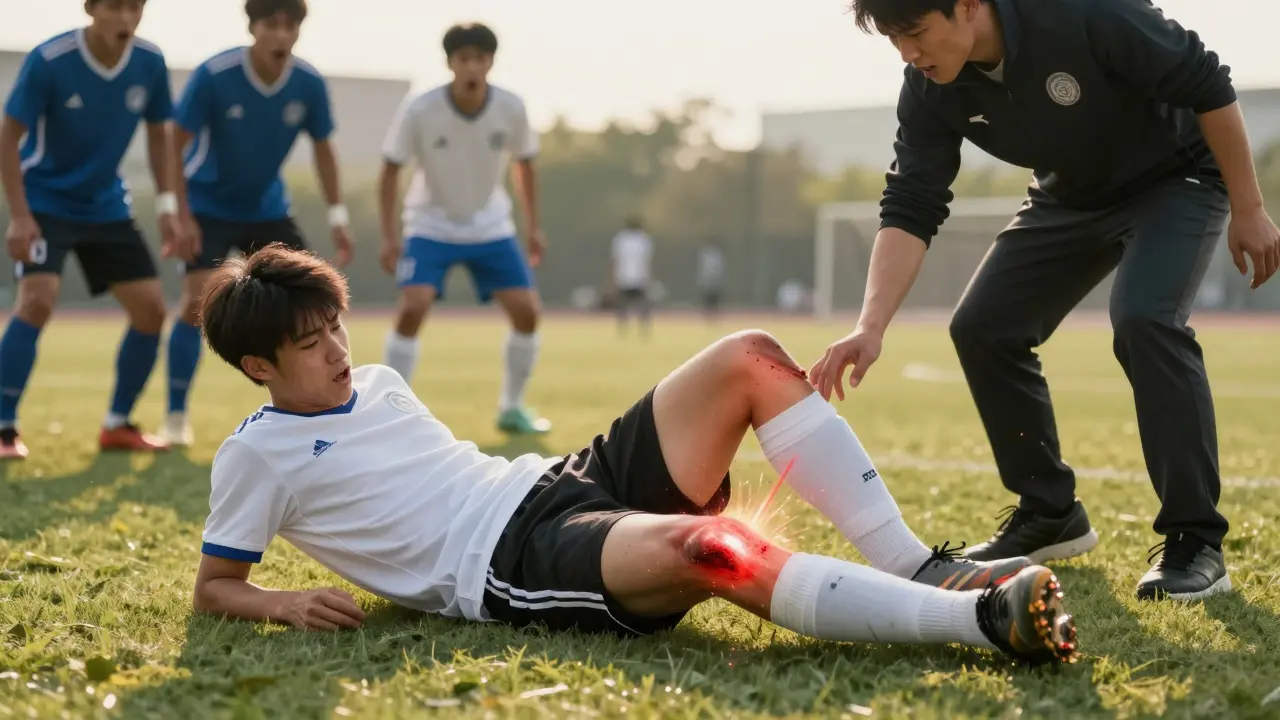
When your knee gives out during a soccer game, or you hear a loud pop while landing from a jump, you're not just dealing with pain-you're facing a decision that could change how you move for years to come. Two of the most common and serious knee injuries are tears to the anterior cruciate ligament (ACL) and the meniscus. They happen often, especially in athletes, but they're not the same. Understanding the difference isn't just medical trivia-it's the key to choosing the right path back to activity, or even just back to walking without pain.
What Happens When Your ACL Tears
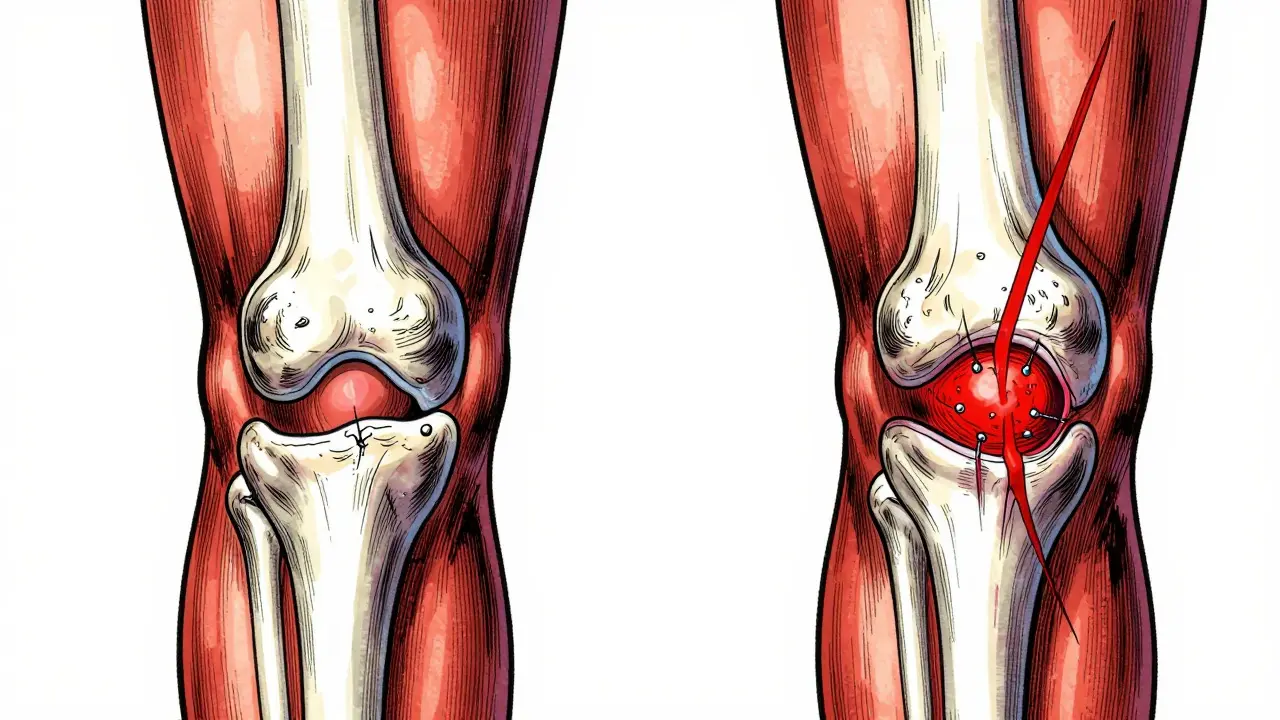
The ACL is the main ligament that keeps your shinbone from sliding too far forward under your thigh bone. It also stops your knee from twisting too far. When it tears, it doesn’t just hurt-it destabilizes your whole knee. About 70% of ACL tears happen without contact: a sudden stop, a bad landing, or a sharp turn. You’ll often feel or hear a pop. Swelling usually hits within two hours. By the next day, your knee might feel unstable, like it’s going to buckle when you stand or step down stairs.Doctors grade ACL tears from I to III. Grade I is a minor stretch. Grade III is a full rupture, which is what most people mean when they say "I tore my ACL." If you’re under 40 and active-whether you play basketball, hike, or just want to keep up with your kids-surgery is usually recommended. Studies show that 95% of active people in this age group will end up with ongoing instability if they don’t get it fixed. Without reconstruction, your knee will keep giving way, and that means more damage to the cartilage and meniscus over time.
The gold standard surgery is ACL reconstruction using your own tissue-called an autograft. The two most common options are the hamstring tendon and the bone-patellar tendon-bone graft. Hamstring grafts have slightly less post-op pain and faster healing in the front of the knee. Bone-patellar tendon-bone grafts are stronger, with a tensile strength of about 2,900N, making them ideal for high-demand athletes. Allografts (donor tissue) are faster to recover from initially, but in patients under 25, they have more than double the re-tear rate compared to autografts. A 2023 MOON study found 7.7% re-tear rates with autografts versus 22.2% with allografts in young athletes.
What Happens When Your Meniscus Tears
The meniscus is your knee’s shock absorber. There are two: one on the inside (medial) and one on the outside (lateral). They’re made of tough, rubbery cartilage that’s mostly water and collagen. Unlike ligaments, they’re not meant to heal easily. Their blood supply is limited. The outer third-the "red zone"-has good blood flow and can sometimes repair itself. The inner two-thirds-the "white zone"-has almost no blood, so tears there rarely heal on their own.Meniscus tears often happen with twisting motions, especially when the knee is bent. You might feel a sharp pain along the joint line, and sometimes your knee locks or catches. Swelling can take 6 to 24 hours to show up. Unlike ACL tears, many meniscus tears don’t need surgery. In fact, 60-70% of tears can be managed without an operation, especially if you’re over 40 or not doing high-impact sports.
But if you’re young and active, and the tear is in the red zone, repair is possible. A 2024 study from Dr. Laura Timmerman’s team showed that if you get a meniscus repair done within 8 weeks of injury, healing rates are 80-90%. Wait longer than 3 months, and that number drops to 40-50%. Why? Because the tissue starts to fray and degenerate. Delaying treatment increases the chance you’ll need a partial removal (meniscectomy) instead of a repair. Dr. Shah from Banner Health warns that delaying past 3 months raises the likelihood of needing a meniscectomy from 35% to 85%.
How Surgery and Recovery Differ
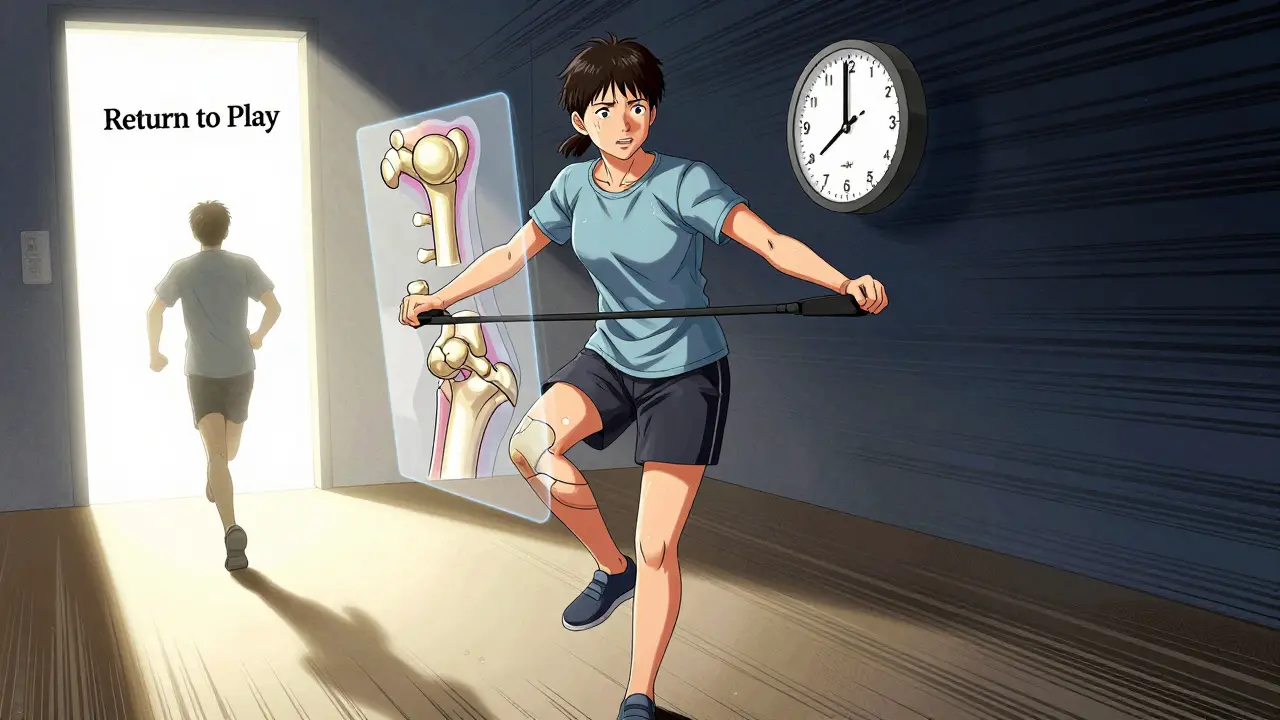
ACL reconstruction and meniscus repair are both done arthroscopically-small incisions, camera, tiny tools. But that’s where the similarities end.After ACL surgery, you’re on a 9-month timeline before returning to cutting, pivoting sports. The first two weeks are about regaining full knee extension and bending to 90 degrees. Weeks 3 to 6 focus on balance and strength. Around month 4, you start light jogging. By month 7, you begin sport-specific drills. At 9 months, you’ll be tested with single-leg hop tests and strength measurements. If you’re not hitting 90% symmetry on both legs, you’re not cleared. Rushing back before 9 months increases re-injury risk from 5% to 25%.
Meniscus repair is the opposite. You can’t put full weight on the leg for the first 6 weeks. You wear a brace locked between 0 and 90 degrees of bend. No squatting, no twisting. Weight-bearing is limited to 30% of your body weight. After 6 weeks, you slowly increase motion and strength. Return to sports takes 5 to 6 months. Meniscectomy (partial removal) is much faster: light activity in 2-4 weeks, full return in 6-8 weeks. But here’s the catch: every 10% of meniscus removed increases your long-term risk of osteoarthritis by 14%. That’s why surgeons now avoid removal unless absolutely necessary.
Cost, Success, and Long-Term Risks
ACL reconstruction costs between $15,000 and $25,000. Meniscectomy runs $6,000 to $12,000. Meniscus repair is more expensive-$9,000 to $18,000-because it’s more complex and requires longer recovery. Insurance covers both, but out-of-pocket costs vary.Success rates look good on paper. ACL reconstruction has 82-92% good-to-excellent outcomes at 2 years. But here’s what most patients don’t realize: 20-30% will develop osteoarthritis within 10 years. That’s because the injury itself, even with perfect surgery, changes how the knee moves and loads over time.
Meniscus repair has a 75-85% success rate if done early and in the right zone. But if you have a meniscectomy, you’re trading short-term relief for long-term risk. A 2020 study in the Annals of the Rheumatic Diseases found that removing even a small portion of the meniscus increases arthritis risk. The more you remove, the higher the risk. That’s why doctors now say: "Repair if possible. Remove only if you must."
Real Stories, Real Outcomes
Reddit user u/KneeWarrior99 had ACL reconstruction with a hamstring graft. He said he regained 90% strength by 6 months, but at 12 months, his MRI showed 15% less muscle mass in his quad compared to the other leg. He still felt weak. Another user, u/MeniscusMom, had a medial meniscus repair. She wore a brace for 6 weeks with flexion limited to 90 degrees. She ended up with a 20-degree permanent loss of full knee extension.Healthgrades reviews show 4.2 out of 5 for ACL surgeons. Patients praise clear communication about graft choices. But 63% of negative reviews complain about the long rehab. For meniscus procedures, 82% of meniscectomy patients are satisfied, mostly because they got back to daily life fast. But 54% still had swelling at 6 months. Only 67% of meniscus repair patients reported satisfaction-mostly because recovery felt slow and uncertain.
What You Should Do Next
If you’ve just injured your knee:- Get an MRI within 2 weeks. Don’t wait. Tissue changes fast.
- Start physical therapy immediately-even if you’re considering surgery. Strengthening your quad and hamstrings before surgery cuts post-op weakness by more than half.
- Ask your surgeon: "Is this tear repairable?" If it’s in the red zone and you’re under 35, repair is likely your best bet.
- Ask: "Do I need surgery?" For ACL, if you’re active and under 40, the answer is usually yes. For meniscus, the answer is often no.
There’s no perfect outcome. But there is a smarter path. The goal isn’t just to fix the tear-it’s to protect your knee for the next 30 years. That means choosing the option that preserves as much natural structure as possible, even if it takes longer.
Can a meniscus tear heal without surgery?
Yes, many meniscus tears can heal without surgery-especially if they’re small, in the outer third of the meniscus (where blood flow exists), and you’re not active in high-impact sports. About 60-70% of meniscus tears are managed successfully with rest, physical therapy, and time. But if you’re young, athletic, or have a large tear with locking or catching, surgery is often needed to restore function.
How long does ACL recovery take?
Full recovery from ACL reconstruction takes 9 months, and sometimes up to a year, before returning to pivoting sports. This isn’t just about healing the graft-it’s about rebuilding strength, balance, and neuromuscular control. Returning too early increases re-injury risk dramatically. Most athletes who return before 9 months have a 20% or higher chance of re-tearing their ACL or injuring the other knee.
Is allograft or autograft better for ACL reconstruction?
For active patients under 25, autografts (using your own tissue) are better. They have a 15% lower re-tear rate than allografts (donor tissue). Hamstring autografts are common because they cause less pain in the front of the knee. Bone-patellar tendon-bone grafts are stronger and preferred for high-level athletes. Allografts allow faster early recovery but carry higher long-term failure rates, especially in young, active people.
Why do some meniscus repairs fail?
Meniscus repairs fail most often when the tear is in the white zone (poor blood supply), when the tear is complex (like a flap or degenerative), or when the repair is delayed beyond 3 months. Healing also drops if you put too much weight on the knee too soon. Repair success is 89% in the red-red zone, but only 43% in the red-white zone. Timing, location, and patient compliance with rehab are critical.
Will I get arthritis after ACL or meniscus surgery?
Yes, there’s a significant risk. About 20-30% of people develop osteoarthritis within 10 years after an ACL injury-even with perfect surgery. For meniscus surgery, removing even a small part of the meniscus increases arthritis risk by 14% per 10% of tissue removed. That’s why preserving the meniscus through repair, rather than removal, is now the top priority in orthopedic care.

8 Comments
Man, I just had my ACL reconstructed last year and wow, the rehab was a whole other job. I thought I'd be back on the soccer field in 6 months, but nope. Nine months felt like forever. They told me to be patient but honestly? I cheated a little at month 7 and did some light cutting - bad idea. My quad still feels weak on that side, and I get this weird clicking when I squat. But hey, I'm walking without pain, which is more than I could say a year ago. Physical therapy saved me, even when I hated it. Start PT early, like the post says. It’s not glamorous, but it’s the real MVP.
Also, my meniscus was fine, thank god. I read somewhere that if you're over 30 and not a pro athlete, you can often just rest it. My doc said most tears in the white zone just… fade away. Who knew your knee could be so chill?
You people are overcomplicating this. ACL tear? Get it fixed. Meniscus tear? If it's not locking, leave it alone. Stop searching for magic answers. Surgery isn't a failure - it's a tool. Stop being scared of your own body.
Oh sweet mercy this post is basically a textbook chapter with a Reddit filter. Look, I'm a PT for 15 years and I've seen every variation of knee disaster. The 9-month ACL timeline? Bullshit if you're not an athlete. I've had construction workers back on ladders at 5 months. Why? Because they had a job to do. And guess what? Their bodies adapted. The 90% symmetry rule? That's for people who think they're going to play in the NFL after a tear. Real life doesn't care about your MRI numbers.
Meniscus repair? Yeah, if it's in the red zone and you're under 30, go for it. But if you're 45 and you're not running marathons? Don't let your surgeon scare you into a $15k surgery. I've seen more failed repairs than successful ones because people didn't follow the brace rules. You think your knee is a smartphone? No. It's a damn bulldozer. Treat it like one.
And for the love of god, stop using allografts on 20-year-olds. That's not medical advice. That's a casino bet. Autografts win every time. End of story.
USA STRONG 💪🇺🇸
Why do we even use donor tissue? We got the best surgeons, the best athletes, the best knees in the world! Allografts? That's for people who don't believe in American ingenuity. Hamstring grafts? YES. Bone-patellar? EVEN BETTER. We don't take shortcuts. We build. We heal. We dominate.
Also meniscus tears? If you're not playing pro sports, you're just weak. Go lift. Go move. Stop whining. Your knee ain't broke. You are.
PS: I had both done. 10/10. No regrets. 💥
Just had my meniscus repair 4 months ago and honestly? The brace was the worst part. Locked at 90 degrees for 6 weeks? I forgot what full extension felt like. But I stuck to the plan - no twisting, no squatting, no rushing. Now I'm walking without pain and even hiking again. The doc said I'm one of the 85% who healed. I think it's because I did PT every day, even on weekends. It's not glamorous, but it works. If you're considering repair, don't wait. I waited 5 weeks and I swear I could feel the tissue starting to fray. Don't be like me - act fast.
As someone from India where access to orthopedic care is uneven, I find this post deeply informative. In urban centers, ACL reconstruction is routine - but in rural areas, many patients are told to "rest and wait," with no MRI, no PT, no follow-up. The statistics here are vital: 60-70% of meniscus tears can be managed conservatively. That’s not just a medical insight - it’s a lifeline for people who can't afford surgery.
What’s missing, though, is the socioeconomic layer. A $20,000 ACL surgery might as well be a moon landing for many. We need systems that prioritize prevention, rehabilitation, and accessible care - not just cutting and grafting. The knee isn’t just a mechanical joint. It’s dignity. It’s mobility. It’s the ability to work, to walk to school, to carry water. Let’s not reduce this to a surgical checklist.
Also - the 14% increased arthritis risk per 10% removed? That’s a quiet epidemic. We need public health campaigns, not just surgeon blogs.
So you're telling me I need to wait nine months to play soccer again? That's absurd. I don't have time for this. My knee popped, I got an MRI, I'm going to the gym tomorrow. Why are we even having this conversation?
How quaint. We’ve reduced the profound, existential rupture of a ligament - a metaphysical severing of one’s physical autonomy - to a flowchart of graft options and rehab milestones. How convenient. How… American. The body is not a machine to be fixed. It is a narrative, a story written in collagen and cartilage. And yet, we treat it like IKEA furniture with a missing Allen wrench.
And let’s not forget: the real tragedy isn’t the tear. It’s the cultural imperative to return. To perform. To be *productive*. We don’t mourn the loss of a meniscus. We mourn the loss of productivity.
Perhaps the real surgery is not in the knee… but in the soul. But I suppose that’s too poetic for a 4.2-star Healthgrades review.
Write a comment