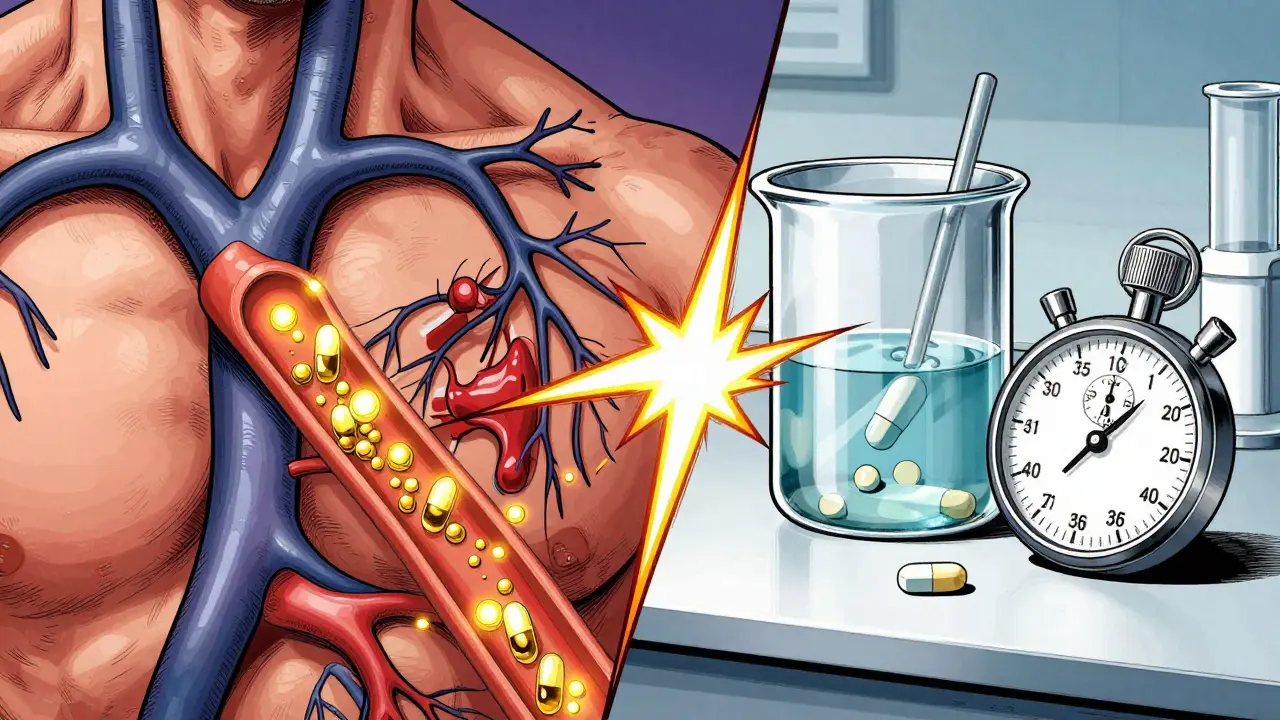
Imagine spending millions of dollars and two years of development only to find out your generic drug doesn't match the brand-name version in a human body. That is the nightmare scenario in pharmaceutical development. To prevent this, regulatory bodies like the FDA require bioequivalence testing to prove that a generic drug delivers the active ingredient to the bloodstream at the same rate and extent as the original. But how do you actually prove it? You either test it in a living system (in vivo) or in a controlled lab environment (in vitro). Choosing the wrong path can lead to massive financial losses or, worse, a rejected drug application.
Essentially, bioequivalence is about ensuring that two different drug products provide the same therapeutic effect. If the generic version is absorbed too slowly, it might not work; if it's absorbed too quickly, it could be toxic. To avoid these risks, developers must decide which testing methodology fits their specific molecule and delivery system.
| Feature | In Vivo Testing | In Vitro Testing |
|---|---|---|
| Environment | Human subjects (Living) | Laboratory (Test tubes/Apparatus) |
| Cost | High ($500k - $1M+) | Low ($50k - $150k) |
| Timeline | 3 - 6 months | 2 - 4 weeks |
| Key Metric | Plasma concentration (Cmax, AUC) | Dissolution rate, particle size |
| Variability | High (Human biological differences) | Low (Strictly controlled) |
Understanding In Vivo Bioequivalence Testing
When the stakes are high or the drug's behavior in the body is unpredictable, In Vivo Bioequivalence is the gold standard. This method involves administering the drug to human volunteers and measuring exactly how much of the active moiety reaches the site of action. In most cases, this is done by tracking the drug's concentration in the blood plasma over time.
The typical setup is a "2×2 crossover design." This means a group of about 18 to 24 healthy adults takes the reference drug, goes through a "washout period" to clear the drug from their system, and then takes the generic version (or vice versa). By comparing the two, researchers look for two main numbers: Cmax (the peak concentration) and AUC (the total area under the curve, representing total exposure). For a drug to be considered bioequivalent, the 90% confidence interval for the ratio of these means must fall between 80.00% and 125.00%.
Why go through all this trouble? Because humans are complex. Factors like gastrointestinal motility, stomach pH, and enzyme activity can drastically change how a drug is absorbed. A lab test can't always predict if a drug will be absorbed differently when a patient eats a high-fat meal or has a specific gut microbiome.
The Precision of In Vitro Bioequivalence Testing
On the other side, In Vitro Bioequivalence testing happens entirely in the lab. Instead of human subjects, scientists use specialized equipment like the USP apparatus to simulate the environment of the body. The most common method is dissolution testing, where the drug is placed in a medium that mimics stomach or intestinal fluid to see how quickly it dissolves.
For certain products, the FDA accepts a suite of specific laboratory tests instead of human trials. This is common for complex delivery systems. For example, with inhalers or nasal sprays, the FDA looks at:
- Droplet size distribution using laser diffraction.
- Drug delivery per actuation (how much actually comes out).
- Particle size distribution via cascade impactors.
- Priming and repriming efficiency.
The biggest draw here is the lack of variability. In human studies, you might see a coefficient of variation (CV) of 10-20%, but in the lab, it's often below 5%. This makes the results incredibly reproducible and much cheaper to achieve.

When to Choose In Vitro Testing (and the Biowaiver)
You don't always need a human trial. In many cases, you can apply for a Biowaiver-essentially a permission slip from the regulator to skip in vivo testing. But you can't just ask for one; you have to prove your drug fits specific criteria, usually based on the Biopharmaceutics Classification System (BCS).
In vitro testing is usually the way to go if:
- The drug is BCS Class I: This means it has both high solubility and high permeability. If the drug dissolves easily and passes through membranes quickly, the FDA is likely to grant a biowaiver. In 2021, about 78% of biowaivers for Class I drugs were approved.
- The drug acts locally: If you have a topical cream for a skin rash, the drug doesn't need to enter the bloodstream to work. Measuring plasma levels in a human would be pointless.
- The delivery is too complex: For metered-dose inhalers, getting a precise, repeatable dose in a human subject is a nightmare. Lab-based cascade impactors provide much more reliable data.
- You have a strong IVIVC: If you can prove a "Level A" In Vitro-In Vivo Correlation (meaning your lab results perfectly predict human results with an r² > 0.95), the regulator may let you rely on the lab data.
When In Vivo Testing is Non-Negotiable
Despite the cost, some drugs are too risky to test only in a lab. The FDA doesn't gamble with "Narrow Therapeutic Index" (NTI) drugs. These are medications where a tiny change in dose can lead to a massive change in effect or toxicity. Think of warfarin (a blood thinner) or levothyroxine (for thyroid issues). For these, the equivalence limits are tightened from the usual 80-125% to a much stricter 90.00%-111.11%.
In vivo testing is also mandatory if:
- Food effects are significant: Some drugs are absorbed differently if taken with food. In these cases, you need both fasting and fed-state human studies.
- Pharmacokinetics are non-linear: If doubling the dose doesn't double the blood concentration, lab models usually fail to capture this complexity.
- The site of action is systemic: If the drug must travel through the blood to reach the heart or brain, you have to prove it actually gets there.

Real-World Trade-offs: Cost vs. Risk
From a business perspective, the choice is often a gamble on time and money. A formulation scientist at Teva once reported saving $1.2 million and eight months of development by using in vitro dissolution for a BCS Class I product. However, that saving came with a catch: they spent three extra months just developing the lab method to satisfy the FDA's strict requirements.
The risk of relying solely on in vitro data is the potential for "post-marketing surprises." A regulatory manager from Viatris mentioned a topical antifungal that was approved via lab tests, only for the company to find efficacy differences once it hit the market. They were forced to run a post-marketing in vivo study, costing them $850,000 and delaying their market expansion by nearly a year.
If you're deciding which path to take, consider this rule of thumb: if your drug is a simple, highly soluble pill (BCS Class I), go in vitro. If your drug is a high-potency hormone or a blood thinner, don't even think about skipping the human trials.
What is the main difference between in vivo and in vitro BE testing?
The primary difference is the environment. In vivo testing is conducted in living human subjects to measure actual drug absorption in the bloodstream. In vitro testing is conducted in a laboratory using apparatus and chemical mediums to simulate how a drug dissolves and releases its active ingredient.
Can a company skip human trials for a generic drug?
Yes, through a process called a biowaiver. This is most common for drugs that are highly soluble and highly permeable (BCS Class I) or for locally acting products like some topical creams and nasal sprays, provided the in vitro data is robust and meets regulatory standards.
Why are Narrow Therapeutic Index (NTI) drugs treated differently?
NTI drugs have a very small window between a therapeutic dose and a toxic dose. Because lab tests cannot perfectly replicate human biological variation, the FDA requires in vivo studies with much tighter equivalence limits (90.00%-111.11%) to ensure patient safety.
How long does a typical in vivo BE study take?
An in vivo study typically takes 3 to 6 months from start to finish. This includes the time needed for protocol development, recruiting 18-24 healthy volunteers, the actual dosing periods, and the washout periods between those doses.
Which is more accurate: in vivo or in vitro?
It depends on what you mean by "accurate." In vitro testing is more precise and reproducible (lower variability). However, in vivo testing is more clinically relevant because it accounts for the actual complex biological interactions that happen inside a human body.
Next Steps for Developers
If you are currently in the formulation phase, your first move should be a detailed BCS classification. If you fall into Class I, start your method development for dissolution testing immediately to pursue a biowaiver. If you are dealing with a complex nasal or inhaled product, look into cascade impactor testing and PBPK (physiologically based pharmacokinetic) modeling to bridge the gap between the lab and the patient.
For those dealing with high-risk or NTI drugs, start your clinical site selection early. Since in vivo studies require certified research units and 21 CFR Part 11 compliant data systems, the logistical setup often takes longer than the actual testing itself.