
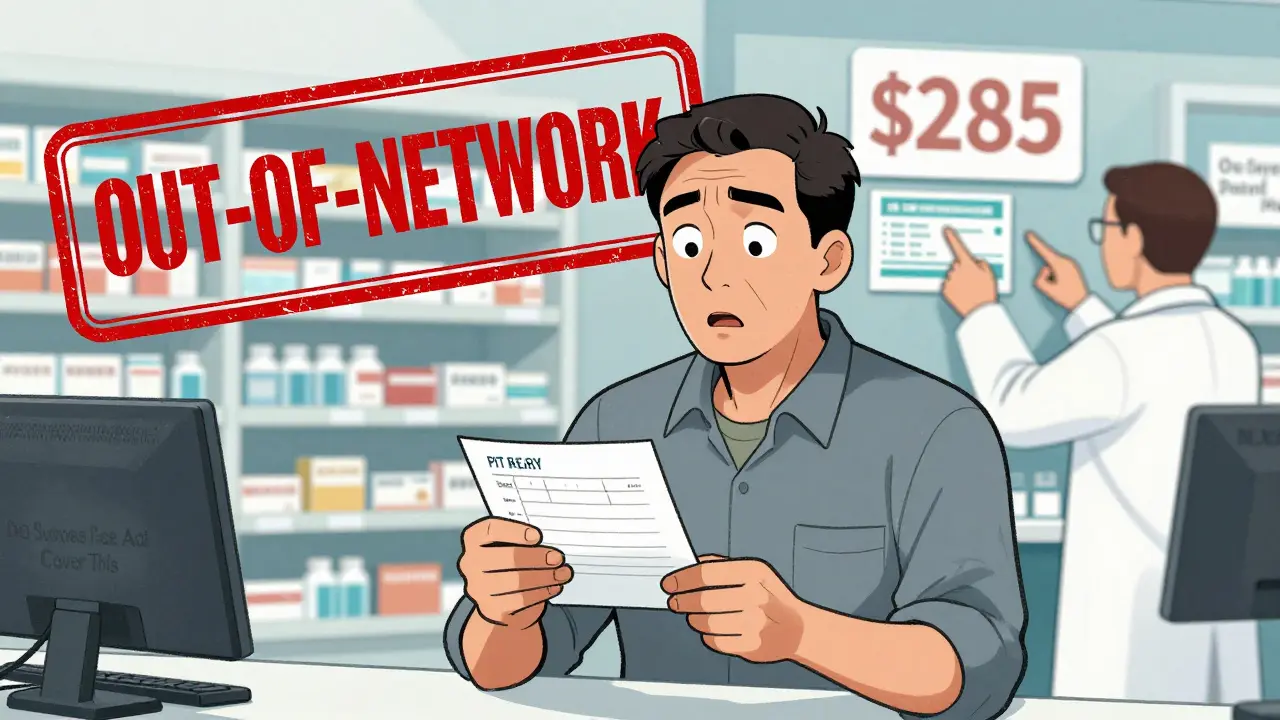
Imagine this: you walk into your local pharmacy to pick up a monthly prescription, and the pharmacist says, "That’ll be $285." You’re stunned. Last month, the same drug cost $32. You didn’t change plans. You didn’t switch pharmacies. You didn’t even get a notice. This isn’t a mistake. It’s a pharmacy network surprise - and it’s happening to millions of people every year.
The No Surprises Act, which went into effect in January 2022, was supposed to stop unexpected medical bills. But here’s the catch: it doesn’t cover prescriptions. That’s right. While emergency room visits, anesthesiology, and radiology services are protected from surprise billing, your insulin, your blood pressure pill, or your cancer drug? Not protected. The law was never designed to touch pharmacy benefits. Those are handled by separate systems - pharmacy benefit managers (PBMs) like CVS Caremark, Express Scripts, and OptumRx - and they operate under completely different rules.
Why Your Pharmacy Isn’t Covered by the No Surprises Act
The No Surprises Act targets balance billing - when an out-of-network provider charges you the difference between what your insurance agreed to pay and what they billed. That’s why you won’t get a $5,000 bill after an ER visit if the doctor wasn’t in-network. But pharmacy costs don’t work that way. Instead of balance billing, you face higher copays or full retail prices when you use an out-of-network pharmacy. There’s no cap. No negotiation. No automatic protection.
Here’s how it breaks down: your health plan has two separate networks - one for doctors and hospitals, and another for pharmacies. Just because your doctor is in-network doesn’t mean your local CVS or Walgreens is. In fact, 92% of large employers use separate PBMs to manage drug coverage, which means your pharmacy network might be narrower than your medical network. A 2023 Kaiser Family Foundation survey found that 28% of insured adults faced unexpected pharmacy costs in the past year. Of those, 63% paid over $100, and nearly one in five paid more than $500.
How Out-of-Network Pharmacies Work
When you fill a prescription at an in-network pharmacy, your insurer has already negotiated a discounted price. The pharmacy agrees to accept that price as payment in full (minus your copay). But if you go to a pharmacy outside your plan’s network, they don’t have that deal. They charge you the full list price - sometimes called the “cash price.” And since most people don’t know what that price is, they assume their insurance will cover it like usual.
Specialty medications are especially risky. About 78% of Medicare Part D plans and 65% of commercial plans require you to use specific specialty pharmacies for drugs like those for MS, rheumatoid arthritis, or rare cancers. If you accidentally use a different pharmacy - even one that’s in-network for other drugs - you could pay 3 to 5 times more. One patient on Reddit reported paying $300 for a medication that normally cost $30. That’s not a glitch. That’s how the system works.
How to Check Your Pharmacy Network Before You Fill a Prescription
You can’t rely on your insurance card, your doctor’s office, or even your pharmacy’s website. You need to check directly with your plan or PBM. Here’s how:
- Use your plan’s online portal - Log in to your insurer’s website or app. Look for a section labeled “Pharmacy Network,” “Find a Pharmacy,” or “Drug Benefits.” Don’t just search for your doctor.
- Call your PBM - The number is usually on the back of your insurance card. Ask: “Is this pharmacy in my network for this specific medication?” Give them the name of the drug and the pharmacy’s address.
- Use the Medicare Plan Finder - If you’re on Medicare Part D, go to Medicare.gov/plan-compare. You can compare plans by drug coverage and pharmacy networks side by side.
- Ask for the pharmacy directory - Consumer Reports says most people ask for the “provider directory,” which only lists doctors. You need the separate “pharmacy network directory.”
Pro tip: If you’re switching plans, always check pharmacy networks before enrollment. A plan that looks cheaper might have a tiny pharmacy network that forces you to drive 30 miles just to fill a prescription.
What to Do If You’re Already Hit With a Surprise Bill
Even if you didn’t know, you’re not stuck. Here’s what to do:
- Call the pharmacy - Ask if they can reprocess the claim through an in-network pharmacy. Sometimes, they can transfer it to a nearby partner pharmacy.
- Contact your PBM - Explain the situation. Some PBMs have exceptions for hardship cases, especially if it was your first time using that pharmacy.
- Request a price match - If you know the in-network price (you can find it on GoodRx or SingleCare), ask the pharmacy if they’ll honor it. Some will, especially if you pay cash.
- File a complaint - If you’re on Medicare, contact 1-800-MEDICARE. For private insurance, file a complaint with your state’s insurance commissioner. In 2022, the Patient Advocate Foundation documented over 12,000 pharmacy billing disputes - many were resolved after complaints.
Special Cases: Specialty Drugs and Mail-Order Risks
Drugs for chronic conditions - like biologics, cancer treatments, or rare disease therapies - are often restricted to specialty pharmacies. These aren’t your local CVS. They’re mail-order or limited distribution pharmacies that require prior authorization. If you don’t follow the rules, you pay full price.
Here’s what to do:
- Ask your doctor: “Which specialty pharmacy does my plan use for this drug?”
- Confirm the pharmacy will accept your insurance before they ship.
- Never assume your regular pharmacy can fill it. Even if they carry the drug, they might not be authorized to dispense it under your plan.
Mail-order pharmacies are another trap. Some plans require you to use mail-order for 90-day supplies - and if you go to a local pharmacy instead, you’ll pay more. Check your plan’s rules before you refill.
What’s Being Done to Fix This?
There’s growing pressure to fix this gap. In 2023, Congress introduced the Pharmacy Benefit Manager Transparency Act, which would require PBMs to show real-time pharmacy network status at the point of sale. The Biden administration proposed $25 million in funding to study solutions. States like California and New York have introduced bills to extend surprise billing protections to prescriptions - but as of now, none have passed.
Meanwhile, the Department of Health and Human Services admitted in its 2023 report that pharmacy benefits were “outside the scope” of the No Surprises Act and that “additional consumer protections may be warranted.”
That means right now, you’re on your own. The system isn’t broken - it’s designed this way. And until laws change, the responsibility falls on you to check, double-check, and verify.
Bottom Line: Don’t Assume. Verify.
You can’t rely on luck, memory, or your doctor’s word. Every time you fill a prescription - even if it’s the same drug you’ve taken for years - check the pharmacy network. Use your plan’s tools. Call your PBM. Ask for the pharmacy directory. Don’t let a $300 bill become your new normal.
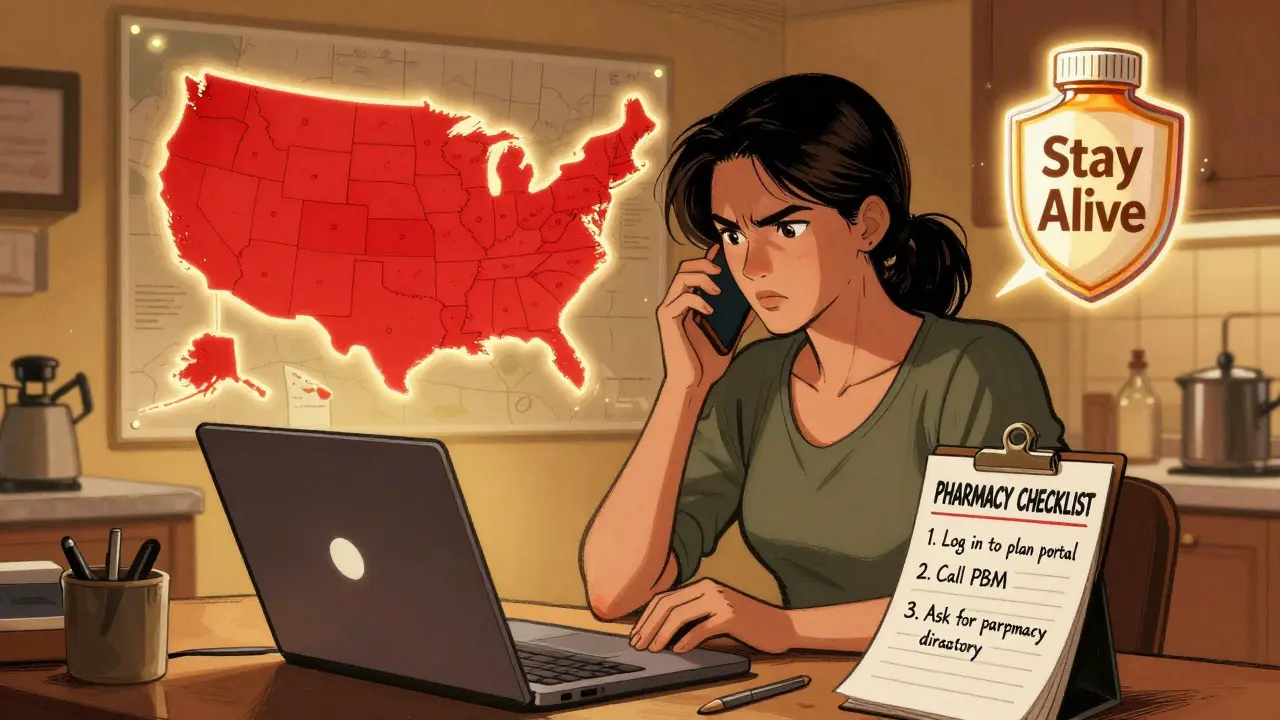
Pharmacy networks aren’t just a billing issue - they’re a health issue. If you skip your medication because you can’t afford it, you’re at risk. That’s why knowing your network isn’t about saving money. It’s about staying alive.
Is the No Surprises Act supposed to cover pharmacy bills?
No. The No Surprises Act, which took effect in January 2022, protects patients from surprise medical bills for emergency care, out-of-network providers at in-network facilities, and air ambulance services - but it explicitly excludes prescription drug coverage. Pharmacy benefits are managed separately by pharmacy benefit managers (PBMs), and federal law does not currently protect patients from out-of-network pharmacy costs.
How do I know if my pharmacy is in-network?
Don’t rely on your insurance card or your doctor’s office. Log in to your health plan’s website and search for the "Pharmacy Network" or "Find a Pharmacy" tool. Call your pharmacy benefit manager (PBM) directly and ask if your pharmacy is in-network for your specific medication. You can also use the Medicare Plan Finder if you’re on Medicare Part D. Always ask for the pharmacy directory - not the provider directory - because they’re different.
Why did my pharmacy bill jump from $30 to $300?
You likely used an out-of-network pharmacy. In-network pharmacies have negotiated discounts with your plan, so you pay only your copay. Out-of-network pharmacies charge the full retail price - sometimes called the "cash price" - and your insurance may cover little or nothing. This is common with specialty drugs or if you filled a prescription at a pharmacy that isn’t contracted with your PBM. Always verify your pharmacy’s network status before picking up your medication.
Can I get a refund if I got a surprise pharmacy bill?
Sometimes. Call the pharmacy and ask if they can reprocess your claim through an in-network pharmacy. You can also contact your PBM and explain the situation - some offer exceptions for first-time errors. If you know the in-network price (from GoodRx or your plan), ask if they’ll match it. If you’re on Medicare, call 1-800-MEDICARE. For private insurance, file a complaint with your state’s insurance commissioner. Many pharmacy billing disputes have been resolved this way.
Are mail-order pharmacies always in-network?
Not necessarily. Some plans require you to use their designated mail-order pharmacy for 90-day supplies. If you order from a different mail-order service - even if it’s well-known - you may pay full price. Always check your plan’s rules before ordering. Your PBM should tell you which mail-order pharmacies are in-network for your specific drug.

9 Comments
This is why I only use GoodRx. No insurance. No pharmacy network. Just pay cash and save 80%. Why are we even playing this game?
lol so PBMs are just middlemen who take 20% of the drug cost and call it 'negotiation'?? i mean come on. my uncle works at express scripts and he says they literally just move paper around and then bill the insurance for 'administrative fees'. we are being robbed and no one talks about it. also i just found out my insulin is 3x more expensive if i use walgreens vs cvs. same drug. same city. wtf. 🤡💸
You're overcomplicating this. Just check the pharmacy network before you walk in. It takes 2 minutes. If you're too lazy to do that, don't blame the system. You're not entitled to free medicine. Your plan pays for a service. You're supposed to verify the details. Simple.
I used to think this was just a financial issue. Then my mom skipped her heart meds because she couldn't afford the $400 bill for a $30 drug. She ended up in the ER. Now I see it as a death sentence disguised as a billing error. We're letting people die because we're too busy arguing about 'networks' instead of fixing the system. Sad.
Call your PBM. Always. It's that simple.
This whole thing is a psyop. The No Surprises Act was written by PBM lobbyists. They knew pharmacy would be excluded. Why? Because they want you to panic and switch plans every year. That’s how they make money. You think you’re saving $10/month? You’re paying $500 every time you refill. They want you confused. They want you scared. They want you to keep clicking 'enroll' without reading the fine print. Wake up. This isn’t capitalism. It’s behavioral manipulation.
I didn't even know there was a separate pharmacy network until I got hit with a $220 bill for a $40 script. I called my plan. They said 'oh yeah, that pharmacy dropped our contract last month.' No one told me. I'm not stupid. But no one told me. That's the problem. Not me. The system.
I work in healthcare IT. We built the systems that let this happen. The pharmacy network data is siloed. It doesn't sync with the medical network. It's not malicious. It's legacy tech. But that doesn't excuse it. We need to fix the infrastructure. Not just tell people to 'check their network'. That's like telling someone to 'check the wiring' when their house is on fire.
i mean... we live in a world where a 30-day supply of insulin costs less in canada than it does in the u.s. but we're arguing about pharmacy networks? 🤷♂️ it's not a network issue. it's a moral issue. we're letting people choose between food and medicine. and we call it 'the market'. i don't know if i'm angry or just... tired. 🌱💊
Write a comment