
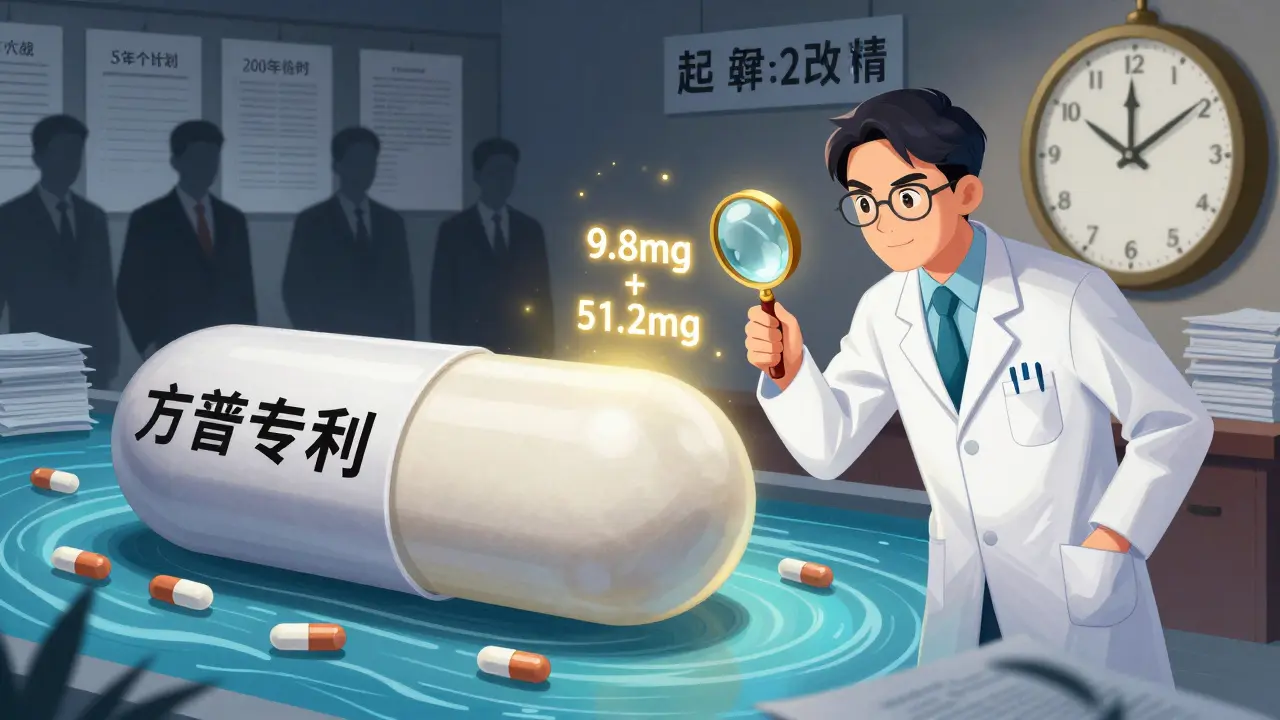
When a drug first hits the market, its patent clock starts ticking. Most people assume that once that 20-year patent expires, generics rush in and prices drop. But in reality, many brand-name drugs stay protected for years-sometimes over a decade-after their main patent expires. The secret? Formulation patents on drug combinations.
What Exactly Is a Formulation Patent on a Drug Combination?
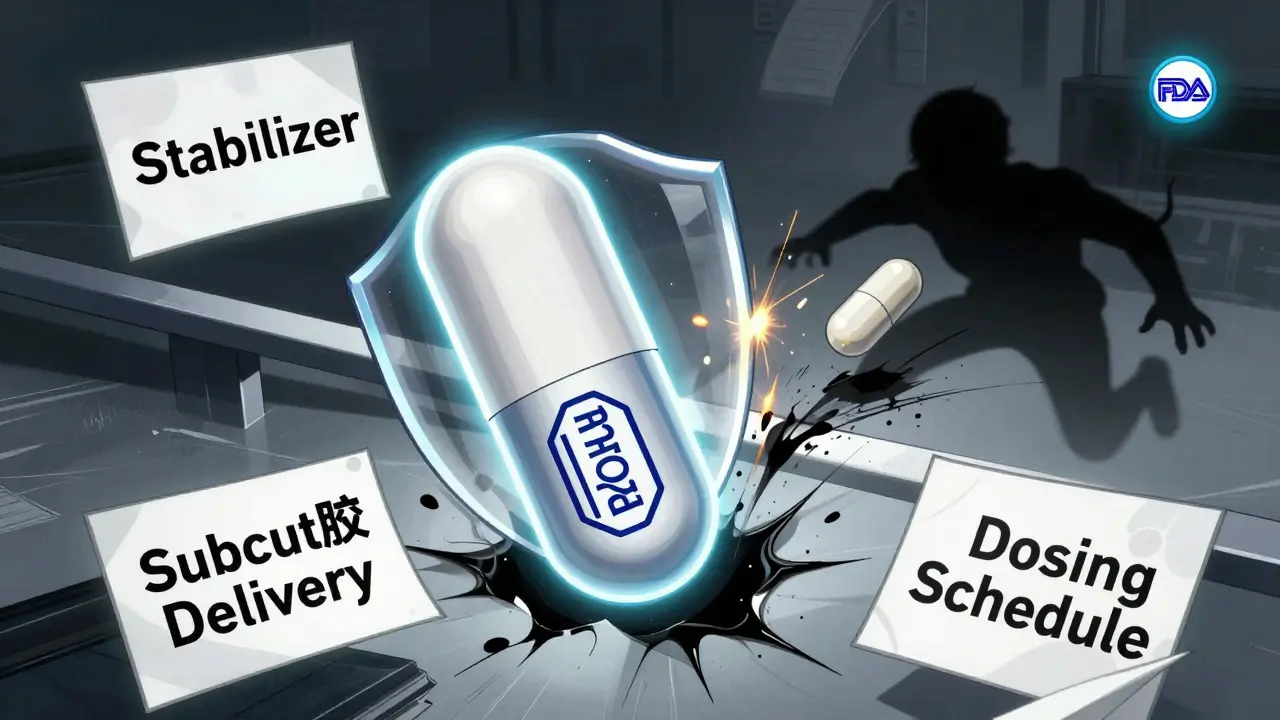
A formulation patent doesn’t protect the drugs themselves. Instead, it protects how those drugs are combined, delivered, or dosed. Think of it like this: if you have two drugs that work well separately, a formulation patent can lock down the exact mix of those two drugs in one pill, capsule, or injection-and even how fast they release in your body. For example, Roche’s Phesgo® combines trastuzumab and pertuzumab into a single subcutaneous injection. The original IV versions of these drugs had separate patents that expired. But Phesgo’s patent covers the specific ratio, the stabilizing agents, and the delivery method. That means even if generics can make trastuzumab or pertuzumab alone, they can’t legally copy Phesgo without infringing on this formulation patent. These patents are called “secondary” because they come after the original “composition-of-matter” patent that covers the drug’s chemical structure. While the primary patent usually lasts 20 years from filing, formulation patents can add 3 to 16 extra years of exclusivity. The U.S. Patent and Trademark Office (USPTO) found that drugs with strong secondary patent portfolios enjoy an average of 11.7 years of market exclusivity after approval-far longer than the 5-7 years generic manufacturers expect.Why Do These Patents Work? The Legal and Scientific Hurdles
You might think combining two known drugs is obvious. And under patent law, it usually is. The 2007 Supreme Court case KSR v. Teleflex made it harder to patent simple combinations. If two drugs are already used for the same condition, and you just put them together, that’s not enough. To get a formulation patent approved, companies must prove something unexpected happened. That could be:- A specific ratio that works better than any prior combination (e.g., 9.8 mg of Drug A + 51.2 mg of Drug B, not 10 mg + 50 mg)
- A delivery system that reduces side effects (like a slow-release tablet that avoids stomach irritation)
- A dosage schedule that improves patient adherence (e.g., one pill per day instead of three)
- A new stabilizer that extends shelf life without changing effectiveness
How Long Do These Patents Last? The Math Behind Exclusivity
The Hatch-Waxman Act of 1984 created a trade-off: faster generic entry in exchange for patent term extensions. Under this system, a drug company can apply for up to five extra years of patent life to make up for time lost during FDA review. But there’s a cap: total exclusivity can’t exceed 14 years after the drug is approved. That’s where formulation patents shine. They don’t always get the full five-year extension. But they stack. A drug might have:- A 20-year composition patent (filed early)
- A 5-year new chemical entity (NCE) exclusivity
- A 3-year exclusivity for a new formulation
- A 7-year orphan drug exclusivity (if treating a rare disease)
- Multiple formulation patents covering different delivery methods
The Dark Side: Evergreening and Regulatory Backlash
This strategy isn’t without controversy. Critics call it “evergreening”-extending monopoly power by making tiny changes that don’t improve patient outcomes. The Federal Trade Commission (FTC) has flagged this as a problem. In 2023, FTC Chair Lina Khan testified that secondary patents on minor formulation changes increase U.S. drug prices by 17-23% beyond what innovation justifies. The Congressional Research Service estimated these practices cost the U.S. healthcare system over $150 billion in potential savings by 2028. Some patents have been invalidated for being too obvious. Amgen tried to patent a device that automated the injection of Enbrel®. The court called it “obvious automation of a manual process” and threw it out. The legal bill? $147 million. Worse, some patents cover changes with no clinical benefit-like switching from a salt form to another, or changing the color of a pill. The FDA’s own data shows that 31% of combination patents filed between 2015 and 2022 involved no measurable improvement in safety or effectiveness. In response, the FDA proposed new rules in May 2024 requiring manufacturers to prove “clinical superiority” to qualify for 3-year exclusivity. If passed, this could block many of the weakest patents.How Generic Companies Fight Back
Generics don’t sit still. They file Paragraph IV certifications-legal challenges that claim a formulation patent is invalid or not infringed. In 2023, there were 842 such challenges, up from 517 in 2020. Success rates? 45%. One common tactic: targeting unpatented uses. In the Mylan v. Celgene case, Mylan got approval to sell a generic version of Revlimid®-but only for indications not covered by Celgene’s formulation patents. That forced the brand to restrict prescribing, which hurt sales. Another strategy: designing around the patent. If a patent claims “10mg + 50mg,” a generic might make “11mg + 49mg” and argue it’s different enough. Courts have accepted this in some cases. Patent attorneys on forums like Reddit say the most successful formulations have precise, almost arbitrary numbers-like 9.8mg and 51.2mg. Why? Because they’re specific enough to avoid prior art, but not so precise that they’re obviously arbitrary. It’s a legal tightrope.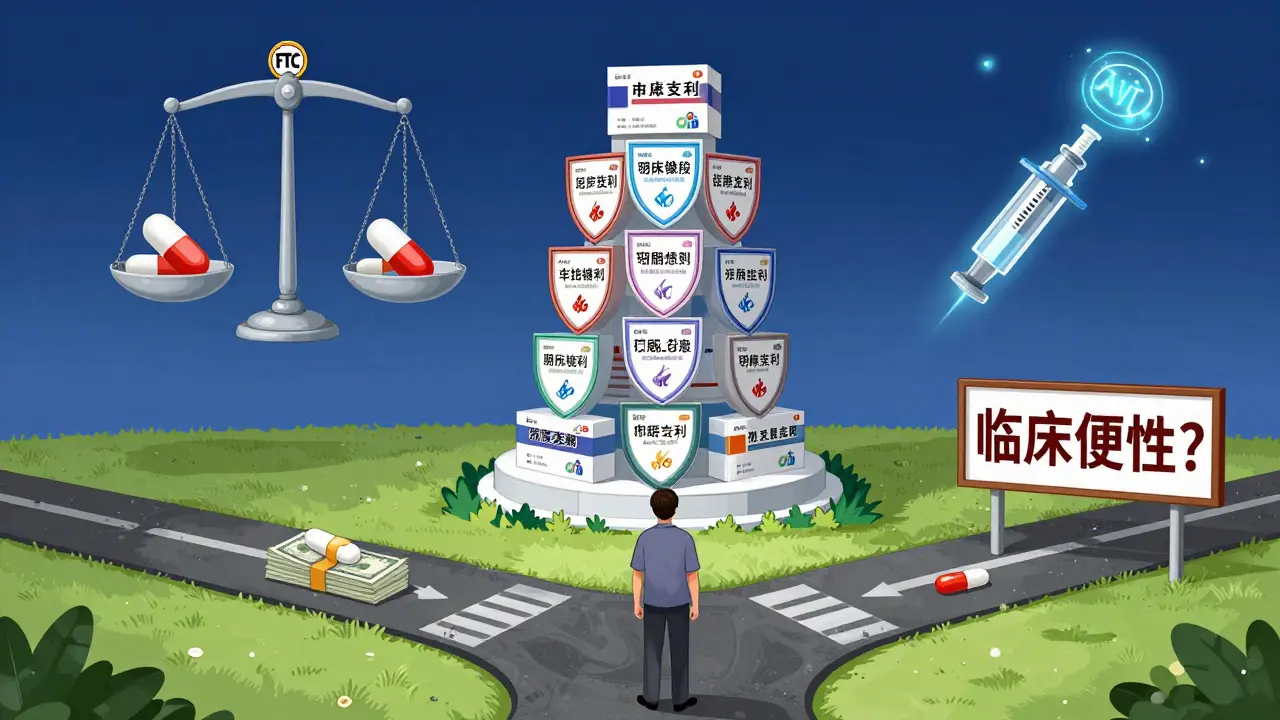
Who Benefits? Who Loses?
Big pharma wins. The top 10 drug companies average 14.7 formulation patents per blockbuster drug. Mid-sized firms? Just 3.2. That gap makes it nearly impossible for smaller companies to compete. Patients and insurers lose. A 2023 study found that drugs protected by formulation patents cost 3-5 times more than generics-even years after the original patent expired. In oncology, where combination therapies are common, patients often pay $10,000+ per month for a branded combo, while generics for individual components cost under $500. But here’s the twist: some of these patents do help. A fixed-dose combo that reduces pills from four to one improves adherence. A subcutaneous injection that replaces an IV infusion reduces hospital visits. These aren’t just profit plays-they’re patient-centered improvements. The key question isn’t whether formulation patents are good or bad. It’s whether they’re meaningful.The Future: Tighter Rules, Smarter Strategies
Regulators are pushing back. Congress is considering the Preserve Access to Affordable Generics Act, which would require “meaningful clinical benefit” to qualify for a secondary patent. If passed, up to 28% of current formulation patents could be wiped out. Companies are adapting. Instead of tweaking pill coatings, they’re building smarter delivery systems. Roche’s 2023 patent for a trastuzumab-deruxtecan combo with pH-sensitive release isn’t just a new pill-it’s a smart drug delivery system that activates only in tumor tissue. That’s innovation. The future of these patents won’t be about small changes. It’ll be about real advances: smart devices, targeted release, AI-guided dosing. The ones that survive will be the ones that actually improve care-not just profits.For now, the system remains a high-stakes game. Brands build thick walls of patents. Generics find cracks. Regulators try to balance innovation with access. And patients? They’re caught in the middle-paying more for drugs that might not be better, but are harder to replace.

12 Comments
So let me get this straight - the whole system is just a legal loophole where Big Pharma writes patents for things like ‘putting two drugs in the same pill’ and calls it innovation? 🤔
And we’re supposed to believe that 9.8mg + 51.2mg is some groundbreaking discovery? That’s not science - that’s math trolling.
I’ve seen patents for pill color changes. Color. Not dosage. Not efficacy. COLOR.
And the FDA approves this? The same agency that lets vape companies market fruit-flavored nicotine to teens?
This isn’t capitalism. This is feudalism with a patent attorney.
They’re not extending innovation - they’re extending monopoly.
And we pay for it. Every. Single. Month.
I’m not even mad. I’m just... disappointed.
Like, I thought the system had rules. Turns out the rules are written in invisible ink.
And the ink? It’s made of shareholder dividends.
Next up: patenting the word ‘pill’.
Oh. My. GOD.
This is the most terrifying, brilliantly horrifying exposé I’ve read in years.
Let me just say - if you thought the pharmaceutical industry was already a nightmare, you were WRONG.
They are not just extending patents - they are weaponizing chemistry, mathematics, and regulatory bureaucracy to create a financial death trap for patients.
And the worst part? It’s all LEGAL.
There’s no villain in a suit - there’s a whole LEGAL ARCHITECTURE built by lobbyists, judges, and FDA bureaucrats who’ve been bought off with revolving-door salaries.
And now we’re supposed to be grateful when they give us a ‘slightly better’ pill that costs ten times more?
It’s not innovation.
It’s extortion.
With a white coat.
And a patent number.
I need to lie down.
And maybe start a revolution.
Here in India, we see this every day.
Patents on combinations? We don’t have that luxury.
Our generics save lives - millions.
But when companies patent a 9.8mg + 51.2mg combo, they’re not protecting innovation - they’re protecting profit.
And it’s not just America - this trick is global.
Big pharma files these patents in the US, then blocks generics in Africa, Latin America, South Asia.
It’s colonialism with a patent office.
And yes - we know what 9.8mg looks like.
It looks like a child who can’t afford insulin.
It looks like a grandmother choosing between her pill and her food.
Patents should save lives.
Not sell them.
It’s not a patent. It’s a scam.
Done.
Next.
I appreciate the depth of this analysis. It’s rare to see such a nuanced breakdown of secondary patent strategies - especially with concrete examples like Phesgo and Nexium.
While I understand the frustration with evergreening, I also think we must acknowledge that some formulation patents do enable meaningful clinical improvements - like once-daily dosing or subcutaneous delivery that reduces hospital visits.
The challenge isn’t eliminating these patents - it’s ensuring that exclusivity is tied to demonstrable patient benefit, not arbitrary chemical tweaks.
Perhaps the FDA’s proposed ‘clinical superiority’ standard is a step in the right direction.
But enforcement will be key.
And oversight.
And transparency.
These aren’t just legal issues - they’re ethical imperatives.
OMG I’ve been screaming about this for YEARS 💥
Formulation patents = corporate extortion 🚨
And the FDA? More like FDA-ward (for-profit) 😭
Just last week, my friend had to pay $12k/month for a combo drug while the individual components cost $300 combined.
And the kicker? The combo has ZERO clinical superiority.
Same active ingredients.
Same efficacy.
Same side effects.
Just… prettier packaging.
And a patent that says ‘you can’t copy this because we said so’.
It’s not capitalism.
It’s feudalism with a white coat and a patent attorney 💼💊
WHO DO WE SUE??
It’s fascinating how the same people who claim to value ‘scientific rigor’ are perfectly fine with patents that hinge on decimal precision - 9.8mg, not 10.0mg.
It’s not science.
It’s legal fiction.
And the fact that the USPTO approves this without requiring a single clinical trial… well.
It’s not incompetence.
It’s intent.
They’re not trying to innovate.
They’re trying to outmaneuver the law.
And the public? We’re just the collateral.
Tragic.
But not surprising.
THIS ISN’T COINCIDENCE - IT’S A CONSPIRACY.
They’re not just patenting pills.
They’re patenting your health.
Every time you see a new ‘combo’ drug, ask yourself - did this actually improve outcomes?
Or did it just delay a generic by 7 years?
And who wrote those patents?
Lawyers. Not scientists.
Who approved them?
Regulators paid by the same industry.
Who profits?
Shareholders.
Who pays?
You.
And your kids.
And your Medicare.
And your insulin.
It’s not a market failure.
It’s a system designed to fail you.
And they’re laughing all the way to the Caymans.
💀💊
Honestly? This is one of those topics where I don’t know whether to be angry or just resigned.
On one hand, yeah - some of these patents are pure profit plays.
On the other hand, I’ve seen patients who couldn’t handle three pills a day - and a single combo tablet literally changed their life.
It’s messy.
Not black and white.
But the fact that 31% of these patents show no clinical benefit? That’s the problem.
Not the concept.
The abuse.
So maybe the solution isn’t to kill formulation patents.
But to demand proof - real, measurable, patient-centered proof - before granting exclusivity.
That’s fair.
And it’s doable.
How is this even legal? The whole system is a joke.
Patents are meant to incentivize innovation - not reward lawyers who can write a claim around a 0.2mg difference.
And let’s not pretend this is about ‘patient adherence’ - most of these ‘improvements’ are cosmetic.
Changing the tablet coating? Adding a stabilizer? Please.
These are not innovations.
They’re tax write-offs with a pill inside.
And the fact that mid-sized pharma only gets 3.2 patents per drug while the top 10 get 14.7? That’s not competition.
That’s a cartel.
And we’re all paying for it.
With our lives.
With our money.
With our dignity.
I’ve worked in pharma compliance for 15 years.
Let me tell you - this is how it works.
Companies don’t file these patents because they’re brilliant.
They file them because they have to.
Because if they don’t, the generics will eat them alive.
It’s not malice.
It’s survival.
But yes - the system is broken.
And the worst part? No one wants to fix it.
Because everyone’s getting paid.
Lawyers.
Execs.
Regulators.
Even the hospitals.
It’s a machine.
And we’re just the fuel.
One cannot help but observe that the entire framework of secondary patenting is a testament to the triumph of legal formalism over substantive innovation.
The notion that a 9.8mg:51.2mg ratio constitutes patentable novelty - rather than a trivial optimization - reveals a profound epistemological failure in the patent regime.
Moreover, the reliance on the Orange Book as a de facto registry of monopolistic extensions underscores a systemic collusion between regulatory bodies and corporate actors.
One must ask: is this the pinnacle of pharmaceutical progress?
Or merely its most sophisticated form of rent extraction?
And if the latter - then by what moral calculus do we justify the continued erosion of access?
Write a comment