
Most people don’t realize that nearly 7 in 10 adults under 50 carry one type of herpes virus. It’s not rare. It’s not shameful. It’s just common-and often misunderstood. Herpes simplex virus (HSV) doesn’t always mean visible sores or dramatic outbreaks. For many, it’s silent. But when it flares up, it can be painful, confusing, and emotionally heavy. Understanding the two main types-HSV-1 and HSV-2-along with their symptoms and how antiviral therapy actually works, makes all the difference in managing it.
HSV-1 and HSV-2: Two Viruses, One Family
Herpes simplex virus comes in two forms: HSV-1 and HSV-2. They look almost identical under a microscope-both are enveloped, double-stranded DNA viruses about 180-200 nanometers wide. But their behavior is very different.
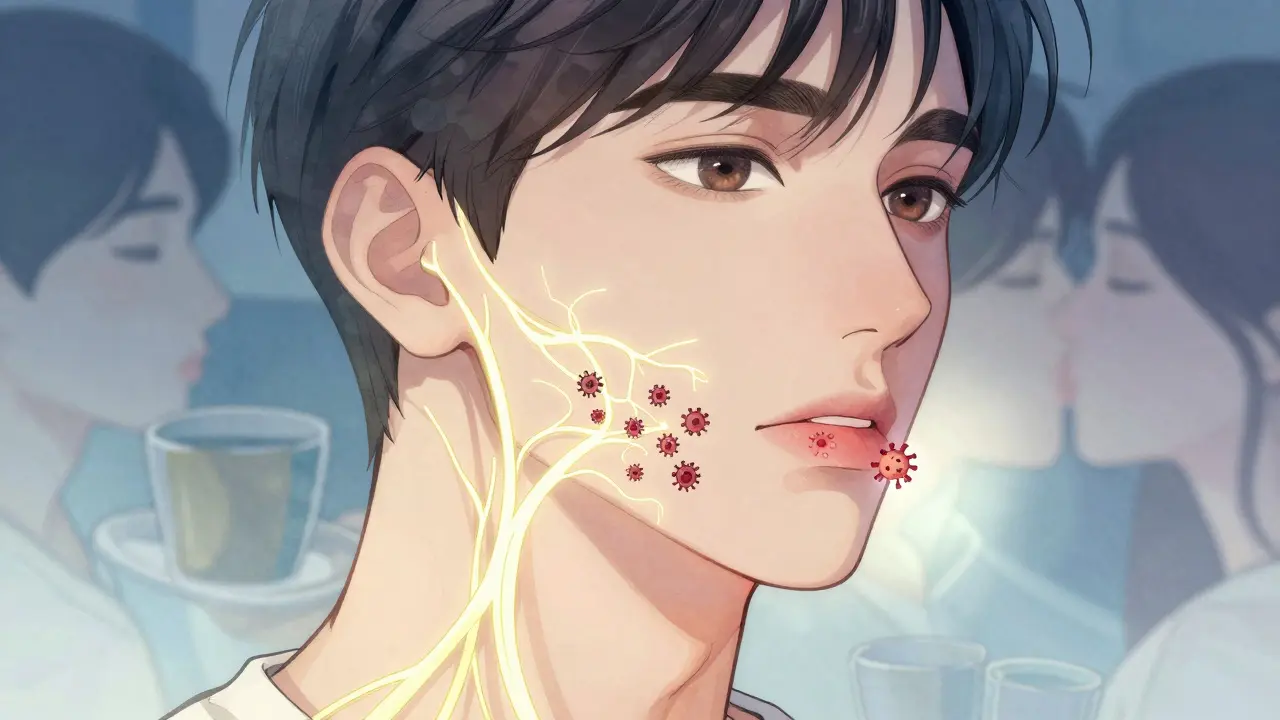
HSV-1 is the classic cold sore virus. It usually lives in the trigeminal ganglion, a cluster of nerves behind your cheekbone. For decades, it was thought to only cause mouth sores. But today, it’s responsible for 30-50% of new genital herpes cases in the U.S., especially among younger adults. Many people get HSV-1 as kids-through a kiss from a relative, sharing a cup, or even a hug. It often shows up as fever blisters around the lips, but sometimes it never causes any symptoms at all.
HSV-2, on the other hand, is the main cause of genital herpes. It hides in the sacral ganglia, near the base of your spine. About 1 in 8 people aged 15-49 have it, according to the WHO. Unlike HSV-1, HSV-2 prefers the genital area. It’s mostly spread through sexual contact. Even when there are no sores, it can still be passed on-this is called asymptomatic shedding.
Here’s the key: both viruses can infect either area. A person with oral HSV-1 can give genital HSV-1 to a partner during oral sex. And someone with genital HSV-2 can pass it to their partner’s mouth. The body doesn’t always distinguish between them. That’s why testing for type matters.
What Do Outbreaks Actually Look Like?
The first outbreak is usually the worst. For oral HSV-1, kids often get herpetic gingivostomatitis-painful mouth ulcers, swollen gums, fever over 38.5°C, bad breath, and trouble swallowing. About 1 in 20 of these cases require hospitalization.
For adults with genital HSV-2, the first outbreak hits hard: 93% report painful sores, 78% feel burning when peeing, 65% have swollen lymph nodes in the groin, and 40% get fever and muscle aches. The sores start as tiny red bumps, turn into fluid-filled blisters, then burst into open ulcers before crusting over. Healing takes 7-21 days. No scarring. But the pain? That lingers.
Recurrent outbreaks are usually milder. With HSV-1 on the lips, you might feel a tingling or burning for a few hours before a single blister appears. It heals in 5-7 days. With genital HSV-2, recurrences happen 4-5 times a year on average. HSV-1 genital outbreaks? Only 0.2-0.5 times per year. That’s a big difference.
Some people never have another outbreak after the first. Others get them every few months. It’s unpredictable. Stress, illness, sun exposure, or even your period can trigger one. But the virus is always there, hiding in your nerves.
Other Ways HSV Can Affect You
Herpes isn’t just about sores. It can show up in unexpected places.
Herpes keratitis-eye infection caused by HSV-1-is the leading infectious cause of corneal blindness in the U.S. About 50,000 new cases happen each year. Symptoms: redness, light sensitivity, blurred vision, feeling like something’s in your eye. Left untreated, it can scar the cornea. Treatment? Hourly antiviral eye drops like trifluridine.
Neonatal herpes is rare-about 1 in 3,200 births-but deadly. Most cases come from HSV-2, but HSV-1 can be just as dangerous. If a mother has an active outbreak during delivery, the baby can get infected through contact with the birth canal. That’s why doctors check for sores before labor. If there’s an outbreak, a C-section is often recommended. With proper care, transmission drops from 30-50% to just 1-3%.
Herpes encephalitis is rare-only 2 cases per million-but serious. HSV-1 causes 95% of these brain infections. It attacks the temporal lobe, causing seizures, confusion, and fever. It’s a medical emergency. Without quick treatment, it can be fatal.

How Antiviral Therapy Works
There’s no cure for herpes. But there are three main antiviral drugs that make living with it manageable: acyclovir, valacyclovir, and famciclovir.
All three work the same way: they block the virus from copying its DNA. That stops outbreaks from getting worse and helps sores heal faster.
For a first genital outbreak, the CDC recommends acyclovir 400mg three times a day for 7-10 days. That cuts healing time from 19 days down to 10. Pain drops from 12 days to 8. Valacyclovir (the prodrug of acyclovir) is often preferred because you take it fewer times a day-500mg twice daily for 7-10 days.
For cold sores, a single 2-gram dose of valacyclovir can shorten the outbreak by a day or two if taken at the first sign of tingling.
For people with frequent outbreaks (more than 6 a year), daily suppressive therapy helps. Taking valacyclovir 500mg once a day reduces outbreaks by 70-80%. It also cuts transmission to partners by nearly half. In one major study, partners of people on daily therapy were 48% less likely to get infected.
For people with weakened immune systems-like those with HIV or after transplants-higher doses are needed. IV acyclovir at 5-10mg/kg every 8 hours is standard. For resistant cases, foscarnet or the newer drug pritelivir may be used.
Resistance and New Treatments
Most people respond well to these drugs. But resistance is growing. About 10% of HSV isolates in HIV patients with low CD4 counts don’t respond to acyclovir. That’s why doctors test for resistance if outbreaks keep coming back despite treatment.
The FDA approved pritelivir in 2023 for acyclovir-resistant HSV. In trials, it reduced viral shedding by 87% in 48 hours-better than foscarnet. It’s not yet first-line, but it’s a lifeline for those who’ve run out of options.
Therapeutic vaccines are in development. Early trials show some can cut viral shedding by 50%. But none are approved yet. For now, antivirals remain the gold standard.
Diagnosis: What Tests Actually Tell You
Doctors don’t just guess. They test.
PCR swabs from active sores are the most accurate-95-98% sensitive. Results come back in 1-3 days. Viral culture is older and less reliable (only 70-80% sensitive), so it’s rarely used now.
If you don’t have sores, a blood test can check for antibodies. Type-specific tests (like HerpeSelect or EUROIMMUN’s recomLine) can tell HSV-1 from HSV-2 with over 96% accuracy. But you need to wait at least 12-16 weeks after exposure. Antibodies take time to build.
Many people are diagnosed too late-or never at all. Only 19% of Americans with HSV know they have it. That’s why testing matters, especially if you’ve had unprotected sex or a partner with herpes.
Living With It: Real Experiences
On Reddit, someone wrote: “First outbreak lasted 18 days. Fever to 39.2°C. Couldn’t pee without lidocaine. Then I started daily valacyclovir. Now I get 2-3 day outbreaks with one tiny blister. Life changed.”
Another said: “I tried acyclovir and got terrible nausea. Switched to famciclovir. No side effects. Outbreaks gone.”
Side effects from antivirals are usually mild: headache, nausea, or stomach upset. Kidney problems are rare and mostly happen in people with existing kidney disease.
But the biggest challenge isn’t physical-it’s stigma. In a survey of 1,500 people with herpes, 74% felt anxious about being judged. 45% had relationship problems. 32% waited over six months to tell a partner.
That’s why education matters. Herpes doesn’t define you. It’s not a punishment. It’s a common virus. You can still have sex, relationships, and a full life. Antiviral therapy makes transmission rare. Open communication makes fear disappear.
What You Can Do Today
- If you have a new outbreak, see a doctor within 24 hours. Starting antivirals early cuts healing time in half.
- If you’ve had herpes before, keep antivirals on hand. Take them at the first sign of tingling.
- If you’re in a relationship and one of you has herpes, talk about suppressive therapy. It reduces transmission risk by almost half.
- If you’re pregnant and have herpes, tell your OB-GYN. They’ll monitor you and plan delivery to protect your baby.
- Get tested if you’re unsure. Knowing your status removes guesswork.
Herpes isn’t going away. But with the right tools, it doesn’t have to control your life.
Can you get herpes from sharing a towel or toilet seat?
No. Herpes doesn’t survive long outside the body. It’s spread through direct skin-to-skin contact with an infected area-usually during kissing, oral sex, or genital contact. The virus dies quickly on surfaces, so towels, toilet seats, or bedding won’t transmit it.
Is herpes only contagious when you have sores?
No. The virus can shed asymptomatically-meaning you can pass it on even when there are no visible sores. This happens more often with HSV-2 (10-20% of days) than HSV-1 (5-10% of days). That’s why daily antiviral therapy is so effective at reducing transmission.
Can you have kids if you have herpes?
Yes. Most people with herpes have healthy babies. The risk is highest if you get infected late in pregnancy or have an active outbreak during labor. If you’ve had herpes before, your body has antibodies that protect your baby. Your doctor will monitor you and may recommend a C-section if sores are present at delivery.
Do antiviral drugs cure herpes?
No. Antivirals like acyclovir, valacyclovir, and famciclovir suppress the virus and reduce symptoms, but they don’t eliminate it from your body. The virus stays dormant in your nerves. You’ll need ongoing management, but most people live normally with few or no outbreaks.
How long do herpes outbreaks last?
First outbreaks usually last 7-21 days. Recurrent outbreaks are shorter: 5-10 days for genital HSV-2, and 5-7 days for oral HSV-1. Antivirals taken early can cut that time in half. Healing without treatment can take weeks, but there’s no scarring.
Can you get herpes from someone who never had a sore?
Yes. Up to 90% of people with HSV-2 don’t know they have it because they never had noticeable symptoms. But they can still shed the virus and pass it on. That’s why testing and open communication with partners are so important-even if neither person has ever had a visible outbreak.

10 Comments
I had my first outbreak at 19 and thought I was doomed. Turned out, it was just a weird stress thing. Now I keep valacyclovir in my medicine cabinet and take it at the first tingle. No more panic. Life goes on.
Also, no, you can’t get it from toilet seats. Stop worrying about that.
Stop acting like herpes is some innocent cold. It's a lifelong STI that ruins relationships and causes emotional trauma. People who say 'it's just common' are sugarcoating a serious health issue. You think it's no big deal until you're the one getting ghosted after disclosure.
And don't even get me started on asymptomatic shedding - that's just predatory behavior wrapped in medical jargon
As a medical professional from India, I must emphasize that antiviral therapy remains the cornerstone of HSV management. The data presented here is statistically robust and aligns with WHO guidelines. However, in resource-limited settings, access to valacyclovir remains a challenge. Generic acyclovir is widely available but requires thrice-daily dosing, which reduces adherence.
Moreover, cultural stigma in South Asia often delays diagnosis by years. Patients present with recurrent ulcers and are misdiagnosed as having fungal infections or tuberculosis. Education is not merely an option - it is a public health imperative.
HSV is a bioweapon disguised as a virus. The pharmaceutical industry profits from lifelong suppression. Why isn't there a cure? Because cures don't make money. The CDC and WHO are complicit. They push antivirals to keep you dependent. Meanwhile, natural remedies like lysine and zinc are ignored. And don't tell me about 'asymptomatic shedding' - that's just fearmongering to sell more pills.
Also, 7 in 10 adults? That's a lie. They're counting everyone who's ever been exposed, not infected. Big Pharma loves numbers like that.
People need to stop being so casual about herpes. It's not a party trick. It's a moral issue. If you're sexually active and you have herpes, you have a duty to disclose. Not 'maybe' - not 'if you feel like it' - but straight up, before anything happens. You're not being punished, you're being responsible.
And if you're not on suppressive therapy? You're playing Russian roulette with someone else's body. That's not love. That's negligence.
I come from a family where we never talked about sex or illness - until my cousin got diagnosed. She cried for three days. Then she started a YouTube channel in Hindi about herpes and now she helps hundreds of girls in small towns understand they’re not broken. I cried again - but this time from pride.
Herpes doesn’t erase your worth. It just means you’re human. And if you’re lucky, you’ll find someone who sees that - not the virus.
Also, thank you for writing this. It’s the first time I’ve seen real info that doesn’t make me feel like a leper.
So let me get this straight - you're telling me I can have a 2-gram dose of valacyclovir before a hot date and turn my herpes into a Tinder hack? 😎
Also, I got HSV-1 from my grandma’s kiss at age 3. So now I’m supposed to feel guilty because I kissed my partner? Nah. I’m just gonna keep kissing people and taking my meds. Life’s too short for shame.
And yes, I do have a whole drawer labeled ‘Herpes Emergency Kit’. You should too.
Herpes is a biological fact. Not a moral failure. Not a tragedy. Not a pandemic. Just a virus that happens to live in your nervous system.
Everything else is narrative. The stigma is manufactured. The fear is cultural. The meds are tools. The rest is noise.
I appreciate how this post avoids fearmongering. I used to think herpes meant I’d never be kissed again. Then I met someone who had it too - and we talked about it like we were discussing the weather. No drama. No guilt. Just honesty.
And yeah, I got HSV-1 from my mom’s cheek kiss when I was five. I’ve never had a sore. So maybe it’s not the virus that’s the problem - it’s what we’ve been taught to think about it.
Thanks for normalizing this.
OMG I JUST GOT MY FIRST OUTBREAK AND I THOUGHT I WAS GONNA DIE 😭
Then I read this and realized - I’m not alone. I’m not broken. I’m just a human with a virus that’s been around since ancient Egypt. And now I’ve got my valacyclovir in my purse like a superhero power 💪
Also, if you’re reading this and you’re scared? You’re gonna be okay. I promise. I’m here. We’re all here.
Write a comment