
Fournier's Gangrene Risk Checker
Critical Warning
Fournier's gangrene is a medical emergency. If you have any of the symptoms below, go to the ER immediately. Do not wait.
This tool helps you recognize potential signs. It does not diagnose or replace medical advice.
Select symptoms you're experiencing:
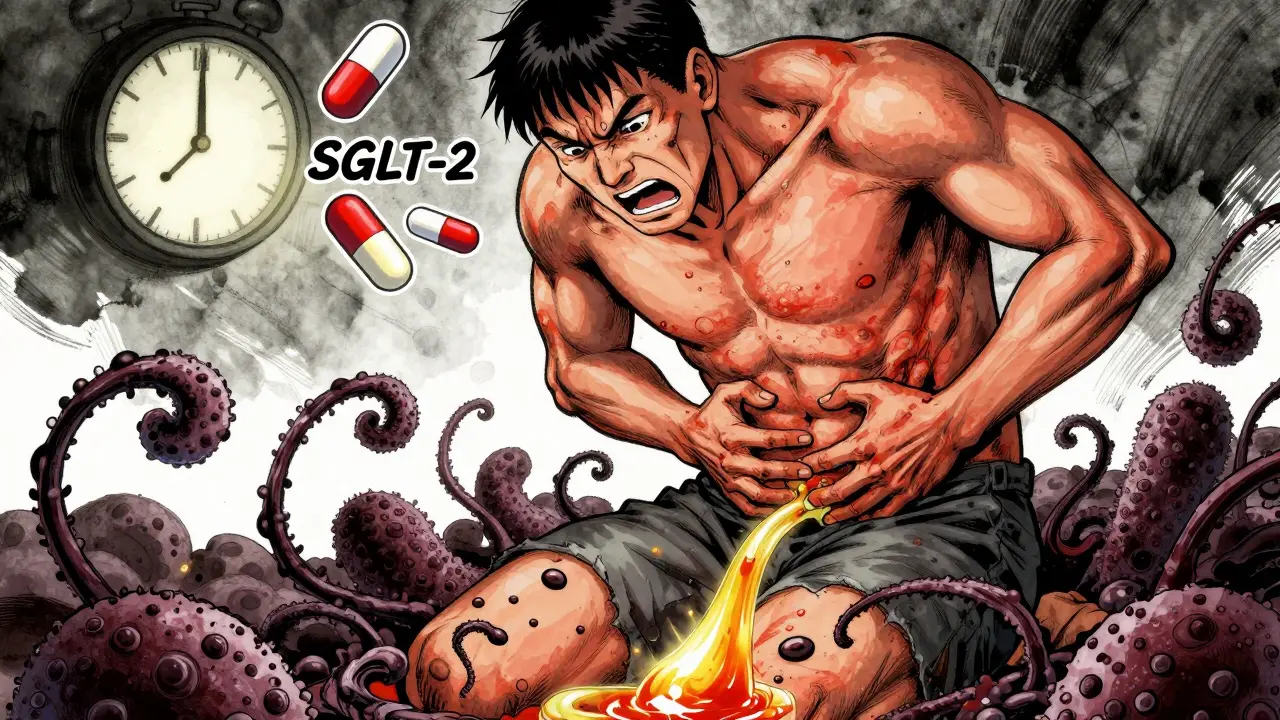
When you’re managing type 2 diabetes, finding the right medication can make a huge difference. But some of the most popular drugs - like Jardiance, a sodium-glucose cotransporter-2 (SGLT-2) inhibitor used to lower blood sugar by making the kidneys flush out excess glucose, Farxiga, and Invokana - carry a hidden, terrifying risk that most patients never hear about until it’s too late: Fournier’s gangrene, a rare, fast-spreading bacterial infection that eats away at skin and tissue in the genital and perineal area.
This isn’t a theoretical concern. Since 2013, when the first SGLT-2 inhibitor hit the market, the FDA has documented at least 12 confirmed cases linked to these drugs. By 2018, they issued a boxed warning - the strongest possible alert - after reports showed these medications could trigger a life-threatening infection that kills up to 16% of those who get it. What’s worse? It doesn’t just affect men. For the first time in medical history, women are being diagnosed at alarming rates, with one-third of reported cases occurring in females.
How a Diabetes Drug Turns Deadly
SGLT-2 inhibitors work by blocking glucose reabsorption in the kidneys. That means more sugar leaves your body through urine. Sounds harmless, right? But that extra sugar doesn’t just vanish. It lingers in the genital area, creating a warm, moist, sugary environment that’s perfect for bacteria and fungi to grow. What starts as a mild yeast infection or urinary tract infection can spiral into a full-blown necrotizing fasciitis - a flesh-eating infection - within days.
The real danger? It spreads fast. Unlike slow-growing infections, Fournier’s gangrene can destroy tissue in 24 to 48 hours. By the time most people realize something’s wrong, the infection has already reached the bloodstream. Hospitalization is almost always required. Many patients need multiple surgeries to cut out dead tissue. Some lose organs. A few don’t survive.
Emergency Signs You Must Act On
If you’re taking an SGLT-2 inhibitor, you need to know the warning signs - and act immediately. Don’t wait. Don’t hope it goes away. Don’t assume it’s just a rash or a UTI.
- Severe pain or tenderness in your genitals, anus, or inner thighs - especially if it feels worse than it looks
- Swelling or redness that spreads quickly around the groin, scrotum, or perineum
- Fever or chills that come on suddenly, even if you don’t feel sick otherwise
- Foul-smelling discharge from the genital or anal area
- Dark, bruised, or blackened skin in the affected area - this means tissue is dying
- Malaise - a deep, overwhelming feeling of being unwell, like the flu but worse
One woman, 71, on dapagliflozin, showed up at the ER with a large abscess and a foul odor. She had diabetes and obesity - two known risk factors - but didn’t realize the drug she took daily could be the trigger. By the time she got care, the infection had spread. She needed three surgeries. She spent weeks in the ICU.
Another patient, a 48-year-old woman with no prior history of infection, developed swelling and pain after starting empagliflozin. She thought it was a yeast infection. She waited three days. By then, the infection had reached her bloodstream. She survived - barely.
Who’s at Risk?
It’s not just older adults or people with obesity. While those are common risk factors, the FDA and European regulators have confirmed cases in women under 50 - people who never fit the old profile of Fournier’s gangrene. That’s why doctors now say: anyone on an SGLT-2 inhibitor should be aware.
Other risk factors include:
- Diabetes (especially if poorly controlled)
- Obesity (BMI over 30)
- Recent trauma or surgery in the genital area
- Immunosuppression from steroids or other drugs
- History of recurrent genital infections
But here’s the twist: you don’t need all of these. Some patients had none. They were healthy, active, and took their medication exactly as prescribed - and still got sick. That’s why regulators say the link is real, even if the risk is low.
What Happens If You Ignore It?
In 2020, a study of over a million people on SGLT-2 inhibitors found roughly 1 extra case of Fournier’s gangrene per 10,000 men treated. That sounds rare. But when you consider how fast it kills, even one case is too many.
Of the 19 cases reviewed in a 2019 study:
- 78.9% needed intensive care
- 63.2% required multiple surgeries
- 15.8% died
Compare that to the general population of Fournier’s gangrene patients - where death rates range from 7.5% to 50% - and you see how aggressive and unpredictable this infection is. With SGLT-2 inhibitors, it’s not just about the infection. It’s about how quickly it overwhelms the body.
What Should You Do?
If you’re on one of these drugs - canagliflozin, dapagliflozin, empagliflozin, or ertugliflozin - and you notice any of the signs above, go to the ER now. Don’t call your doctor. Don’t wait until morning. Don’t try to treat it yourself. This is a surgical emergency.
Doctors will:
- Start IV antibiotics immediately
- Perform emergency surgery to remove dead tissue
- Stop your SGLT-2 inhibitor
- Monitor your blood sugar closely - these drugs can cause dangerous spikes when stopped
There’s no home remedy. No cream. No OTC painkiller. Delaying treatment by even 12 hours can mean the difference between survival and death.

Should You Stop Taking Your Medication?
No - not unless you’re experiencing symptoms. The FDA, European Medicines Agency, and Medsafe all agree: the benefits of these drugs still outweigh the risks. They reduce heart failure hospitalizations, lower the risk of kidney failure, and help people live longer. For many, they’re life-saving.
But awareness is key. If you’re at higher risk - if you’re a woman, if you’re overweight, if you’ve had genital infections before - talk to your doctor. Ask if another diabetes medication might be safer for you. There are plenty of alternatives: metformin, GLP-1 agonists, insulin. You don’t have to stay on an SGLT-2 inhibitor if you’re uncomfortable.
What’s changed since 2018? Labels now warn about Fournier’s gangrene. Pharmacies must include the risk in patient counseling. Doctors are supposed to ask about symptoms at every visit. But if you’re not told, you won’t know. So educate yourself. Read your prescription leaflet. Know the signs. Trust your body.
Final Word: Don’t Wait for a Diagnosis
Fournier’s gangrene doesn’t care if you’re young, healthy, or diligent about your meds. It doesn’t care if you’re a man or a woman. It moves fast. It kills silently. And if you’re on an SGLT-2 inhibitor, you’re in the small group of people who could be next.
Here’s what to do right now:
- Check your medication name. If it ends in “-flozin,” you’re on an SGLT-2 inhibitor.
- Bookmark this list of emergency signs. Share it with someone you live with.
- If you’ve had genital infections more than twice since starting the drug - talk to your doctor about switching.
- If you feel sudden pain, swelling, or fever in your groin - go to the ER. No excuses.
These drugs saved lives. But they also changed the rules. What was once a disease of elderly men is now a silent threat to anyone with diabetes. Your body is trying to tell you something. Listen before it’s too late.

12 Comments
Wow, I had no idea this was a thing. My mom’s on dapagliflozin and she’s been having recurring yeast infections lately. I’m going to text her this right now. Better safe than sorry.
If you’re on one of these drugs and feel weird pain down there, just go to the ER. No excuses. It’s not a ‘maybe tomorrow’ thing. It’s a ‘call an ambulance’ thing.
Love how the article says ‘don’t wait’ but then says ‘talk to your doctor.’ Like, no. If your groin looks like it’s been in a war, you don’t call your doc. You call 911. This isn’t a second opinion kind of situation.
I’ve been on Jardiance for three years. Never had an issue. But reading this… I get it. It’s not about fear. It’s about awareness. I showed my wife the signs list. She’s the one who’d notice if something was off before I even did. That’s what matters. Knowing who to tell.
The pathophysiological cascade initiated by SGLT-2 inhibition-namely, the localized glucosuria and consequent microbial proliferation in the perineal microbiome-represents a paradigmatic example of unintended iatrogenic consequence. The body, in its attempt to homeostatically regulate glycemic flux, inadvertently cultivates a necrotic niche. This is not merely a pharmacological side effect; it is a systemic betrayal of physiological integrity.
ok so i read this and i was like ‘wait, my doc never told me this’ and then i checked my rx bottle and yeah its jardiance. i mean i guess i’m lucky? but like… why isn’t this on the pill bottle? like, it should be right next to ‘may cause dizziness’ or whatever. why hide this?
My cousin had this. She’s 42, active, no obesity, just type 2. Took Invokana for a year. Thought it was a UTI. Waited three days. By the time she got to the hospital, she was septic. They had to remove part of her bladder. She’s okay now, but man… I’m telling everyone I know on these drugs. You don’t need to be scared. Just be ready.
So let me get this straight. You’re telling me the same drug that helps me lose weight and keeps my sugar down could also make me lose my junk? And the FDA’s like ‘eh, 1 in 10k’? Cool. I’ll just take my chances. Sarcasm off.
Bookmarking this. Sharing with my sister. She’s on Farxiga. She’s also the kind of person who waits until it’s ‘really bad’ to do anything. This could save her life.
Why are we still using these drugs? This isn’t ‘rare.’ It’s a cover-up. Big Pharma knows. They just don’t want you to panic. Look at the stats: 16% death rate. That’s not a side effect. That’s a hazard. And they still sell it like it’s a vitamin.
Have you considered that this isn’t just about the drug? What if the real issue is the glyphosate in our food? The EMFs from 5G? The fact that the FDA is controlled by pharmaceutical lobbyists? This isn’t coincidence-it’s a coordinated effort to depopulate the diabetic population under the guise of ‘management.’
Thank you for writing this. I’m so glad someone is speaking up. I’m on Invokana and I’m scared-but now I know what to watch for. I’m not stopping my meds. But I’m printing this out and taping it to my bathroom mirror.
Write a comment