
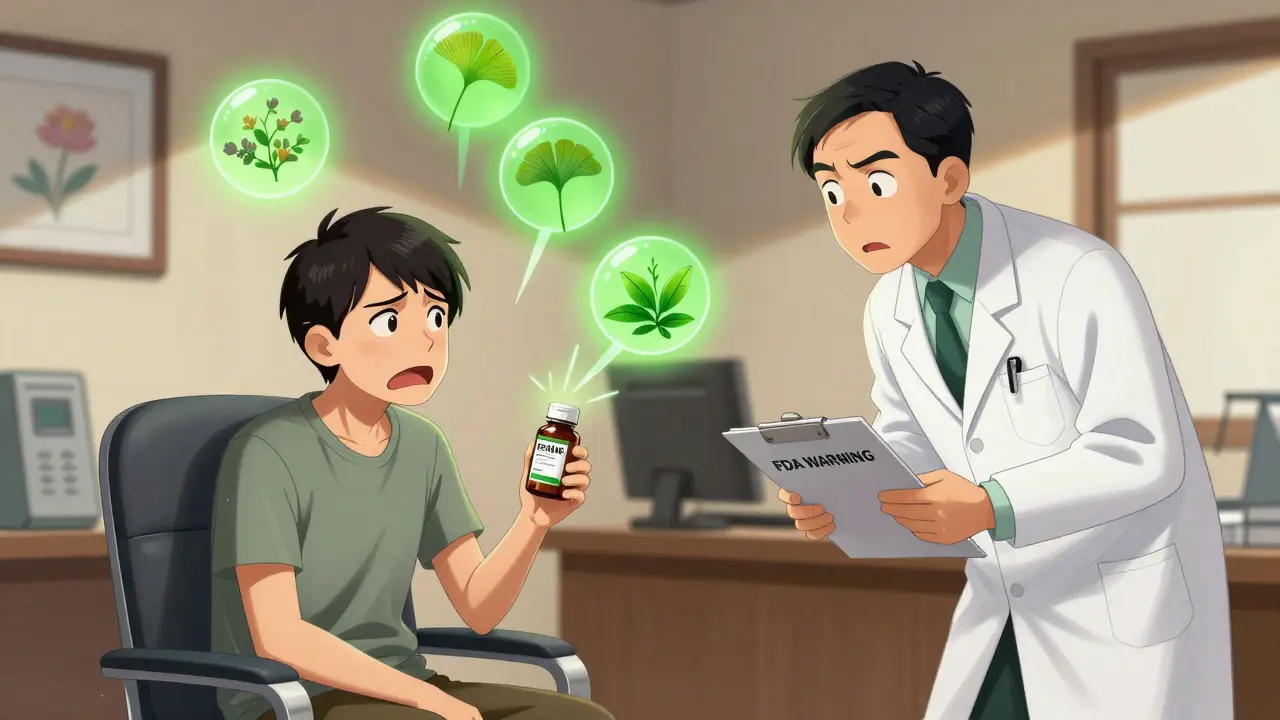
Every year, thousands of people in the U.S. take herbal supplements thinking they’re harmless-just natural remedies with no side effects. But the truth is, some of these products can be dangerous, especially when mixed with prescription meds. The FDA has issued dozens of warnings over the past decade about specific herbal products that need to be disclosed to your doctor. Ignoring this advice isn’t just risky-it can land you in the hospital.
Why the FDA Cares About Herbal Supplements
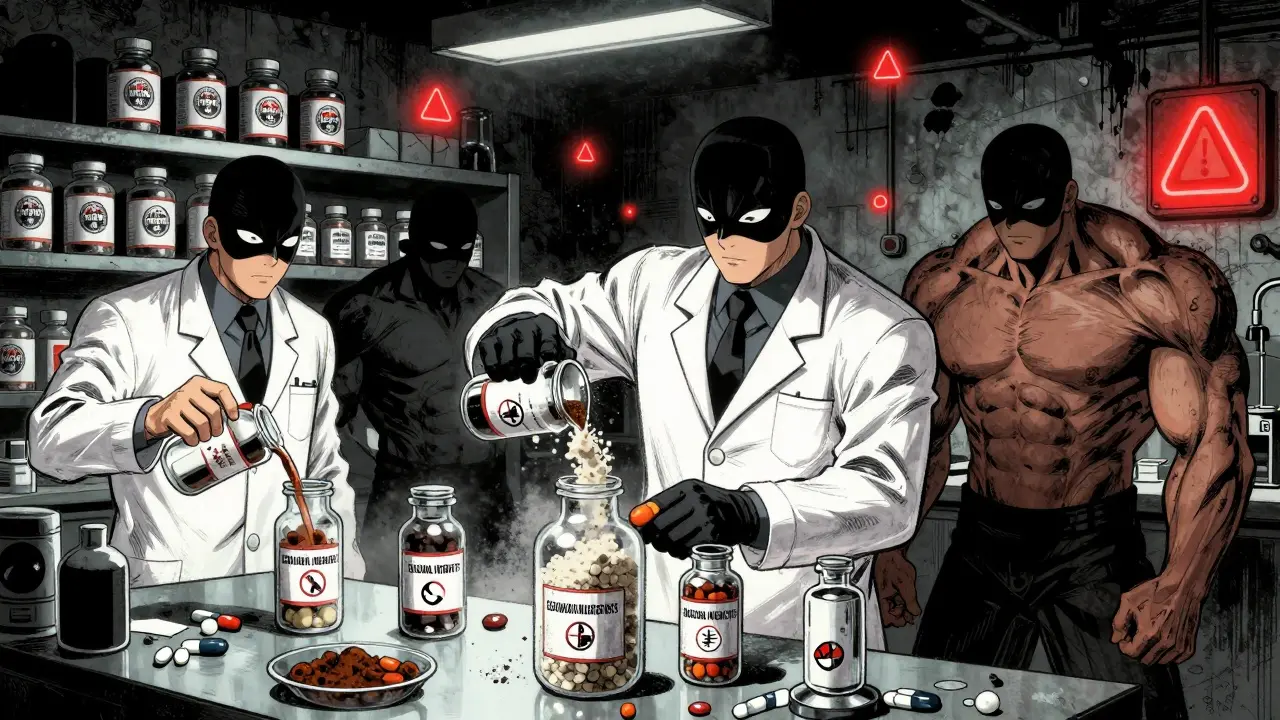
The FDA doesn’t approve herbal supplements before they hit the shelf. Unlike pills like blood pressure or diabetes medications, which go through years of testing, herbal products can be sold without proof they work-or even without proof they’re safe. Under the Dietary Supplement Health and Education Act (DSHEA) of 1994, manufacturers only need to notify the FDA if they add a completely new ingredient. That’s it. No safety data. No efficacy studies. Just a form and a shelf. This means products labeled as “natural” or “herbal” can still contain hidden drugs. A 2013 study in JAMA Internal Medicine found that 15% of tested supplements had undeclared pharmaceuticals. Some had stimulants like sildenafil (the active ingredient in Viagra). Others had steroids or antidepressants. These aren’t mistakes-they’re deliberate. And they’re often found in weight loss, sexual enhancement, and bodybuilding products.Herbal Products That Interfere With Medications
Certain herbs are known to interact badly with common prescriptions. Here are the top ones the FDA and medical experts warn about:- St. John’s Wort - Used for mild depression, but it can cut the effectiveness of birth control pills, blood thinners like warfarin, HIV meds, and even some cancer drugs. One patient stopped bleeding properly after starting St. John’s Wort while on warfarin-leading to a life-threatening clot.
- Ginkgo Biloba - Marketed for memory and circulation, but it thins the blood. When taken with aspirin, NSAIDs, or anticoagulants, it can cause internal bleeding. A 2021 case report in the Journal of Clinical Pharmacy and Therapeutics documented a patient who bled into the brain after combining ginkgo with clopidogrel.
- Green Tea Extract - Popular for weight loss, but concentrated doses have been linked to liver damage. The FDA has received over 200 reports of acute liver injury from green tea extract supplements since 2007.
- Kava - Used for anxiety, but it’s been tied to severe liver toxicity. The FDA issued a consumer warning in 2002, and several countries have banned it. Still, it’s sold online and in health stores.
- Garlic Supplements - While eating garlic is fine, high-dose supplements can increase bleeding risk during surgery or when taken with blood thinners. One study found patients on warfarin needed dose adjustments just from taking garlic pills.
What the FDA Actually Does (And Doesn’t Do)
The FDA doesn’t stop these products from being sold. It waits until someone gets hurt. Then, it issues a warning letter. Since 2002, the agency has sent over 1,800 warning letters to supplement companies. Most are for:- Adding undeclared drugs (like sildenafil or sibutramine)
- Making false claims (e.g., “cures cancer” or “lowers cholesterol like statins”)
- Contaminated with heavy metals, pesticides, or bacteria
- Failing to follow Good Manufacturing Practices (GMP)
Why You Should Tell Your Doctor About Every Supplement
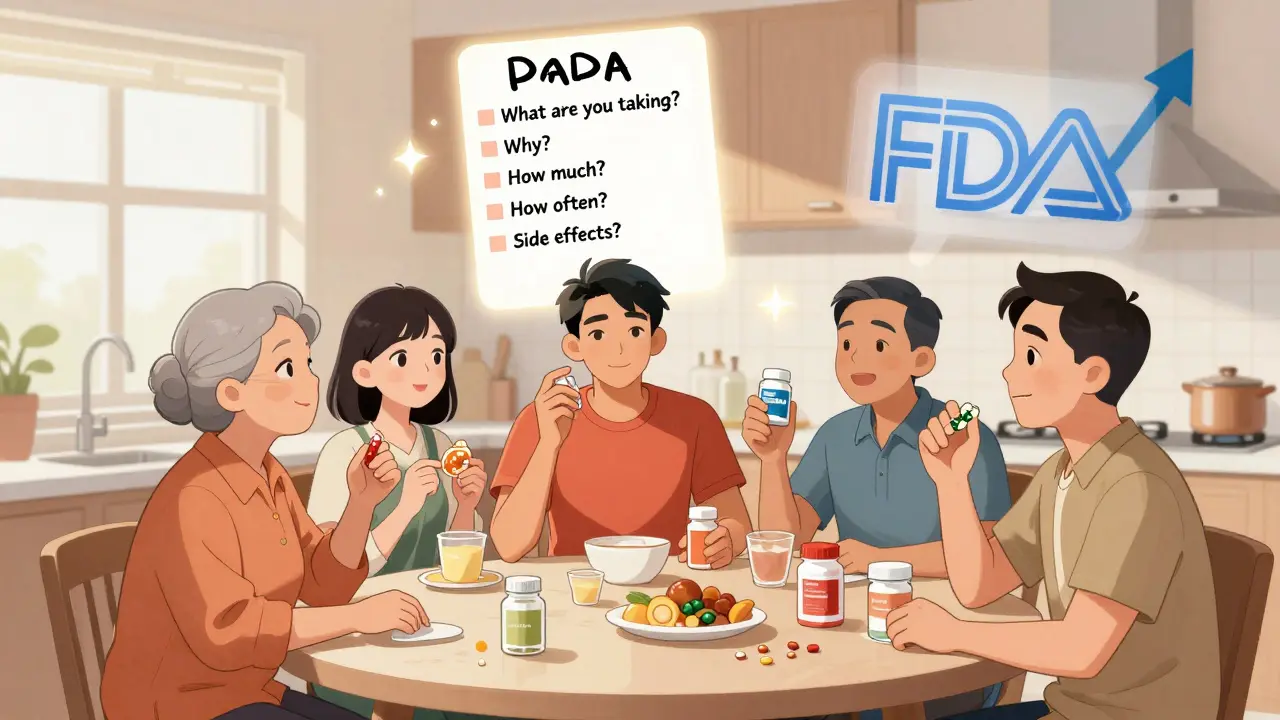
Doctors don’t ask about supplements because they assume you’ll tell them. But most patients don’t. A 2022 survey of 1.5 million doctors on Sermo found that 68% say patients never mention their supplements during visits. That’s a problem. Imagine you’re on blood pressure medication and start taking hawthorn berry because you read it helps circulation. Hawthorn can lower blood pressure too. The result? Your pressure crashes. You pass out. You end up in the ER. And no one knows why-because you didn’t mention the herb. The American College of Physicians recommends asking patients five simple questions during check-ups:- Are you taking any vitamins or supplements?
- What are you taking them for?
- How much are you taking?
- How often?
- Have you noticed any side effects?
How to Spot a Safe Supplement
Not all herbal products are dangerous. But you need to know how to pick the good ones:- Look for third-party verification - The USP Verified Mark, NSF Certified for Sport, or ConsumerLab.com seal means the product was tested for what’s on the label. A 2022 USP study found verified products had 94% accuracy in ingredient labeling. Non-verified ones? Only 67%.
- Check the Latin name - Labels should list botanicals by their scientific names. For example, “Hypericum perforatum” instead of just “St. John’s Wort.” This helps avoid confusion with similar plants.
- Avoid products with “proprietary blends” - These hide how much of each ingredient is in the dose. If you can’t see the amount, you can’t assess the risk.
- Don’t trust miracle claims - If it says “cures diabetes,” “boosts immunity 500%,” or “burns fat while you sleep,” it’s not science. It’s a scam.
What to Do If You’ve Had a Bad Reaction
If you feel dizzy, nauseous, have chest pain, or notice unusual bruising after taking a supplement, stop using it. Then report it. The FDA’s Safety Reporting Portal lets you file a report online. But here’s the catch: only 12% of people complete the full form. Most quit halfway because it’s long. You don’t need to be a doctor to report. Just describe what happened: what you took, when, and what symptoms you had. Your report could help the FDA catch a dangerous product before it hurts someone else.What’s Changing? What’s Coming
There’s pressure to fix this broken system. In 2023, Congress introduced the Dietary Supplement Listing Act, which would require all supplements to be registered with the FDA before sale. That’s a big shift. Right now, companies don’t even have to tell the FDA what they’re selling. The FDA’s 2023-2027 plan aims to cut adulterated products in high-risk categories (weight loss, sexual enhancement, bodybuilding) by 25% over five years. They’re also cracking down on CBD products making unapproved claims-117 warning letters were sent in 2022 alone. Experts like Dr. Pieter Cohen from Harvard predict that by 2025, 15% of supplement products will carry a USP Verified label-up from just 5% in 2020. That’s progress. But it’s still a small fraction of the $50 billion market.Bottom Line: Don’t Assume It’s Safe
Herbal supplements aren’t inherently bad. But they’re not regulated like medicine. That means you have to be your own advocate. If you’re taking anything-vitamins, teas, capsules, powders-tell your doctor. Even if it’s “just garlic.” Even if you think it’s harmless. The FDA doesn’t protect you before you get hurt. But you can protect yourself-by asking questions, checking labels, and speaking up.Do herbal supplements need FDA approval before being sold?
No. Herbal supplements are not required to get FDA approval before being sold. Under current law, manufacturers can market them without proving they’re safe or effective. The FDA only steps in after a product is on the market and linked to health problems or false claims.
Which herbal products are most likely to contain hidden drugs?
Weight loss, sexual enhancement, and bodybuilding supplements are the most likely to contain undeclared pharmaceuticals. Common hidden ingredients include sildenafil (Viagra), sibutramine (a banned appetite suppressant), and anabolic steroids. The FDA has found these in over 700 products since 2007.
Can I trust supplements with “natural” or “organic” on the label?
No. “Natural” and “organic” are marketing terms with no legal meaning for supplements. A product labeled “natural” can still contain synthetic chemicals, heavy metals, or undeclared drugs. Always look for third-party verification seals like USP or NSF instead.
How do I know if my supplement is interacting with my medication?
Talk to your doctor or pharmacist. Bring the supplement bottle with you. Some known interactions include St. John’s Wort with antidepressants, ginkgo with blood thinners, and garlic with blood pressure meds. Use the FDA’s Supplement Your Knowledge app or the National Center for Complementary and Integrative Health’s database to check for risks.
What should I do if I think a supplement made me sick?
Stop taking it immediately. Contact your doctor. Then report the reaction to the FDA’s Safety Reporting Portal. Even if you’re not sure it caused the issue, your report helps the agency identify dangerous products. You don’t need medical records-just your experience.

8 Comments
Look, I get it-people think ‘natural’ means ‘safe,’ but that’s like saying ‘organic candy’ won’t rot your teeth. I’m a nurse, and I’ve seen patients show up with liver failure because they thought ‘green tea extract’ was just a healthy smoothie booster. It’s not. It’s a chemical bomb in a capsule. Tell your doctor. Always. No exceptions.
So let me get this straight-the FDA doesn’t care until someone dies, but we’re supposed to trust them to regulate supplements? That’s not regulation, that’s funeral planning. If you want real safety, ban the whole damn industry. Let’s stop pretending this is medicine. It’s the Wild West with gummy bears.
I used to take St. John’s Wort for anxiety and didn’t tell my doctor because I thought it was ‘just herbal.’ Then I started having weird heart palpitations and realized I was on a beta-blocker. Turns out, the interaction was real. I felt stupid. But I’m glad I spoke up. Now I bring every pill, powder, and tea to every appointment. No shame. Just safety.
My mom took kava for stress after Dad passed. She didn’t tell her cardiologist. Three months later, she was in the ER with jaundice. We found out the kava had a heavy metal contaminant and was frying her liver. She’s fine now, but it scared the hell out of us. If you’re taking something ‘natural,’ it’s still a drug to your body. Say it out loud. Your doctor isn’t judging. They’re trying to keep you alive.
I used to roll my eyes when my doctor asked about supplements. ‘It’s just turmeric,’ I’d say. Then I read about the blood thinner interactions. Now I keep a little notebook. I write down the name, dose, why I’m taking it. I show it to my doctor. It takes 90 seconds. But it might save my life. Small habits. Big consequences.
Why should Americans care about FDA warnings? In India, we’ve used herbs for 5,000 years without a single bureaucrat telling us what to take. This is cultural imperialism disguised as safety. Your body knows what it needs. Let people decide. Stop infantilizing adults with your ‘warning letters’.
Prakash, I get where you’re coming from-but you’re ignoring the data. In India, you have traditional systems with centuries of documentation and trained practitioners. Here? A guy in a warehouse mixes ashwagandha with sildenafil and sells it as ‘male vitality tea.’ That’s not tradition. That’s fraud. And people are dying.
Just took garlic pills for ‘heart health’-woke up with a nosebleed. Stopped. Told my doc. She laughed. Said, ‘That’s why we ask.’
Write a comment