

Imagine getting a letter that doesn't just point out a mistake but threatens your entire business license. For pharmaceutical manufacturers, an FDA warning letter is exactly that-a formal, public notification from the U.S. Food and Drug Administration (FDA) stating you have violated the Federal Food, Drug, and Cosmetic Act (FD&C Act). It’s not a suggestion box note; it’s a regulatory hammer.
In fiscal year 2023 alone, the FDA issued 327 warning letters to drug manufacturers globally. That’s a 12.7% jump from the previous year. If you are in manufacturing quality, this isn’t hypothetical. A warning letter means the agency has found significant evidence of non-compliance with Current Good Manufacturing Practice (CGMP) regulations. Ignoring it leads to import alerts, product seizures, or even criminal prosecution. But responding correctly can save your company’s reputation and bottom line.
What Triggers an FDA Warning Letter?
Warning letters don’t appear out of thin air. They are usually the escalation step after an inspection reveals serious issues. The process typically starts with a Form 483, which lists specific observations made by inspectors during a facility visit. If the FDA determines that these observations represent systemic failures rather than isolated incidents, they issue a warning letter.
The most common triggers involve failures in Current Good Manufacturing Practice (CGMP) compliance. According to data from 2023, inadequate investigation of out-of-specification (OOS) results appeared in 63.4% of all pharmaceutical warning letters. Another major culprit is inadequate quality unit oversight, cited in nearly 58% of cases. For sterile products, the stakes are higher: 78.3% of warning letters cite failures in aseptic processing controls, often pointing to flawed media fill programs or poor environmental monitoring.
Data integrity is also becoming a huge red flag. Recent trends show that 67% of warning letters now reference data integrity issues, up from 42% just four years ago. This includes things like altering electronic records, deleting failed test results, or failing to maintain audit trails. The FDA is watching how you handle data as closely as how you handle pills.
Warning Letters vs. Form 483: Knowing the Difference
It is easy to confuse a Form 483 with a warning letter, but the difference is critical for your response strategy. A Form 483 is an immediate, on-site document given at the end of an inspection. It lists specific deficiencies observed by the inspector. It is technical and observational. You have time to investigate and respond, often within 15 days, but it is not yet a final legal determination.
A warning letter is different. It is a formal enforcement action. It means the FDA has reviewed your response to the Form 483 (or lack thereof) and decided that the violations are significant enough to warrant public notice and potential further legal action. While a Form 483 might be seen as a "check-up" gone wrong, a warning letter is a diagnosis of a chronic condition. About 18.3% of domestic inspections result in warning letters, compared to 62.1% resulting in Form 483s. This shows that while many facilities have issues, only those with severe or unresolved problems get the letter.
| Feature | Form 483 | Warning Letter |
|---|---|---|
| Timing | Issued at the end of an inspection | Issued weeks or months after inspection |
| Public Record | No (usually private) | Yes (posted on FDA website) |
| Severity | Observational / Advisory | Enforcement Action |
| Response Time | Typically 15 days | Typically 15 working days for initial response |
| Goal | Identify immediate deficiencies | Prompt systemic corrective action |

The Anatomy of a Warning Letter
When you receive a warning letter, do not panic, but do read it carefully. These documents follow a strict structure designed to leave no room for ambiguity. Understanding this structure is key to crafting a defense.
First, the letter details the specific violations. It won’t just say "you failed to clean." It will say, "Inspectors observed exposed skin in the ISO 5 area during aseptic processing" or "non-sterile tape was used on the filling line." These examples come straight from recent letters, such as the one issued to Daewoo Pharmaceutical Co., Ltd. in July 2025. The specificity is intentional; it forces you to address exact behaviors, not vague concepts.
Second, it provides regulatory citations. Every violation is linked to a specific section of the Code of Federal Regulations (CFR), usually 21 CFR Parts 210 and 211 for drugs. This tells you exactly which rule you broke. If you argue against the letter, you must argue against the interpretation of these specific rules.
Third, it outlines required corrective actions. The FDA will tell you what they expect to see. This might include "complete results of examination of retain/reserve samples" or "thorough investigations including CAPA." The letter serves as a roadmap for your remediation. If you miss a requirement listed here, your response will likely be rejected.
How to Respond: The First 15 Days
You typically have 15 working days to submit an initial response. This clock starts ticking the moment you receive the letter. Here is how to use that time wisely.
- Assemble a Cross-Functional Team: Do not let Quality Assurance handle this alone. You need Regulatory Affairs to draft the communication, Microbiology experts if sterility is involved, and Engineering for equipment fixes. The FDA expects a holistic response, not just a paperwork shuffle.
- Conduct a Root Cause Analysis: The FDA hates superficial fixes. Saying "we retrained staff" is rarely enough. You must prove why the failure happened. Was it a design flaw? A training gap? A culture issue? Use tools like Fishbone diagrams or 5 Whys. Dr. Jane Axelrad, a former FDA official, notes that 85% of warning letters contain repeat violations, signaling deep cultural failures. Your root cause must dig deeper than surface errors.
- Draft the Corrective and Preventive Action (CAPA) Plan: Your plan must include three parts: Immediate containment (stop the bleeding), Corrective action (fix the current problem), and Preventive action (ensure it never happens again). Include timelines, responsible parties, and metrics for success.
- Verify Effectiveness: The FDA wants to know how you will measure if your fix works. Will you monitor batch yields? Increase sampling frequency? Run additional media fills? Provide concrete data points.
Remember, the goal is not just to close the letter but to demonstrate a shift in quality culture. As one executive noted, a single warning letter cost their company $28 million in lost revenue due to delayed launches. A thorough response prevents future fines.
Financial and Operational Impact
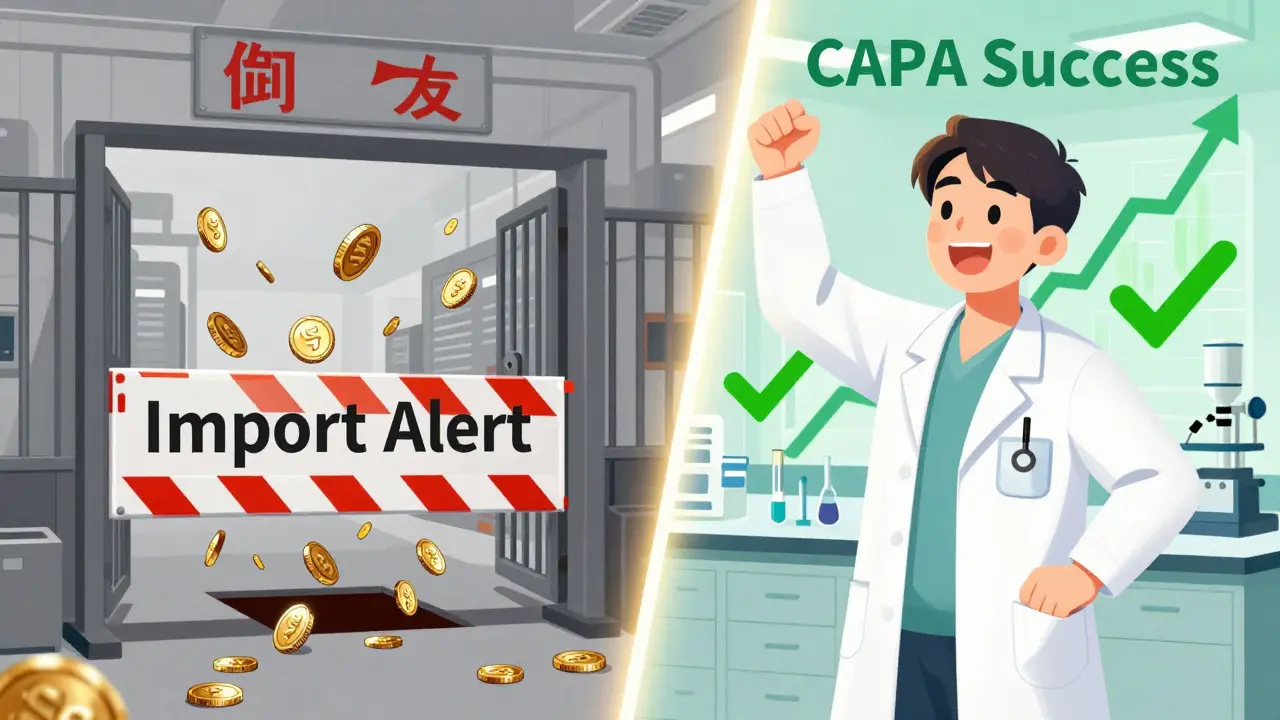
The cost of a warning letter goes far beyond the price of consultants. A 2023 survey found that 68% of companies halted new product submissions during remediation. The average delay in regulatory timelines was 8.7 months. For a mid-sized generic manufacturer, one warning letter led to $4.2 million in immediate remediation costs and a 14-month delay in launching an ophthalmic product.
There is also a reputational tax. Warning letters are public. Investors watch them. In 2023, firms with active warning letters saw 18.4% lower stock performance compared to industry averages. Suppliers may hesitate to work with you, and hospitals may question your reliability. Conversely, companies that respond well can turn it around. Teva Pharmaceuticals, for example, reduced product defects by 30% after addressing a warning letter at their Israeli facility, eventually getting removed from import alert status within 11 months.
Future Trends: What to Expect in 2026 and Beyond
The FDA is not slowing down. In fact, enforcement is intensifying. The issuance rate of warning letters grew by over 90% between 2018 and 2023. With the implementation of the Risk-Based Certificate of Pharmaceutical Product Pilot Program and increased budget allocations for foreign inspections ($112.7 million in FY2023), the agency has more resources to dig deep.
Expect a sharper focus on data integrity and aseptic processing. The FDA’s strategic plan aims to reduce repeat violations by 25% by 2027. This means they will prioritize inspecting facilities with past violations. If you have received a Form 483 recently, treat it as a near-miss warning letter. Fix it now before it becomes a public scandal.
Also, be aware of geographic disparities. Indian manufacturers received nearly 39% of all warning letters in 2022, while U.S. manufacturers accounted for 31.5%. However, foreign facilities generally receive warning letters 22% more frequently than domestic ones for equivalent violations. If you manufacture overseas, ensure your local teams understand U.S. expectations, not just local standards.
How long does it take to resolve an FDA warning letter?
Resolving a warning letter typically takes 6 to 12 months of intensive effort. While you must submit an initial response within 15 working days, the full remediation-including root cause analysis, implementing CAPA, and verifying effectiveness-requires sustained work. Complex issues like sterile processing failures or widespread data integrity problems may take longer.
Can a warning letter lead to prison time?
Indirectly, yes. A warning letter itself is a civil enforcement action. However, if a company ignores the letter or continues to violate laws, the FDA can escalate to injunctions, product seizures, or refer the case to the Department of Justice for criminal prosecution. Individuals, including executives, can face criminal charges for fraud or reckless endangerment.
What is the most common violation in FDA warning letters?
The most common violation is inadequate investigation of out-of-specification (OOS) results, appearing in 63.4% of pharmaceutical warning letters. This is followed by inadequate quality unit oversight (57.8%) and failures in aseptic processing controls for sterile products (78.3%).
Does receiving a warning letter mean my products are banned?
Not immediately. A warning letter does not automatically ban your products. However, the FDA may place your facility on an Import Alert, which blocks your products from entering the U.S. market until compliance is verified. Continued non-compliance can lead to seizure of products already in the supply chain.
How much does it cost to respond to a warning letter?
Costs vary widely based on complexity and location. Industry benchmarks suggest median remediation costs of $1.8 million for domestic facilities and $2.7 million for foreign facilities. Small manufacturers may spend significantly less but face disproportionate strain on resources, often hiring external consultants at rates exceeding $250 per hour.

9 Comments
It is frankly absurd that we are still treating the FDA as some infallible oracle of quality. The article suggests a 'cross-functional team' is needed, but in reality, this is just bureaucratic theater designed to extract more fees from consultants who know nothing about actual manufacturing floors. I have seen facilities with perfect data integrity get hammered while others with obvious shortcuts walk away because they had better lawyers. The whole system is rigged to punish compliance rather than reward it.
honestly this stuff sounds super scary but i guess if u follow the rules its ok? my dad works in pharma and he always complains about the paperwork. seems like a lot of stress for just making pills. maybe they should just trust the scientists more instead of sending inspectors everywhere lol
Oh, my goodness! Isn't it absolutely fascinating how detailed these regulatory processes are?! I mean, think about it! Every single step, from the root cause analysis all the way through to the CAPA plan, is designed to ensure that we, as a society, are safe! It's truly remarkable! And don't you just love the idea of transparency? It makes me feel so much better knowing that there are people watching out for us! We should all be so proud of our commitment to quality!
The narrative presented here is a classic example of institutional gaslighting. The FDA isn't protecting public health; they are enforcing a monopoly on pharmaceutical production to keep prices artificially high. When they cite 'data integrity,' they are actually targeting whistleblowers who expose the real crimes: the deliberate under-dosing of generics and the suppression of natural alternatives. The 'warning letter' is merely a tool of corporate control, ensuring that only compliant entities survive while dissenters are crushed by legal fees and import alerts. Wake up!
i can really relate to the stress mentioned here especially when you think about the human element behind all those regulations because nobody wants to lose their job or their company to fail so it must be incredibly overwhelming for the quality teams who are trying to do their best while also dealing with constant scrutiny from above which creates this toxic environment where mistakes are punished rather than learned from and that just feels wrong to me
This entire premise is laughable. Who cares if your sterile processing controls are flawed as long as the pill looks right? The FDA is just a bunch of bureaucrats looking for reasons to fine people. I've got a cousin who runs a small batch facility and he gets harassed constantly for minor issues that don't affect anyone. It's time we stop letting these unelected officials dictate how business is run. If you want quality, let the market decide, not some inspector with a clipboard.
listen up folks! this is your wake up call! you cant just ignore the rules and expect things to work out! if you dont fix your root causes now you will be paying millions later! take charge of your quality culture today! dont let fear stop you from doing what is right! get your team together and crush those violations! success belongs to those who fight for it! no excuses!
Oh, sure, because nothing says 'trustworthy partner' like spending $2.7 million on remediation costs. I'm sure the investors are thrilled to see their stock performance drop by 18.4% due to a 'public notification.' Let's all clap for the companies that managed to delay product launches by 14 months. Truly inspiring leadership. Maybe next year they'll issue a warning letter for using too much ink on the forms.
this is so stressful to read especially for us in india where we get almost half of all warning letters it feels like we are always being targeted even though we try our best to meet standards why is it so hard for foreign facilities to comply without being punished so harshly it just makes everyone anxious
Write a comment