
Imagine you’ve spent years getting your generic drug approved by the FDA (Food and Drug Administration). You’re finally selling it. Then, a machine breaks down, or you find a cheaper supplier for raw materials. You want to fix it, but here’s the catch: changing anything in how you make that drug can trigger a massive regulatory headache. If you mess up the paperwork, the FDA could pull your product off the shelf.
This isn’t just bureaucracy; it’s about safety. The FDA needs to be sure that even after you change your process, your pill is still identical to the original brand-name version. This guide breaks down exactly which changes force you to stop and ask for permission, which ones you can do on the fly, and how to navigate the maze of ANDA supplements.
Why Does the FDA Care About How You Make It?
To understand why re-evaluation happens, you have to look at the foundation: the Abbreviated New Drug Application (ANDA). Authorized by the Hatch-Waxman Act of 1984, this pathway lets generic makers skip clinical trials. Instead, you prove your drug is bioequivalent to the Reference Listed Drug (RLD)-the original innovator drug.
The deal is simple: the FDA already knows the RLD is safe and effective. Your job is to show your version is chemically and physically the same. When you change your manufacturing process, you risk breaking that equivalence. Maybe a new machine heats the powder differently, altering how the drug dissolves in the body. Maybe a new supplier provides an active pharmaceutical ingredient (API) with slightly different impurities. The FDA’s job is to catch those risks before they reach patients.
Under the current framework, driven by GDUFA III (Generic Drug User Fee Amendments), manufacturers must submit post-approval change requests as supplemental ANDAs (sANDAs). The type of supplement you file depends entirely on the risk level of the change.
The Three Tiers of Manufacturing Changes
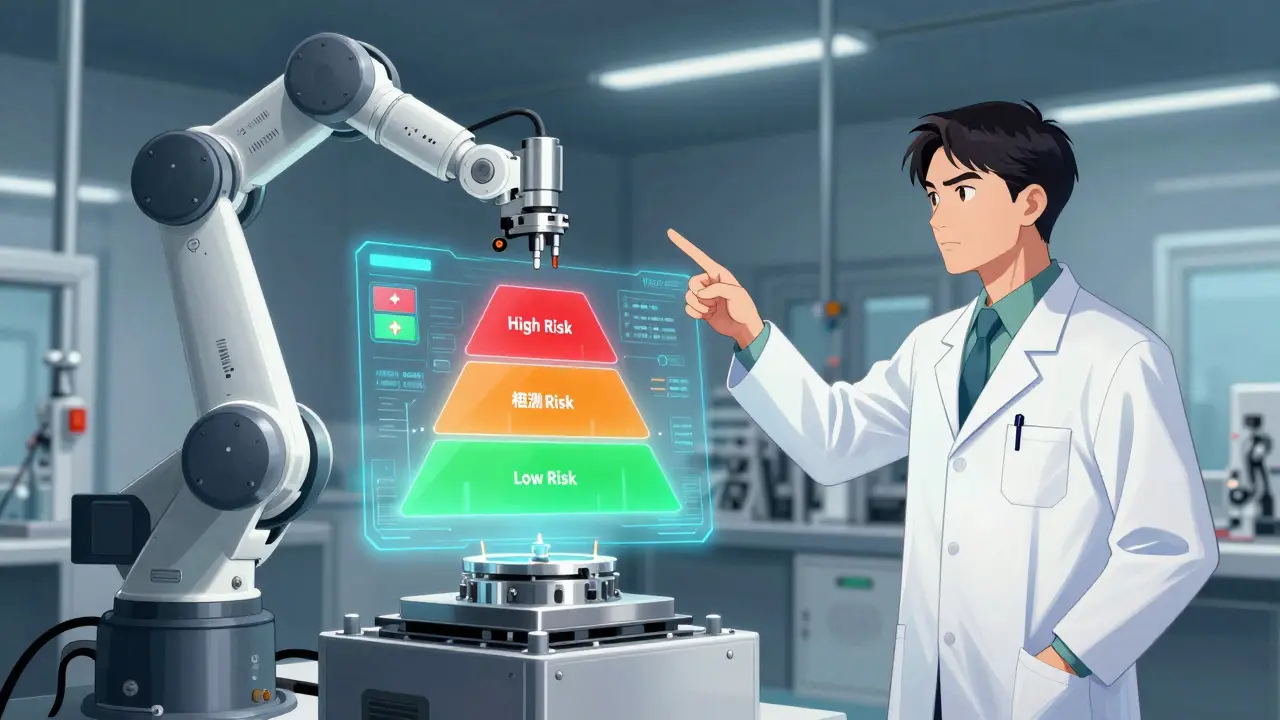
Not all changes are created equal. The FDA categorizes them into three buckets based on how much they might impact the drug’s quality, safety, or effectiveness. Knowing which bucket your change falls into is the first step in avoiding delays.
- Prior Approval Supplements (PAS): These are high-risk changes. You cannot implement them until the FDA says yes. Think major facility moves, new synthetic routes for the API, or significant formulation tweaks.
- Changes Being Effected (CBE): Medium-risk changes. You can start implementing these while the FDA reviews them, but you must notify them first. There are two types: CBE-30 (notify 30 days before) and CBE-0 (notify immediately).
- Annual Reports: Low-risk changes. You document these and report them once a year. Examples include minor equipment adjustments or small-scale packaging updates.
Data from FDA submissions between 2018 and 2022 shows a 27.3% increase in major changes (PASs). Why? Because companies are trying to optimize processes or dealing with supply chain shocks. But here’s the kicker: 68.4% of PAS submissions for manufacturing changes required at least one Complete Response Letter (CRL). That means the FDA said, "We need more info," delaying your launch.
| Category | Risk Level | Implementation Timing | Avg. Review Time |
|---|---|---|---|
| Prior Approval Supplement (PAS) | High | After FDA Approval | ~10 months |
| CBE-30 | Medium | 30 Days After Notification | ~3 months |
| CBE-0 | Medium-High | Immediately (Notify ASAP) | ~9 months |
| Annual Report | Low | Anytime | No Review |
What Specifically Triggers a Re-Evaluation?
If you’re wondering what crosses the line from "Annual Report" to "Prior Approval Supplement," look at the data. A 2023 survey in Pharmaceutical Technology highlighted the most common triggers.
Process Changes (15.9% of submissions): This includes scaling up production, switching to a new reactor, or adopting continuous manufacturing. For example, increasing batch size by 30% for a solid oral dosage form isn’t just turning up the volume. It requires extensive process validation and six months of stability data to prove the larger batches don’t introduce uneven mixing or heat distribution issues.
Control Changes (15.9% of submissions): Altering specifications, in-process controls, or stability protocols. If you change how you test for impurities, the FDA wants to see that your new method is at least as sensitive as the old one.
Facility Transfers: Moving production to a new site is a classic PAS trigger. The FDA often inspects the new facility to ensure it meets Current Good Manufacturing Practice (cGMP) standards. In 2023, 24.5% of PAS submissions faced additional scrutiny due to facility transfers.
Analytical Method Changes: Updating how you test the drug substance or product. This triggered 28.7% of additional information requests in recent years. Why? Because if your testing method changes, your historical data might no longer be valid.
For complex generics, like peptide drugs, the rules are tighter. FDA guidance from September 2021 states that any new specified peptide-related impurity must be less than 0.5%, with justification proving no impact on safety compared to the RLD.
The Cost of Changing: Time and Money
Let’s talk numbers. Submitting a PAS is expensive. Industry data from 2023 estimates the average cost at $287,500 per submission. For low-margin generic products, this price tag creates a real disincentive to innovate. Dr. Robert Chen of Harvard Medical School noted in a 2022 NEJM perspective that this system can stifle improvements because the cost outweighs the benefit.
Time is money, too. According to FDA Manual of Policies and Procedures (MAPP) 5240.3, the average review timeline for a PAS is 10 months. Compare that to 3 months for a CBE-30. But don’t expect smooth sailing. Complex changes can extend reviews significantly. A 2022 case study showed a tablet press upgrade taking 18 months to approve, despite identical product quality metrics, due to regulatory paralysis and inconsistent feedback.
Small manufacturers suffer more. A 2023 survey by the Association for Accessible Medicines found that small companies (with fewer than 5 ANDAs) experienced 43% longer review times than large manufacturers. They also reported 78.4% difficulty in determining the correct supplement category for complex changes.

How to Navigate the Process Successfully
You can’t avoid the FDA, but you can make their job easier-and yours faster. Here’s how top-performing companies handle manufacturing changes.
Invest in Quality by Design (QbD): The FDA’s 2021 guidance recommends implementing QbD principles during initial ANDA development. By establishing a robust "design space" early on, you create a buffer that allows for minor variations without triggering a full re-evaluation. Companies using advanced Process Analytical Technology (PAT) reported 32.6% fewer PAS submissions over five years.
Pre-Submission Meetings: Don’t guess. The FDA suggests 3-5 pre-submission meetings for complex changes. Teva Pharmaceuticals successfully reduced PAS review time to 8 months for amlodipine by holding extensive pre-meetings and providing comprehensive comparative analytics. Use these meetings to align on expectations before you spend millions on studies.
Risk Assessment First: Conduct a thorough comparative analysis between pre- and post-change products. Include analytical testing, stability studies, and bioequivalence studies if necessary. The FDA’s risk-based approach demands proof that the change doesn’t adversely affect safety or effectiveness.
Leverage Expedited Pathways: If you manufacture in the US, look into the ANDA Prioritization Pilot Program launched in September 2023. It accelerates reviews for generics with US-based manufacturing and domestic API sources, potentially cutting approval times to 8 months instead of the standard 30-month average for new approvals. By 2026, analysts project 37.5% of new generic approvals will qualify for such pathways.
Future Outlook: What’s Changing in 2026?
The landscape is shifting. The FDA’s draft guidance released in January 2024 proposes a tiered risk assessment framework for complex generics, which could reduce PAS submissions for minor changes by up to 35%. Additionally, the PreCheck program, announced in February 2024, aims to cut facility transfer timelines from 18 months to 9 months through a two-phase inspection approach.
As GDUFA IV negotiations loom, industry groups like the Generic Pharmaceutical Association are pushing for standardized change classification criteria. Currently, there’s a 41.7% variation in how different FDA divisions categorize supplements, leading to unpredictable outcomes. Standardization would help manufacturers plan better and reduce costly surprises.
Manufacturers who adapt now-by embracing transparency, investing in process understanding, and leveraging expedited programs-will gain a competitive edge. Those who wait risk falling behind in an increasingly fast-paced market.
What is the difference between a PAS and a CBE supplement?
A Prior Approval Supplement (PAS) requires FDA approval before you can implement the change. It’s for high-risk modifications like facility transfers or major process changes. A Change Being Effected (CBE) supplement allows you to implement the change while the FDA reviews it, provided you notify them first. CBEs are for medium-risk changes where immediate implementation is necessary but oversight is still required.
How long does it take the FDA to review a manufacturing change?
Review times vary by category. Prior Approval Supplements (PAS) average 10 months, though complex cases can take longer. CBE-30 supplements take about 3 months, and CBE-0 supplements take around 9 months. Annual Reports do not require FDA review. Delays often occur if the FDA issues a Complete Response Letter requesting more data.
Can I change my drug’s manufacturer without FDA approval?
No. Changing the manufacturing site is considered a high-risk change and typically requires a Prior Approval Supplement (PAS). The FDA may inspect the new facility to ensure it meets cGMP standards. You cannot move production until the FDA approves the supplement.
What is the ANDA Prioritization Pilot Program?
Launched in September 2023, this program accelerates FDA review timelines for generic drugs manufactured in the US with domestic API sources. Eligible applications can receive approval within 8 months, compared to the standard 30-month average. It aims to strengthen the US supply chain and incentivize domestic manufacturing.
How can I reduce the risk of a Complete Response Letter?
Conduct thorough pre-submission meetings with the FDA to align on expectations. Provide comprehensive comparative analytics, including stability data and bioequivalence studies if needed. Implement Quality by Design (QbD) principles during development to establish a robust design space, which reduces the likelihood of unexpected issues during review.