
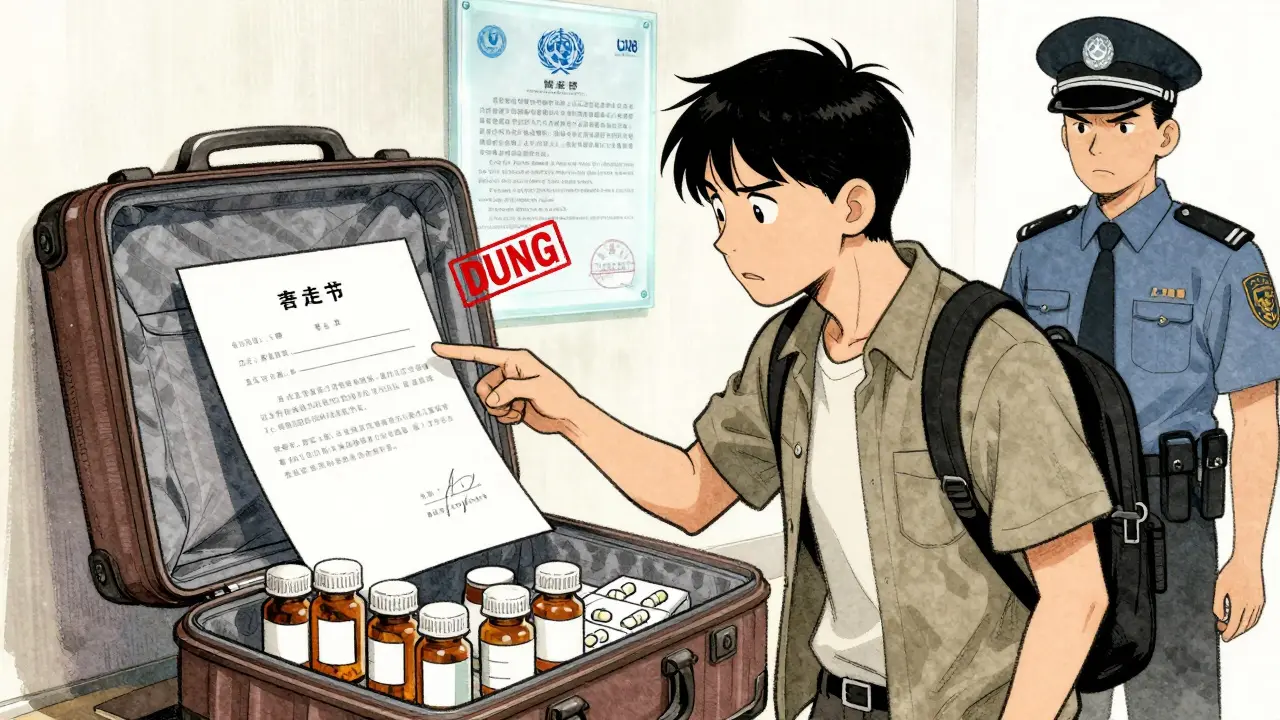
Imagine this: you’re at customs in Tokyo, suitcase in hand, and the officer asks for your prescription. You hand over your pill bottle - but it’s not in the original container. You didn’t bring a doctor’s letter. Suddenly, your Adderall is flagged as illegal. You’re detained. Your flight is canceled. Your trip is ruined - all because of paperwork you didn’t know you needed.
This isn’t a horror story. It happens. Every year. And it’s avoidable.
If you’re traveling internationally and take medications like opioids, stimulants, benzodiazepines, or other controlled substances, you’re not just packing pills. You’re carrying legal documents under international law. The doctor’s letter for controlled substances during international travel isn’t optional. It’s your ticket to staying healthy, legal, and free while abroad.
Why a Doctor’s Letter Isn’t Just a Good Idea - It’s Required
The rules aren’t made up. They come from three global treaties signed by 184 to 191 countries: the 1961 Single Convention on Narcotic Drugs, the 1971 Convention on Psychotropic Substances, and the 1988 UN Convention Against Illicit Traffic. These treaties let countries ban drugs - but they also allow exceptions for medical use. The catch? You must prove you’re not smuggling. That’s where the doctor’s letter comes in.
The International Narcotics Control Board (INCB), the UN body that oversees these rules, says 142 countries have official rules for travelers carrying controlled substances. And in 2022 alone, 127 travelers were detained because their paperwork was incomplete or missing. Average detention time? Over two weeks.
Dr. Ghada Wible of UNODC put it bluntly: “The absence of appropriate medical documentation remains the single largest cause of traveler detention related to medication possession.”
This isn’t about bureaucracy. It’s about survival. If you’re on pain meds, ADHD meds, or anxiety medication, your life depends on this letter.
What Goes Into a Valid Doctor’s Letter
A good letter isn’t just a note from your doctor. It’s a legal document. The CDC’s 2023 template spells out exactly what it needs:
- Your full name and date of birth - exactly as it appears on your passport
- The prescribing doctor’s full name, title, license number, clinic address, phone, and email
- Every medication you’re carrying - by generic name (not brand)
- Dosage, frequency, and route (e.g., 10 mg oral tablet, once daily)
- The medical condition being treated (e.g., “chronic lower back pain,” “ADHD,” “severe anxiety”)
- A clear statement: “This patient requires these medications for legitimate medical treatment and is authorized to carry them during international travel.”
- The doctor’s handwritten signature and official letterhead
Why generic names? Because “Adderall” doesn’t exist in Japan. “Lisdexamfetamine” does. “Oxycodone” is recognized worldwide. “Percocet” is not. If your letter says “Percocet,” you risk being turned away - even if you have the right pills.
And don’t forget: the letter must be printed on official letterhead and signed. An email or PDF won’t cut it at most borders.
Quantity Limits - Don’t Overpack
Carrying too much is as dangerous as carrying none.
The FDA and U.S. Customs and Border Protection (CBP) advise travelers to bring no more than a 90-day supply. That’s the universal benchmark. But some countries are stricter.
For example:
- Singapore and Malaysia: Maximum 30 days’ supply. Exceed it, and you could face criminal charges - even with a letter.
- Japan: Many stimulants like Adderall are banned outright. No letter, no exception.
- United Arab Emirates: You need advance approval from the Ministry of Health - even with a perfect letter.
- European Union: Generally accepts up to 90 days if documentation is complete.
- Canada: Accepts doctor’s letters alone for under 100 dosage units.
- United States: Requires both letter and original prescription for Schedule II-V drugs.
One mistake travelers make: packing a 6-month supply “just in case.” That’s not a medical need - it’s a red flag. Border agents aren’t looking for travelers with extra pills. They’re looking for drug traffickers. Don’t give them reason to suspect you.
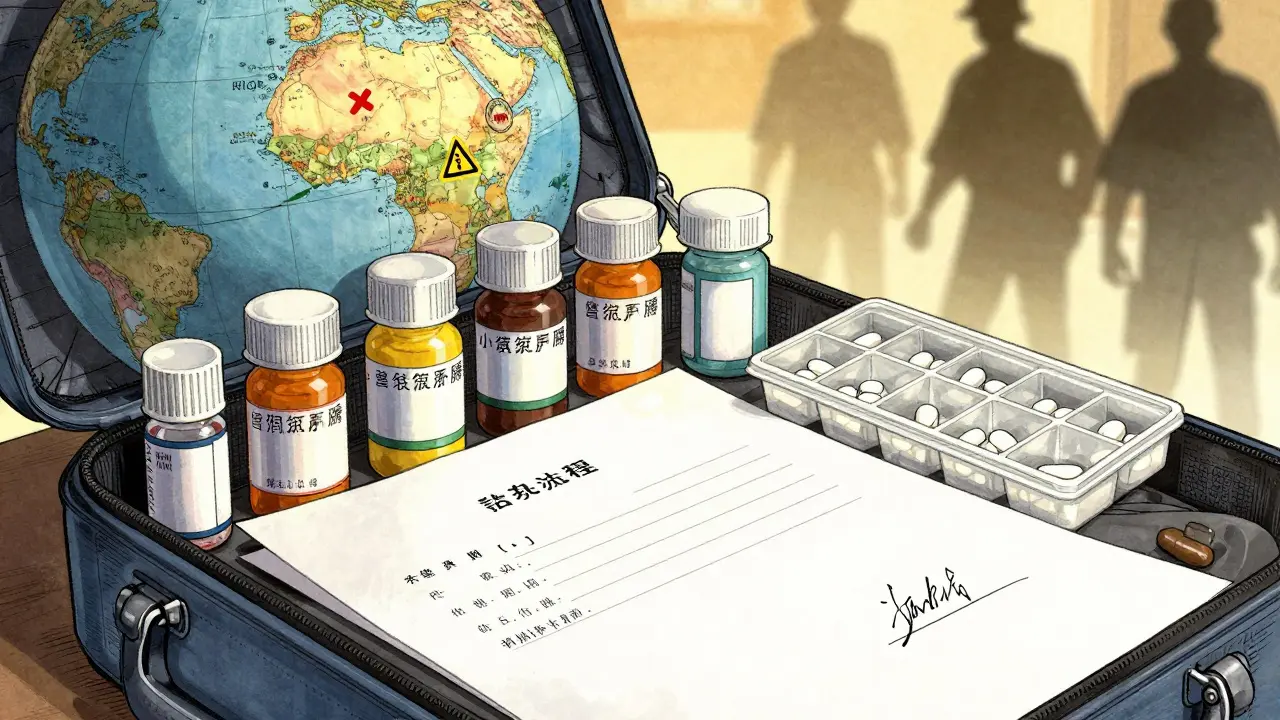
Containers Matter - Keep Pills in Original Bottles
Yes, you can transfer pills to a pill organizer. But only if you bring the original bottles with you - and they match your letter.
The FDA’s 2023 guidelines say: “Medications should be carried in their original containers with the prescription label attached.” That label should have your name, the drug name, dosage, and prescribing doctor’s info.
Why? Because a pill in a Ziploc bag looks like contraband. A pill in a bottle with a pharmacy label looks like medicine. The difference between a warning and a detention.
If you need a pill organizer for convenience, bring both: the organizer for daily use, and the original bottles for customs.
Language Is a Minefield
Your letter must be in English - or accompanied by a certified translation.
That’s not a suggestion. That’s a rule from the FDA. If your doctor writes it in Spanish, and you’re landing in Dubai, you’re not just out of luck - you’re at risk.
Translation services aren’t expensive. Get it done before you leave. Use a certified translator - not Google Translate. One wrong word - like “painkiller” instead of “opioid” - can trigger a full search.
And here’s a hidden trap: some countries don’t recognize certain medications at all. For example:
- Modafinil is legal in the U.S. with a prescription. In France, it’s a controlled substance. In Thailand, it’s banned.
- Tramadol is available over the counter in some countries. In the U.S., it’s Schedule IV. In Australia, it’s Schedule 8 - tightly restricted.
Know what your meds are called in your destination country. Use the WHO’s International Nonproprietary Names (INN) list to find the global generic name.
What to Do Before You Leave
You need time. At least two months.
Here’s your checklist:
- Make a full list of every medication you take - including supplements and over-the-counter drugs that might be controlled abroad (e.g., pseudoephedrine).
- Call your doctor. Ask them to write a letter using the CDC’s template. If they say they’ve never done it, ask for a referral to a travel medicine clinic.
- Check the U.S. Department of State’s website or the embassy website of your destination country. Don’t rely on blogs or forums.
- Call the embassy directly. Ask: “What are the requirements for bringing [generic name] into your country?” Write down their answer.
- Get your letter printed on letterhead. Sign it. Make two copies. Keep one in your carry-on, one in your checked luggage.
- Label every pill bottle with your name and the prescription info. Don’t remove original labels.
- Carry a copy of your prescription - even if you have the letter. Some countries, like the U.S., require both.
Pro tip: If you’re on ADHD meds, you’re in the highest-risk group. 89% of countries require special documentation for stimulants. Don’t assume your letter will be enough. Double-check.
What Happens If You Get Caught Without It?
Detention. Fines. Deportation. Criminal charges. In some countries, even a small amount of unapproved medication can mean jail time.
Japan has arrested travelers for carrying Adderall - even with a letter - because the drug isn’t approved there at all. In Singapore, possession of unapproved stimulants can mean the death penalty. Yes, you read that right.
And it’s not just about the drug. It’s about the paperwork. The INCB found that 68% of medication-related incidents at borders were caused by missing or incorrect documentation - not the drugs themselves.
Bottom line: If you don’t have the letter, you’re not a patient. You’re a suspect.
What’s Changing in 2025
Good news: things are getting better - slowly.
The INCB is piloting a digital medical certificate in 12 European countries. The European Commission is funding a €2.4 million project to create a unified EU-wide system for medication travel documents - expected to launch in late 2024.
But until then, you’re still stuck with paper. And paper doesn’t change fast.
Meanwhile, 28 countries tightened their rules in 2022 alone. The DEA reports a 22% rise in medication-related incidents between 2021 and 2022 - mostly because travelers didn’t prepare.
Don’t be one of them.
Final Advice: Don’t Guess. Verify.
There’s no universal rule. Every country is different. What works in Canada won’t work in Dubai. What’s allowed in Germany might be illegal in Thailand.
Here’s what you do:
- Start early - at least 60 days before departure.
- Use the CDC’s template - it’s free, official, and updated as of January 2023.
- Call the embassy - not a travel agent, not a blog, not your friend who “went to Bali.”
- Carry originals. Carry copies. Carry the letter. Carry the prescription. Carry the bottles.
- Never assume. Always confirm.
Your health, your freedom, and your trip depend on it. A doctor’s letter isn’t paperwork. It’s your insurance policy against disaster.
Do I need a doctor’s letter if I’m only carrying a 30-day supply?
Yes. Even a 30-day supply requires documentation. Many countries treat any amount of controlled substances as potentially illegal without proof of medical need. A letter confirms you’re not smuggling - even if you’re carrying just a few pills.
Can I use an electronic copy of my doctor’s letter?
Some countries accept digital copies, but most require a printed, signed original. Border agents may not have access to printers or scanners. Always carry a physical copy - and keep a backup in your phone as a secondary option.
What if my medication is banned in my destination country?
If your medication is completely banned - like Adderall in Japan or modafinil in Thailand - no letter will help. You must find an alternative before you travel. Talk to your doctor about switching to a legally allowed medication or obtaining a prescription for an equivalent drug approved in that country.
Do I need a letter for over-the-counter drugs?
Yes - if they contain controlled ingredients. Pseudoephedrine (in cold medicines), codeine (in some cough syrups), and loperamide (in high doses) are controlled in many countries. Check your destination’s list of regulated substances. If in doubt, bring a letter.
Can my pharmacist write the doctor’s letter?
No. Only the prescribing physician can write it. Pharmacists can provide labels and copies of prescriptions, but only a licensed doctor can legally certify your medical need and sign the letter.
What if I’m flying through multiple countries?
You must comply with the strictest rules of any country you’ll enter - including layovers. If you’re transiting through Dubai, you need to meet UAE requirements. If you’re connecting in Singapore, follow their limits. Always check each country’s rules, not just your final destination.
Is there a global database to check medication rules?
No single global database exists. The best resources are the U.S. Department of State’s travel site, the CDC’s Yellow Book, and the embassy websites of your destination countries. The INCB provides guidelines, but enforcement is up to each nation.
Can I mail my medication ahead of time?
Almost never. International mail of controlled substances is heavily restricted and often illegal. Even if you’re shipping to yourself, customs will likely seize it. Always carry your medication with you in your personal luggage.

11 Comments
This is the kind of post that should be mandatory reading for every American who thinks they can just 'wing it' abroad. I've seen people get arrested for carrying ibuprofen in Dubai because they didn't know it was regulated. This isn't drama-it's survival. Do the paperwork. Period.
Look, I get it, I really do. But honestly? This whole thing feels like the government turning medicine into a spy novel. I take Adderall for ADHD, I’m not smuggling cocaine. Why should I need a signed scroll from my doctor with a notary seal just to get through customs? I’ve flown to 17 countries and never had a problem-until now, because now everything’s got a 12-page PDF you gotta fill out before you can even check your bag. It’s exhausting. And honestly? Kinda ridiculous.
Let’s be brutally honest: the real issue isn’t the letter-it’s the colonialist mindset baked into international drug policy. Why does a U.S. doctor’s signature carry more weight than a local physician’s? Why are we still operating under 1961 treaties that treat mental health medication like contraband? This isn’t about safety-it’s about control. And the fact that people are still treating this as a 'personal responsibility' problem instead of a systemic injustice? That’s the real tragedy. You don’t need a letter to be human-you need a revolution.
As someone who moved from Indonesia to the U.S. and had to switch my anxiety meds because sertraline was flagged as 'suspicious' at LAX-I can’t stress this enough. The letter saved me. I had to get it translated into English, notarized, and carry my original prescription in a ziplock with my name written on it in Sharpie. It felt ridiculous. But when the officer nodded and said 'Welcome back, Ms. Sari'? Worth every minute. Don’t wait until you’re in a detention room to learn this.
Let’s deconstruct this like a systems engineer: the CDC template is a Band-Aid on a hemorrhage. We’re applying 20th-century bureaucratic protocols to 21st-century pharmacology. The INCB’s digital pilot? A step-yes-but still centralized, state-dependent, and non-interoperable. What we need is a blockchain-based, WHO-certified, HIPAA-compliant, zero-trust medical credential that auto-validates across borders via QR code. Until then? You’re not just carrying pills-you’re carrying legacy infrastructure. And yeah, it’s a mess. But at least the letter gets you past the guard. For now.
I’ve been on long-term antidepressants for years and never thought about this until I read this. I’m planning a trip to Thailand next year-would you recommend just avoiding my meds entirely if they’re banned? Or is there a way to get a local prescription? I don’t want to risk anything, but I also don’t want to go off my meds cold turkey.
THIS. IS. EVERYTHING. 🙌 I’m on gabapentin and thought I was fine until I read about how it’s controlled in 14 countries. I just printed my letter, laminated it, and taped a copy to my passport. My doctor was like 'Wait, you need what?' and I said 'A life.' 🚨❤️ Thank you for this. I’m sharing this with everyone I know.
Why are Americans always so scared of foreign rules You think the world owes you your pills Just because you have a prescription doesn't mean it's legal everywhere Get over it
My country has no problem with any medicine as long as its for real treatment Why do you Americans make everything a crime You think the whole world is your DEA You are the problem not the countries who say no
ok so i just got back from mexico and i had my adderall in a pill organizer and the original bottle in my checked luggage and no letter and no one even asked?? like?? i’m not saying don’t do it but… did we just make this up?? also my doctor refused to write the letter bc she said ‘it’s not real’??
Let me tell you about my cousin who got detained in Singapore for carrying a 10-day supply of oxycodone. He had the letter, the bottles, the prescription-everything. But he wrote ‘painkiller’ instead of ‘oxycodone’ on the form. They held him for 17 days. He lost his job. His wife left him. And the letter? It was perfectly written. The problem wasn’t the pills. It was the language. So please-don’t just get the letter. Get the *right* words. And maybe, just maybe, hire someone who speaks both English and bureaucratic.
Write a comment