

By the time you’re 70, there’s a better than even chance you’re struggling to hear. Not because you’re not paying attention, but because your ears have changed. This isn’t just about turning up the TV. It’s presbycusis - the slow, silent erosion of hearing that comes with age. And it’s more common than diabetes or arthritis in older adults.
What Exactly Is Presbycusis?
Presbycusis (pronounced prez-buh-KYOO-sis) isn’t just "getting a little deaf." It’s a specific type of sensorineural hearing loss caused by the natural breakdown of tiny hair cells in your inner ear. You’re born with about 16,000 of these cells. They don’t grow back. And starting around age 30, you lose about 1% per year. By 70, many people have lost 40% or more.These hair cells are responsible for turning sound waves into electrical signals your brain understands. When they die off, especially in the high-frequency range (2,000 to 8,000 Hz), you start missing critical speech sounds - like "s," "th," "f," and "sh." That’s why you can hear someone talking but can’t make out what they’re saying. Conversations in restaurants, family gatherings, or even watching TV become frustrating puzzles.
It’s not just about volume. It’s clarity. Studies show people with presbycusis lose up to 25% of their ability to understand speech in noisy environments. And it’s progressive. What starts as missing a few words turns into avoiding conversations altogether.
Why Does This Happen? It’s Not Just Aging
While aging is the main driver, it’s not the only one. Genetics play a role - about one-third to half of cases are linked to inherited traits like mutations in the GRHL2 and GJB2 genes. But lifestyle and health conditions speed things up.Diabetes increases your risk by 28%. High blood pressure adds another 23%. Smoking? That’s a 15% higher chance of losing hearing. And if you’ve spent years around loud noises - construction sites, concerts, power tools - you’ve already damaged your ears. Cumulative noise exposure over 85 decibels for more than eight hours a day raises your risk of presbycusis by 40%.
It’s not a mystery. It’s a buildup. Your ears have been working hard your whole life. And if you’ve had other health issues, they’ve put extra stress on your auditory system. That’s why two 70-year-olds can have very different hearing abilities.
The Hidden Costs: More Than Just Missed Words
Most people think hearing loss is just an inconvenience. It’s not. It’s a silent crisis.People with untreated hearing loss are 5.3 times more likely to feel socially isolated. Nearly 41% avoid gatherings because they’re tired of pretending they heard everything. That isolation leads to depression - rates jump 32% in those with unaddressed hearing loss.
There’s also a direct link to brain health. A 2020 Lancet Commission report found untreated hearing loss increases dementia risk by 50%. Why? Your brain has to work harder to fill in missing sounds. That mental strain wears down cognitive reserves. Dr. Frank R. Lin at Johns Hopkins says treating hearing loss at 60 instead of 70 could cut dementia risk by 8-10% over ten years.
And it affects your safety. One in three seniors with hearing loss has missed a fire alarm, car horn, or doorbell. That’s not just annoying - it’s dangerous.
There’s even a financial toll. People with untreated hearing loss earn $30,000 less per year on average than peers with normal hearing. Why? Missed instructions, fewer promotions, and social withdrawal all play a part.
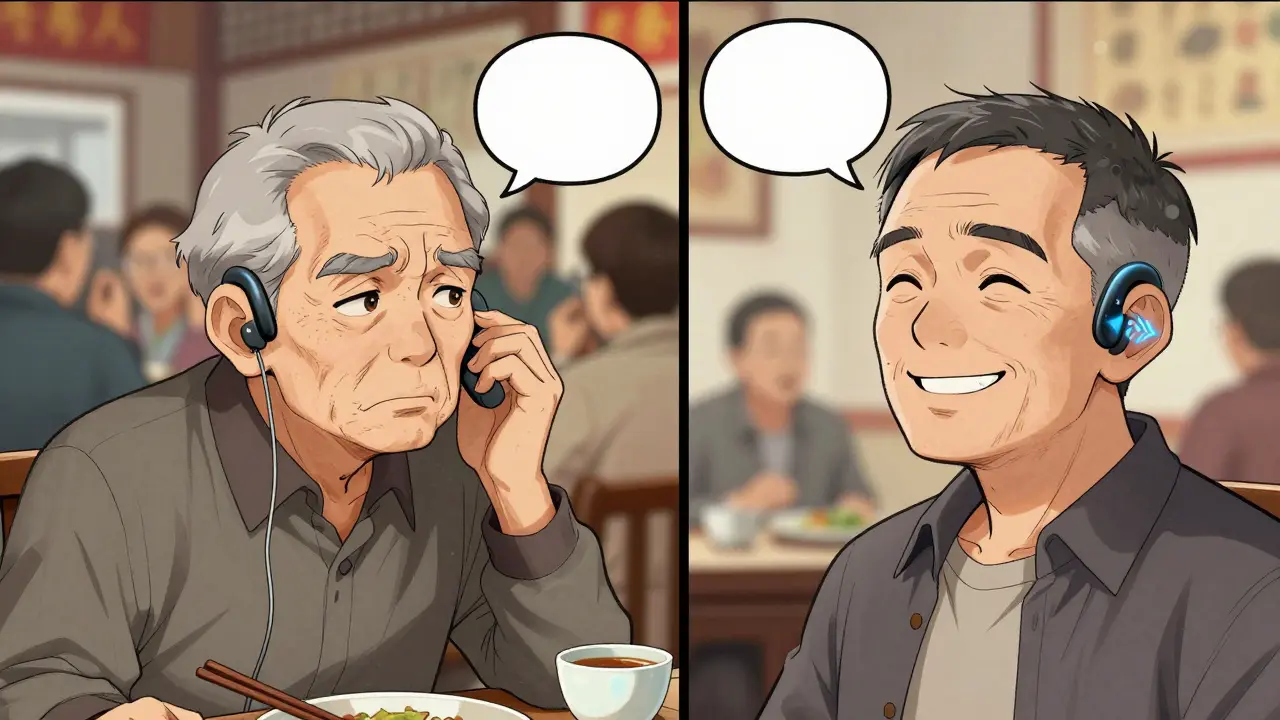
Hearing Aids: The Real Solution
There’s no cure for presbycusis. But there’s a solution: amplification. And modern hearing aids aren’t just little speakers that make everything louder. They’re smart devices.Today’s premium models - like Phonak Paradise, Oticon More, or Signia Styletto - have 16 to 64 frequency channels. That means they can boost speech frequencies while reducing background noise. Directional microphones improve your ability to hear someone in front of you by 3 to 6 decibels. Bluetooth lets you stream calls, TV, and music directly to your ears.
Properly fitted, they can improve speech understanding by 40-60% in quiet settings and 25-40% in noise. Eighty-five percent of users report better communication. But here’s the catch: only 30% of people who need hearing aids actually use them.
Why So Many People Don’t Use Them
The biggest reason? Poor fit and unrealistic expectations.Forty-five percent of people who quit using their hearing aids say they didn’t fit right. Thirty percent found them uncomfortable. Twenty-five percent said they still couldn’t hear well in noisy places - often because they weren’t properly adjusted.
And cost is a huge barrier. Prescription hearing aids range from $1,800 to $3,500 per ear. Most people pay out of pocket. Even though Medicare Advantage plans now cover hearing aids for 28 million beneficiaries as of 2024, traditional Medicare still doesn’t.
Enter OTC hearing aids. Since the FDA opened the market in 2022, over-the-counter options have exploded. You can now buy effective devices for $200-$1,000 a pair. Brands like Jabra Enhance Select and Audien Atom have gained popularity for their affordability and ease of use.
But here’s the problem: OTC devices aren’t for everyone. If you have moderate to severe hearing loss, or if you’re dealing with tinnitus or ear infections, you need a professional evaluation. OTC aids are designed for mild to moderate loss. They can’t replace a custom fit or advanced programming.

How to Get Started
If you think you have presbycusis, don’t wait. Start here:- Get a hearing test. Don’t rely on phone apps. See an audiologist. Baseline screenings are recommended at age 50, then every two years.
- Ask about a 30- to 60-day trial. Most clinics offer this. Use it. Don’t give up after a week.
- Expect a learning curve. It takes 4 to 6 weeks for your brain to adapt. Practice listening in different environments.
- Get it fitted right. If it whistles, buzzes, or hurts, go back. Adjustments are normal. Don’t accept discomfort.
- Consider telehealth. Sixty-two percent of audiology practices now offer remote fine-tuning. You can adjust volume and settings from your phone.
Top-rated prescription models in 2023 include Widex Moment (87/100) and Oticon More (85/100). For OTC, Jabra Enhance Select leads at 78/100. But ratings mean nothing if the device doesn’t match your hearing profile.
What’s Next for Hearing Technology
The field is moving fast. New AI-powered systems like Signia’s Nx platform reduce listening effort by 20%. Some hearing aids now track your physical activity and social interactions - giving doctors insight into your overall health.Direct-to-consumer hearing tests, like Beltone’s SoundClear app, have over a million downloads. But they’re screening tools, not diagnostics. Always follow up with a professional.
The global hearing aid market is projected to hit $14.7 billion by 2030. That’s not just business - it’s public health. The WHO predicts 1.5 billion people will have hearing loss by 2050. Without action, this will become a global crisis.
Final Thought: It’s Not Weakness. It’s Wisdom
Asking for help with your hearing isn’t admitting defeat. It’s choosing to stay connected. To hear your grandchild laugh. To understand your doctor. To enjoy a quiet dinner without straining.Presbycusis is inevitable for many. But its impact isn’t. With the right tools and the right timing, you can keep your voice - and your life - fully alive.
Is presbycusis the same as general hearing loss?
No. Presbycusis is a specific type of age-related sensorineural hearing loss caused by the natural degeneration of inner ear hair cells. Other types of hearing loss can be caused by noise exposure, infections, medications, or earwax buildup. Presbycusis is progressive, permanent, and tied to aging - not a one-time injury or temporary blockage.
Can hearing aids restore my hearing to normal?
No. Hearing aids don’t cure hearing loss. They amplify and clarify sound to help your brain process it better. Most users report significant improvement - 40-60% better speech understanding in quiet settings - but they won’t make you hear like you did at 20. The goal isn’t perfection. It’s connection.
Are over-the-counter hearing aids good enough?
For mild to moderate hearing loss, yes - and they’re a great first step. Brands like Jabra Enhance Select and Audien have helped thousands avoid expensive prescriptions. But if you struggle in noisy places, have tinnitus, or have significant hearing loss, OTC devices may not be powerful or customizable enough. Always get tested first.
Why do some people stop using hearing aids?
The top reasons are poor fit (45%), discomfort (30%), and not hearing well in noise (25%). Many people expect instant results. But it takes weeks for your brain to adjust. If you give up too soon, you miss the benefits. Always ask for a trial period and schedule follow-up appointments for adjustments.
How often should I get my hearing checked after 50?
The American Speech-Language-Hearing Association recommends a baseline test at age 50, then every two years. If you notice changes - like turning up the TV, asking people to repeat themselves, or avoiding conversations - don’t wait. Get tested sooner. Early detection means better outcomes.
Can hearing loss cause dementia?
It doesn’t directly cause dementia, but untreated hearing loss is one of the strongest modifiable risk factors. When your brain struggles to process sound, it overworks other areas. Over time, this can accelerate cognitive decline. Studies show treating hearing loss can reduce dementia risk by up to 10% over a decade.
Do I need to wear hearing aids all day?
Yes - for maximum benefit. Your brain needs consistent input to relearn how to process sound. Wearing them only during conversations or at home won’t give you full results. Most experts recommend wearing them from morning until bedtime, except when swimming or sleeping. Consistency is key to long-term success.

9 Comments
Man, I wish I’d known all this when I was 55. My dad waited until he couldn’t hear his own grandkids crying - now he’s got a pair of Phonak Paradise and he’s back to laughing at dinner. It’s not about being old, it’s about staying in the game. 🎧❤️
So you’re saying we should all spend $3k on gadgets because we’re getting old? What about just learning to lip-read or using subtitles? This feels like corporate propaganda wrapped in pseudoscience.
As a former audiologist with a PhD from Johns Hopkins, I must correct several dangerous inaccuracies in this post. The 50% dementia risk increase is misleadingly extrapolated from a single longitudinal cohort. Also, OTC devices are not FDA-approved for clinical use - they are consumer electronics with zero regulatory oversight. This is irresponsible.
Think about it - we’ve engineered our bodies to decay. We eat processed food, sit all day, drown in noise, then act shocked when our ears give out. Presbycusis isn’t just aging - it’s the sound of a society that stopped listening to itself. The hearing aid is a Band-Aid on a bullet wound.
But here’s the real question: If we’re so afraid of silence, why do we fill every moment with noise? Maybe the solution isn’t amplification - maybe it’s learning to be still.
My uncle got OTC aids for $300 and now he’s calling us every Sunday to tell us about the birds outside his window. He said it felt like the world came back to life. No fancy clinic, no insurance drama - just a little tech and a lot of heart. Seriously, if you’re hesitating, just try one. No regrets.
Also - get your hearing checked at 50. It’s like a dental checkup for your brain.
OMG I KNEW IT!! This is all a scam by Big Hearing to make us buy overpriced devices so they can track our brainwaves and sell our thoughts to advertisers!! 😱 I heard on a secret forum that the FDA is secretly owned by Phonak and they’re using the ‘dementia’ thing to scare old people into buying chips that record their dreams!! 🤫🎧👁️🗨️
So we’ve turned a natural biological process into a medical emergency because capitalism needs new markets. Hearing aids are the new iPhone - status symbols for the elderly who can’t accept their own decline. The real tragedy isn’t the loss of sound - it’s the loss of dignity in pretending technology can fix what time has done
I’m not saying I’m right… but… I just… I think… maybe… hearing aids… are… overrated? Like… I mean… I’m 68… and I’ve been fine… without… them… for… years…
Thank you for this well-researched article. I recommend all individuals over 50 to consult an audiologist annually. Early intervention is critical and cost-effective in the long term.
Write a comment